
The Green Resistance: Echoes of the Forgotten War
In the deepest jungles of the East, the earth itself resisted — and remembered.

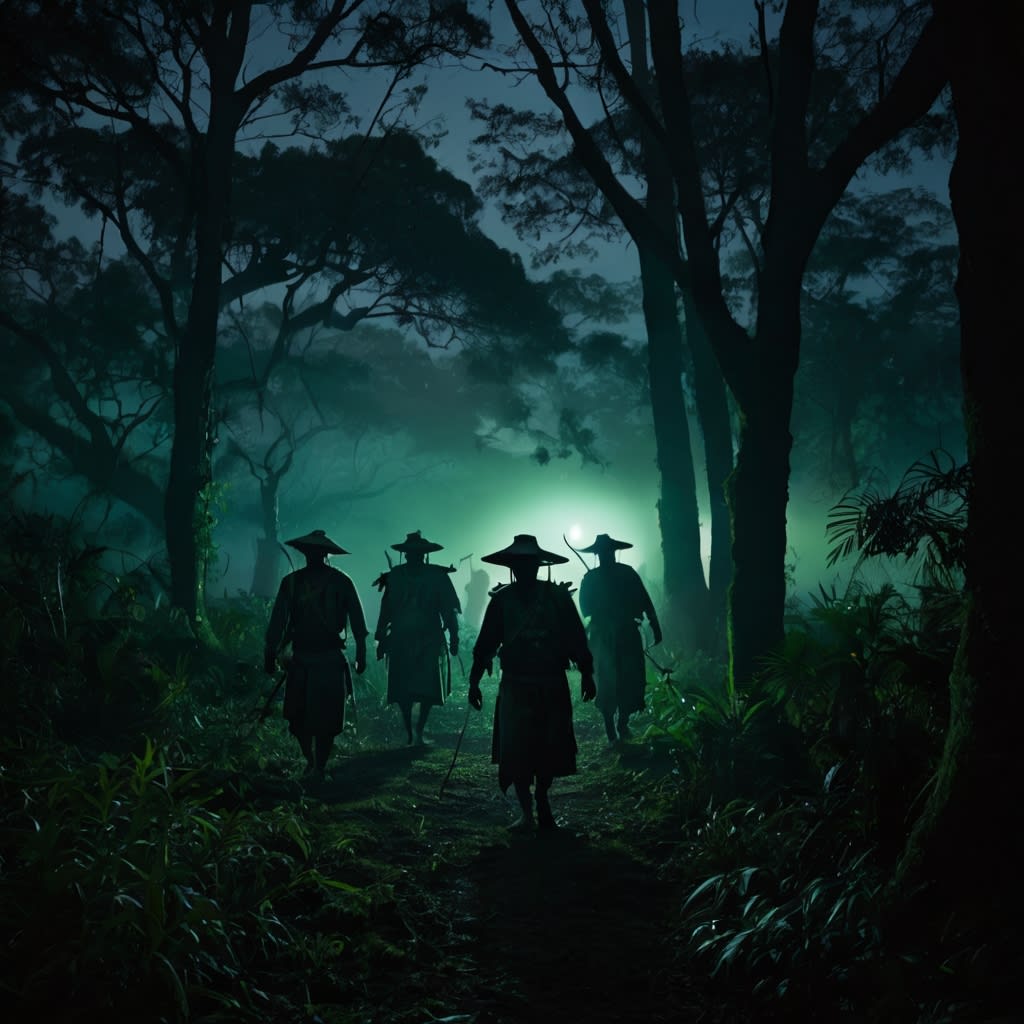
The Green Resistance: Echoes of the Forgotten War
1857 – Eastern Province, Edge of the Colonial Frontier
The first thing they killed was the silence.
Axes swung into sacred trunks, and the birds that once sang in spirals of sunlight vanished. The jungle, which had lived in balance for generations, trembled beneath foreign boots.
The British mapped the region in red and called it “Uncharted Territory.”
To the locals, it was Aaranyak — the soul-forest. A living being.
A god with green skin and roots for veins.
Anarwan, the memory keeper of the forest, knew it would begin like this.
He had seen it in fire, in dream, in the language of falling leaves.
He was not young. His eyes bore more rings than the trees around him.
But he was no myth. He walked among his people, barefoot and watchful, his skin a canvas of inked memories — battles long gone, faces long buried, stories that still breathed.
---
The First Cut
The British began by chopping down the Bara Dev, a colossal banyan tree believed to be the forest’s heart. Seven villages considered it sacred. It was where elders whispered prayers and children played in its hollow roots.
Anarwan stood beneath it when the trunk groaned like a dying animal.
He did not weep. He listened.
> "It begins," he said quietly.
The vines around him curled tighter. The air thickened.
The forest was awakening.
---
The Colonel
Colonel Reginald Chase arrived shortly after. A career officer, he believed discipline and order could bend any land into submission.
He saw the jungle as chaos — a thing to be tamed, structured, named.
He ordered a fort built beside the river. He named it Fort Newton, after his father.
“The natives worship dirt,” he wrote in his logbook. “We’ll teach them to worship law.”
But Fort Newton never settled.
The walls sweated at night. Insects swarmed in geometric patterns. Compasses spun.
Men complained of whispers, of being watched by unseen eyes.
Chase dismissed them.
> "Superstition spreads like rot," he barked. "Cut it out."
So they burned the nearby grove — a sacred medicine patch.
That night, a soldier's throat was found filled with vines.
No blood. Just green silence.
---
The Resistance
Anarwan never called it a war.
> “You cannot wage war against the earth,” he said. “You can only provoke it into memory.”
He taught the young to listen, not shout.
To vanish between leaves, not fight on roads.
They learned to whistle like birds, to move like wind.
And in the quiet, they planted stories — seeds of resistance.
Children smuggled messages inside gourds.
Old women brewed potions that made men forget.
And under moonless nights, tattoos were inked again — the vines of remembrance crawling across backs and chests, binding the rebels to the land.
Anarwan gave no orders.
He gave ritual.
---
Colonial Collapse
The more Chase tried to crush the rebellion, the more it slipped into shadow.
Entire patrols vanished.
Supply lines grew tangled in roots.
One soldier went mad, carving trees with words:
> “It’s watching. It knows me.”
Then came the flood.
One calm morning, the river beside Fort Newton rose — without rain, without warning.
It swallowed the fort like a mouth closing.
When they dug into the mud, they unearthed bones — tribal bones from a war long ago. Bones arranged in a circle. Smiling.
Chase, now pale and sleep-starved, began to unravel.
He stopped trusting his men.
Stopped writing letters.
He spoke to trees, and when they didn't reply, he screamed at the stars.
In his final journal entry, he wrote:
> “The forest doesn’t fight. It remembers.
We didn’t invade land.
We invaded memory.”
He vanished the next day. His boots were found at the base of a young banyan, already growing fast.
---
The Return
1923 – Village of Hiran, Eastern Edge
Seventy years later, the jungle still stood. Lush. Green. Untouched by the steel cities blooming miles away.
A boy named Arjun, no older than twelve, walked with his grandfather — a frail man whose back was covered in faded tattoos, like vines in winter.
> “Did you fight the British?” Arjun asked.
The old man chuckled.
> “I didn’t fight. I listened.”
> “To who?”
> “The earth. And to Anarwan.”
Arjun’s eyes widened.
> “He was real?”
The old man nodded toward the trees.
> “He is. Look closely. He’s in every leaf that refuses to fall.”
They reached the same sacred grove where Anarwan once walked.
The banyan had returned.
Taller than ever.
Its roots carved with names — some recent, many old.
The old man placed his hand on the bark and closed his eyes.
That night, he passed away silently in his sleep.
Arjun stayed up, listening.
He heard the wind whisper a name he’d never spoken.
Not in books.
Not in dreams.
But deep, within his own chest:
Anarwan.
---
Legacy
To this day, villagers say the jungle protects those who remember.
They say if you step in with respect, the vines move for you.
But if you enter with greed,
They wrap around your name.
And erase it.
Some say Anarwan still walks — barefoot, quiet, leaving no prints.
Others believe he became the jungle itself.
But those who truly listen…
Know he never left.
About the Creator
Keep reading
More stories from Azimullah Sarwari and writers in Fiction and other communities.
The Book That Forgot Its Story
📖 The Book That Forgot Its St --- It began with silence. Not the comfortable kind that wraps around you like a wool blanket on a rainy afternoon. No—this was the kind of silence that hollows you out, echoing every thought back at you, louder than intended.
By Azimullah Sarwari7 months ago in Fiction
Miss Persephone's Manual to a Seemingly Ordinary Life
Miss Persephone was found at the dining table, her blue eyes swollen, her tears arriving and retreating like the tides of the ocean. Earlier that day, her family had visited her in the retirement home where she had lived for eight years. It was her eightieth birthday.
By Imola Tóth7 days ago in Fiction
Rachel Reviews: The Spiral Archive by Pieter Hendrik
It's difficult for me to know where to start with a review of this book as it was, for me, an entirely unique experience and one that I'll probably never have again. I don't want that to be interpreted as unenjoyable but it has left me scratching my head a little and ruminating on its content, its themes and its characters.
By Rachel Deeming4 days ago in BookClub



Comments
There are no comments for this story
Be the first to respond and start the conversation.