
The Green Rebellion
How Children Planted a New World to Combat Pollution

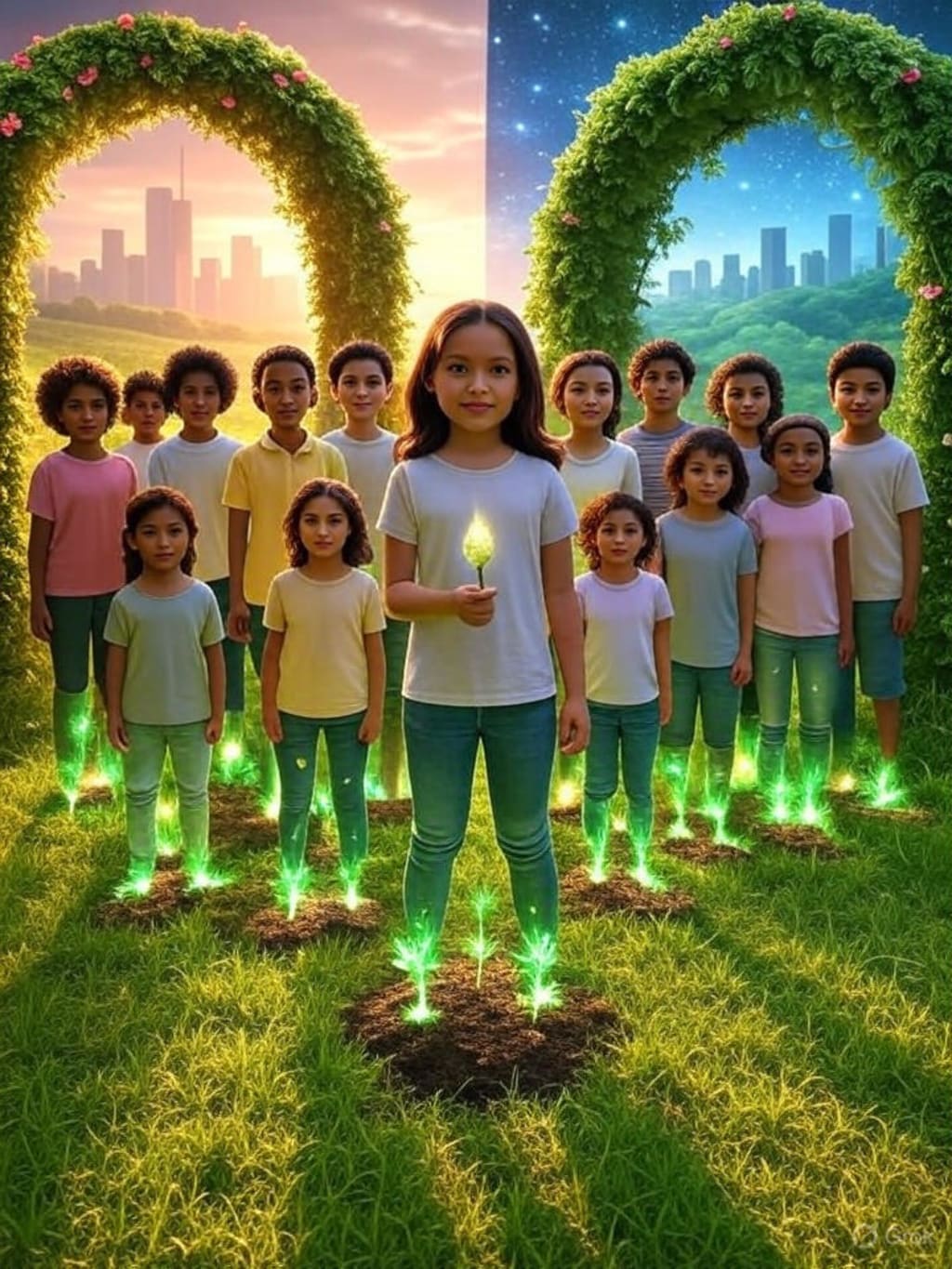
In a world choked by smog, where city skies glowed an eerie orange and rivers ran thick with waste, a whisper of hope stirred in the unlikeliest of places—a small, forgotten playground on the edge of a sprawling metropolis. The year was 2045, and the Earth groaned under the weight of pollution. Factories belched black clouds, and plastic littered every corner of the planet. But in that rusty playground, under a gnarled old tree, a group of children discovered something extraordinary: a secret that would spark The Green Rebellion.
It began with Lila, a ten-year-old with wild curls and a knack for noticing things others missed. One cloudy afternoon, while kicking through piles of leaves, she found a single, glowing seed no bigger than a marble. It pulsed with a soft green light, warm to the touch, and when she held it to her ear, it hummed a faint, musical note. Curious, she showed it to her friends—Milo, who dreamed of flying; Aisha, who loved stories; and Kai, who could fix anything. Together, they puzzled over the seed’s mystery. “It’s not normal,” Aisha whispered, her eyes wide. “It feels… alive.”
The children decided to plant the seed in the cracked soil of the playground. As they dug, a strange sensation washed over them, like the air itself was watching. The moment the seed touched the earth, the ground trembled softly, and a tiny sprout unfurled, its leaves sparkling like emeralds. Within hours, it grew into a sapling, its branches stretching toward the smoggy sky. But here’s where the mystery deepened: the air around the tree smelled clean, crisp, like a forest after rain. The smog seemed to dissolve, and the children’s lungs felt lighter than they ever had.
Word of the strange tree spread like wildfire. Other kids joined Lila and her friends, bringing their own glowing seeds, which they found in the oddest places—tucked in sidewalk cracks, hidden in old junkyards, even floating in polluted streams. Each seed, when planted, sprouted into a tree that devoured pollution. Factories nearby coughed less smoke. Rivers began to shimmer again. The children, now calling themselves the Green Rebellion, realized they held the key to something magical: a way to heal the Earth.
But the seeds were more than just plants. At night, the trees whispered to the children in dreams, sharing visions of a world where cities bloomed with greenery and the air sparkled with possibility. The trees seemed to know things—secrets about the Earth’s forgotten magic, about how humanity had once lived in harmony with nature. “You are the gardeners of tomorrow,” the whispers said. “Plant the seeds, and the world will follow.”
The adults, however, weren’t so sure. Factory owners grumbled about profits, and city officials scoffed at “children’s games.” Some even tried to uproot the trees, claiming they were a danger. But the Green Rebellion was unstoppable. The children organized secret planting missions, sneaking into abandoned lots and polluted riverbanks under the cover of darkness. They painted murals of their glowing trees on city walls, sparking curiosity and hope in passersby. Social media buzzed with videos of kids planting seeds, captioned with #GreenRebellion. Soon, children in other cities—then other countries—found their own glowing seeds and joined the movement.
The mystery of the seeds’ origin kept everyone guessing. Were they gifts from the Earth itself, a last-ditch effort to save its air and water? Or were they something older, a magic buried long ago and now reawakened by the children’s belief? Scientists studied the trees, baffled by their ability to absorb carbon dioxide and break down plastics into harmless dust. Environmentalists called it a miracle. But the children didn’t care about theories—they cared about action.
One unforgettable day, the Green Rebellion staged their boldest move: a march to the city’s largest factory, a hulking beast that spewed smog day and night. Thousands of children gathered, each holding a glowing seed. As they planted them in a circle around the factory, the ground shook, and a forest of shimmering trees sprang up, their roots cracking the concrete. The factory’s smoke dissolved into wisps, and for the first time in decades, the city saw a clear blue sky. The adults who had doubted them now stood in awe, some wiping tears from their eyes.
The Green Rebellion spread across the globe. Cities once gray and choking transformed into green havens. Rivers ran clear, and birds returned to skies that had been silent for years. The children’s movement inspired laws to protect the environment, and adults began to listen, realizing that the youngest among them had seen what they couldn’t: a future worth fighting for.
And the mystery of the seeds? It was never fully solved. Lila, now a teenager, would smile when asked, saying only, “Maybe the Earth was waiting for us to believe in it again.” The Green Rebellion taught the world that change starts with a single act—a seed planted, a dream shared. It reminded us that curiosity and courage, even in the youngest hearts, can heal a planet.
A Positive Message for the World:
The story of The Green Rebellion is more than a tale—it’s a call to action. You don’t need to find a magical seed to make a difference. Plant a tree, clean a river, or share an idea that sparks change. The Earth is waiting for your rebellion, no matter how small. Together, we can grow a greener, cleaner world—one curious, courageous step at a time.
About the Creator
Gorgon's Purgatory
A tingling sensation fills my head. A deep pressure builds into agonizing pain as the serpents swallow their midnight meal. They move their jaws in synchronized contractions, forcing the bodies of mice down their gullets. The mice wiggle within the snakes for what feels like an eternity, brushing the scaly, cold skin in a ballet of torture.
By Tas The Artist about 10 hours ago in Fiction


Comments
There are no comments for this story
Be the first to respond and start the conversation.