

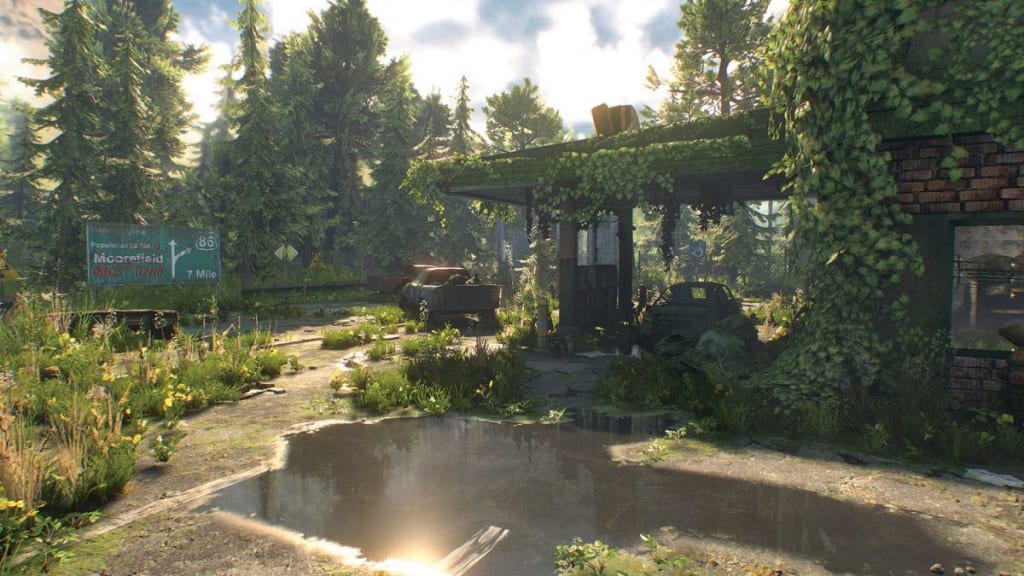
I wake up with the worst pain in my lower back, as the sun shines down upon me through the glass ceiling of the metal home. I grab my bag and my machete and begin to travel east following signs towards Galveston. Sleeping in metal homes is always uncomfortable, but they keep me from interrupting a husk’s path at night. I don’t see them often which is why I choose to travel along highways. Despite overgrown foliage breaking through the concrete, highways are some of the only discernable landmarks still intact. Most towns have overgrown buildings covered in vines and flowers. Trees have broken through the pavement, and animals have found shelter in the old world’s homes.
I try my best to stay away from old towns to avoid any wandering husk, but sometimes I can’t help to explore. The husks walk around the streets, languished and in perpetual repetition. They have lost all expression, grey in the face with colorless eyes, thin and haggard. Their teeth have begun to rot, and their skin is dry. Abhorrent creatures, who infect the world with their existence. As peaceful as they are, everyone avoids them as much as they can. Any slight interruption to their movement agitates. When agitated their eyes are blood red and their physical posture resembles a ravenous animal. They become unstoppable forces of nature that focus on hunting down their prey. The nature of their origin remains a mystery to most. Nonetheless, most people believe they are remnants of the old world’s inhabitants.
The larger towns, with landmarks that sore through the sky, are pretty much abandoned. Crowded places make it difficult to navigate without interrupting the husks' movement. Most people live in rural settlements far away from most husk. They’ve constructed walls to keep the husk who become aggressive, the night wanderers, out. Settlements across the Great Land united and created the Trade Union. The increased trade between settlements increased the prosperity of the Great Land.
I come from a settlement along the west coast, New Seattle, which is the main source of education in the Great Land. Most people decide to stay and teach students the knowledge of the old world. Few people, like myself, choose to become archeologists. They live a nomadic lifestyle dedicated to exploring the old world. Their main function is to discover and preserve artifacts. But I've grown an obsession with discovering and documenting landmarks. Buildings, towers, and monuments of unnatural size and aesthetics liter the old world.
Most landmarks, ruined by age or disaster, are indiscernible nowadays. The meaning of them lost to time and nature. But along my travels, I’ve come across quite a few remaining landmarks, like this one. A small building with giant a “K” and a dull faded red circular border. It’s one of the most common landmarks I’ve seen along my journey. These landmarks seemed like rest stops for people of the old world during their travels. Each of them filled with food, drinks, and other knickknacks. Most of them had lavatories, sometimes even two. I’ve followed in tradition and use these landmarks to stock up and rest on my way to another settlement. Like every other landmark similar in style, a husk was behind the counter. Fitted with a shirt bearing the building’s insignia, it trotted without purpose. I ignore it as I gather supplies, grabbing anything that hasn't perished that I can find. There always seems to be an overabundance of canned goods and bottled drinks. Sometimes, if I'm lucky, I'll find a pack of stale cookies. They aren't the best, and have a brittle texture, but help cut through all the canned food.
After I finish scavenging the building, I grab an old picture book. These picture books feature men and women with faultless figures and flawless complexions. They are my favorite artifact, imbuing me with intrigue about the stories of the old world’s people. They, unfortunately, give me a limited perspective of the old world. Since all the picture books talk about the same people, I don't get much practical use out of them. Despite not knowing them past their names, I can't help losing myself in their scandalous stories. From divorce to adultery, their lives documented with unnerving dedication. I imagine they were of great importance, possibly worshipped like gods. And whose mere existence demanded documentation. I pondered this thought as I flipped through the pages.
As I leave, picture book in hand, I take one more look at the husk lugging itself around the counter. It has long colorless hair, with weird markings on its body that look like distorted animals. They remind me of body markings I see in some settlements but lacking any purpose or narrative. Around their neck lays a golden heart-shaped locket, opened with a picture of a woman. The woman in the picture seemed to be different from the husk, she was older but with a thinner face. I got to thinking who she was before any of this started. Was she happy here? Or was this place a prison of some sort? What was her life like outside of this landmark and who was the woman in the golden locket?
I couldn’t help myself, but I had to be in possession of the locket. I knew of the dangers of disturbing a husk, so I had to strike it down in one swell swoop or meet my end. It sways back and forth, slow, moving with no determination as I raise my machete over my head. In one heavy blow, I split through its head, and it falls to the floor even more lifeless than it was before. I remove the locket from its body, feeling different, and look at it with an idle gaze. Through my travels, I’ve never actually taken anything from a husk until now. The necklace inundated me with questions. I had no choice but to take and examine it. I cleaned myself up and continued my journey.
I arrived at Galveston, a settlement along the south coast, who refuse to join the Trade Union. They remain peaceful but have they have a unique lifestyle compared to most of the Great Land. I found myself lucky to pass through during their third annual Maiden Voyage. All year they construct a wooden boat, the Maiden, which sets sail every year to the Last Hope. They described, in length, a beautiful city in the middle of the ocean where food and shelter are bountiful. It's a paradise. The last surviving town of the old world. When procuring the locals for information about this legend, they led me to an ancient text. It was a small piece of paper with colorful images and drawings with promises of safety at sea. At the very top of one of the folds, read U.S.S. The Last Hope.
I decided to stay the night to witness the Maiden’s voyage. The settlement gathered some of their elderly, their sick, and wounded, put them on the boat with no food or water, and let the winds guide them to salvation. As the boat left the harbor the band erupted with loud music. People began to dance, rhythmless but with purpose. Afterward, everyone celebrated with a large feast in the center of the settlement. The table lined with fish, cheese, bread, and various fruits they’ve grown in their farms over the year. I didn’t join and chose to be a witness to the event. The reality of celebrating over sending people to certain death seemed odd to me.
As the night passed, I stayed at a local lodge they had for travelers. I tried my best to sleep, taking advantage of sleeping on linen for the first time in about seven days. But the thoughts of the necklace continued to overtake me. I pulled it out of the bag and held it in my hands examining every corner of it. I’ve come along many artifacts over my time as an archeologist. I sell most of them to settlements in exchange for food, services, or lodging, but this locket felt like it kept calling out to me.
I opened it up and took the picture out; on the back was a message that read “from Sarah to Tracey.” Sarah must have been the girl in the picture. Tracey, the husk whose head is now split open and lying on the floor. This embarrassing feeling came over me. I couldn’t help but feel like I took something I shouldn’t have. I returned the picture to the locket. A thought overcame me about Tracey. She was once a person who, unlike those in the picture books, had a normal life before becoming a husk. She was the insight I’ve been looking for all this time. Tracey and her life were all I could think about for the rest of the night. I fell asleep with a new outlook on the old world, eager to discover more about husk.
About the Creator
Josue Iglesia
Aspiring author - Horror - Scifi - Fantasy
Keep reading
More stories from writers in Fiction and other communities.
🅼🅸🅳🅽🅸🅶🅷🆃 🆂🅽🅰🅲🅺🆂
"It's 10 in Tuscon! We all know what that means... It's Time for Midnight Snacks with your man, Gerald Gee! Ready to spend the night together? Me too! I'm full of snacks and can't wait to regurgitate them all back into your hungry ears. Crack a brew! Pop some corn! Anything to get ready for one hell of a show where the talk maybe cheap but the words cut deep...
By Lamar Wiggins7 days ago in Fiction


Comments
There are no comments for this story
Be the first to respond and start the conversation.