

This article is about the novel. For other uses, see The Great Gatsby (disambiguation).
The Great Gatsby
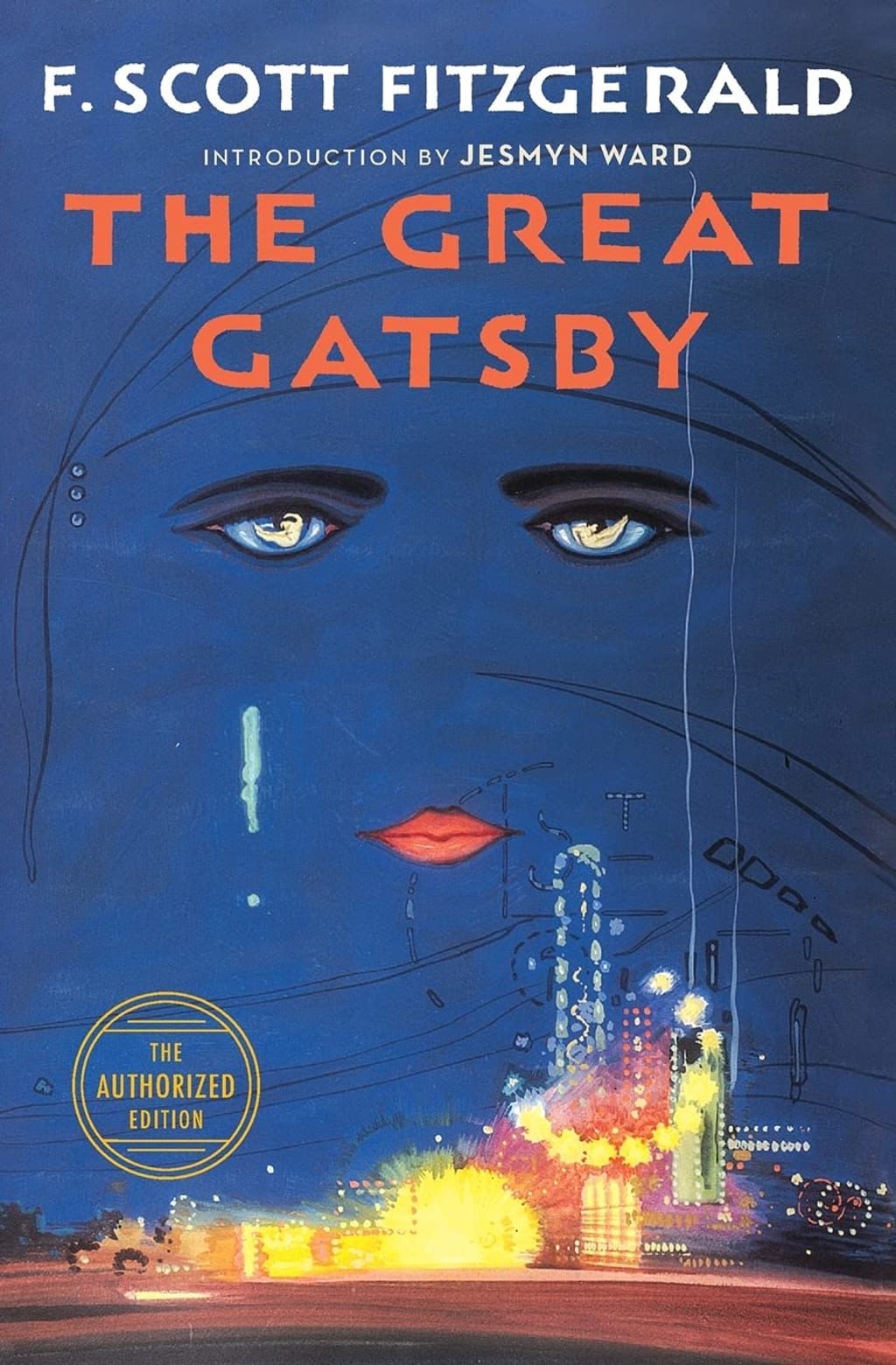
The book cover with title against a dark sky. Beneath the title are lips and two eyes, looming over a city.
The cover of the first edition
Author F. Scott Fitzgerald
Cover artist Francis Cugat
Country United States
Language English
Genre Tragedy
Published April 10, 1925
Publisher Charles Scribner's Sons
Media type Print (hardcover & paperback)
Preceded by The Beautiful and Damned (1922)
Followed by Tender Is the Night (1934)
Text The Great Gatsby at Wikisource
The Great Gatsby is a 1925 novel by American writer F. Scott Fitzgerald. Set in the Jazz Age on Long Island, near New York City, the novel depicts first-person narrator Nick Carraway's interactions with mysterious millionaire Jay Gatsby and Gatsby's obsession to reunite with his former lover, Daisy Buchanan.
The novel was inspired by a youthful romance Fitzgerald had with socialite Ginevra King, and the riotous parties he attended on Long Island's North Shore in 1922.
Following a move to the French Riviera, Fitzgerald completed a rough draft of the novel in 1924.
He submitted it to editor Maxwell Perkins, who persuaded Fitzgerald to revise the work over the following winter.
After making revisions, Fitzgerald was satisfied with the text, but remained ambivalent about the book's title and considered several alternatives. Painter Francis Cugat's cover art greatly impressed Fitzgerald, and he incorporated its imagery into the novel.
After its publication by Scribner's in April 1925, The Great Gatsby received generally favorable reviews, though some literary critics believed it did not equal Fitzgerald's previous efforts.
Compared to his earlier novels, such as This Side of Paradise and The Beautiful and Damned, Gatsby was a commercial disappointment.
It sold fewer than 20,000 copies by October, and Fitzgerald's hopes of a monetary windfall from the novel were unrealized.
When the author died in 1940, he believed himself to be a failure and his work forgotten.
During World War II, the novel experienced an abrupt surge in popularity when the Council on Books in Wartime distributed free copies to American soldiers serving overseas. This new-found popularity launched a critical and scholarly re-examination, and the work soon became a core part of most American high school curricula and a part of American popular culture. Numerous stage and film adaptations followed in the subsequent decades.
Gatsby continues to attract popular and scholarly attention. Contemporary scholars emphasize the novel's treatment of social class, inherited versus self-made wealth, gender, race, and environmentalism, and its cynical attitude towards the American Dream.
One persistent item of criticism is an allegation of antisemitic stereotyping.
The Great Gatsby is widely considered to be a literary masterwork and a contender for the title of the Great American Novel.
"The Great Gatsby" is a novel by F. Scott Fitzgerald that explores themes of the American Dream, social class, love, and the corrupting influence of wealth and power. The story is set in the 1920s and is narrated by Nick Carraway, a young man from the Midwest who moves to New York City to pursue a career in finance.
Nick becomes involved with his wealthy neighbor, Jay Gatsby, who throws extravagant parties and is known for his mysterious past.
Gatsby is in love with Nick's cousin, Daisy Buchanan, who is married to Tom Buchanan, a wealthy and arrogant man with whom Nick attended college.
Throughout the novel, Fitzgerald uses vivid and poetic language to describe the opulence and excess of the wealthy elite in the 1920s.
He also portrays the darker side of this lifestyle, including infidelity, deceit, and violence.
One of the central themes of the novel is the American Dream, and the idea that anyone can achieve success and prosperity through hard work and determination. Gatsby embodies this idea, as he rose from humble beginnings to become a wealthy and powerful figure in New York society. However, the novel also highlights the limitations of the American Dream, as Gatsby's success is ultimately hollow and unfulfilling.
Another important theme is social class, and the rigid hierarchy that existed in 1920s America.
Gatsby, despite his wealth, is never fully accepted by the old money elite of East Egg, where Daisy and Tom live.
This divide between new and old money is also reflected in the relationships between the characters, as Gatsby struggles to win the approval of Daisy's social circle.
Love is also a major theme, particularly the idea of romantic love and the pursuit of it.
Gatsby's obsession with Daisy drives the plot of the novel, and he is willing to do anything to win her back, including lying and manipulating those around him.
However, their love is ultimately doomed, as Daisy is unable to leave her husband and the life of luxury that she has become accustomed to.
Finally, the novel explores the corrupting influence of wealth and power. Gatsby's success has come at a cost, and his pursuit of wealth and status has led him down a dark path. The characters in the novel are often morally ambiguous, and their actions are driven by self-interest and greed.
In conclusion,
"The Great Gatsby" is a timeless novel that continues to resonate with readers today.
Fitzgerald's use of language and his exploration of themes such as the American Dream, social class, love, and the corrupting influence of wealth and power make it a masterpiece of American literature.
Thank you




Comments
There are no comments for this story
Be the first to respond and start the conversation.