
The Grave That Was Never Found — Genghis Khan: The Conqueror Who Shook the World and His Hidden Resting Place
History remembers his storms; legends conceal his tomb — and those who buried him erased every trace so the world would never know.

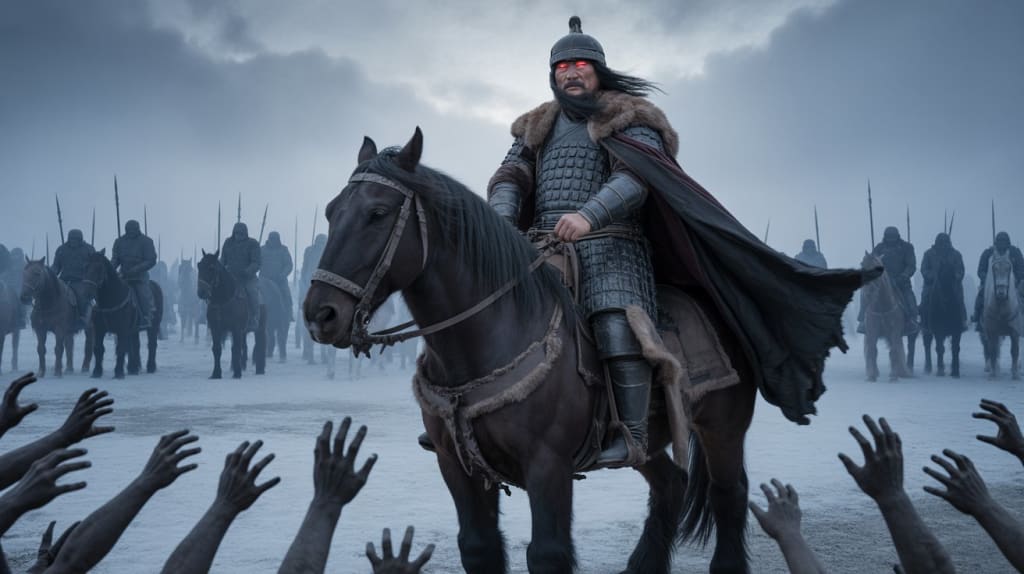
No man in history has inspired such a strange mixture of fear, fascination, and mystery as Genghis Khan — the ruler who emerged from the wild steppes of Mongolia and reshaped the entire face of the ancient world. His empire stretched from the edges of China to the heart of Europe, his armies sweeping through kingdoms like a storm of fire and steel. He was ruthless, unstoppable, and by some accounts, responsible for the deaths of more than forty million people — nearly one-tenth of the world’s population at that time.
Yet the greatest mystery about Genghis Khan is not his life of conquest, but his death — and the secret that followed him to the grave.
When the great Khan died in 1227, somewhere on his way back from a campaign in Western China, his death was shrouded in absolute secrecy. His generals feared that knowledge of his death might weaken the vast Mongol Empire, or worse, invite rebellion. So, they hid everything — the time, the place, even the cause. Some say he died from a wound in battle, others whisper it was from a fall from his horse, and some even claim he was poisoned by a vengeful queen.
But what happened next is where the legend truly begins.
According to Mongol custom, his body was taken back to Mongolia, wrapped in silk and sealed in a black coffin. The caravan that carried his body was escorted by a thousand soldiers sworn to silence. As they rode across the steppes, they killed every person they met along the way — hunters, travelers, even stray shepherds — anyone who might witness the funeral procession. When they finally reached a secret valley somewhere in the mountains near the Onon River, the soldiers buried their emperor beneath the earth, without a single mark or stone to show his resting place.
To ensure that no one would ever discover the tomb, the Mongols performed an even darker ritual. The soldiers who buried the body were executed on the spot. Then, the soldiers who killed them were also put to death — until there were none left alive who knew where Genghis Khan lay. In some versions of the tale, the Mongols diverted a river over the burial site, allowing the water to wash away all traces of the grave. Others claim a forest was planted on the spot, so that nature itself would guard the secret.
For centuries, explorers, treasure hunters, and historians have searched for the tomb of Genghis Khan. None have succeeded. Not a single artifact, not a fragment of bone, not even a whisper of truth has been found. The land of Mongolia remains silent — as if the earth itself has sworn an oath of secrecy to its most fearsome son.
In modern times, archaeologists have tried to use satellites, drones, and ground-penetrating radar to locate the grave. They have scoured the mountains of Burkhan Khaldun, a sacred place in Mongolian tradition believed to be linked to the Khan’s birth and perhaps his death. But every time someone comes close, something seems to stop them — unexplained weather, sudden funding cuts, or strange political restrictions. To the Mongols, it is not mere coincidence. They believe that disturbing the grave of Genghis Khan would bring a curse upon the world, awakening an ancient spirit that was never meant to be found.
To his descendants, Genghis Khan is not just a conqueror — he is a symbol of unity, power, and destiny. They say his soul merged with the mountains and rivers of Mongolia, watching over his people for eternity. For them, the secret of his tomb is sacred. It is not a mystery to solve but a promise to keep — that their great ancestor will rest forever, undisturbed, in the heart of his homeland.
But beyond the reverence and myth, the question still lingers: What if someone did find it? What if beneath the green steppes lies a chamber filled with relics of a forgotten empire — gold, weapons, and the unbroken silence of the world’s greatest conqueror?
Would the discovery rewrite history — or destroy it?
As night falls across the Mongolian plains, the wind howls through the grasslands like a whisper from another age. Somewhere beneath that endless sky, the tomb of Genghis Khan lies waiting — unseen, untouched, and unknown. A secret too heavy for time to carry, too sacred for man to uncover.
About the Creator
Wellova
I am [Wellova], a horror writer who finds fear in silence and shadows. My stories reveal unseen presences, whispers in the dark, and secrets buried deep—reminding readers that fear is never far, sometimes just behind a door left unopened.
Miss Persephone's Manual to a Seemingly Ordinary Life
Miss Persephone was found at the dining table, her blue eyes swollen, her tears arriving and retreating like the tides of the ocean. Earlier that day, her family had visited her in the retirement home where she had lived for eight years. It was her eightieth birthday.
By Imola Tóth5 days ago in Fiction
Center Stage with Paul Stewart
*** I'm keen to republish the interviews I did for my series with Vocal creators. It's been a few years and I thought it might be nice to revisit these wonderful conversations. I'll be releasing them one at a time for a few weeks/months.
By Heather Hubler5 days ago in Interview



Comments
There are no comments for this story
Be the first to respond and start the conversation.