
The Grave Candle
Where a candle burns, must someone have been there to light it?
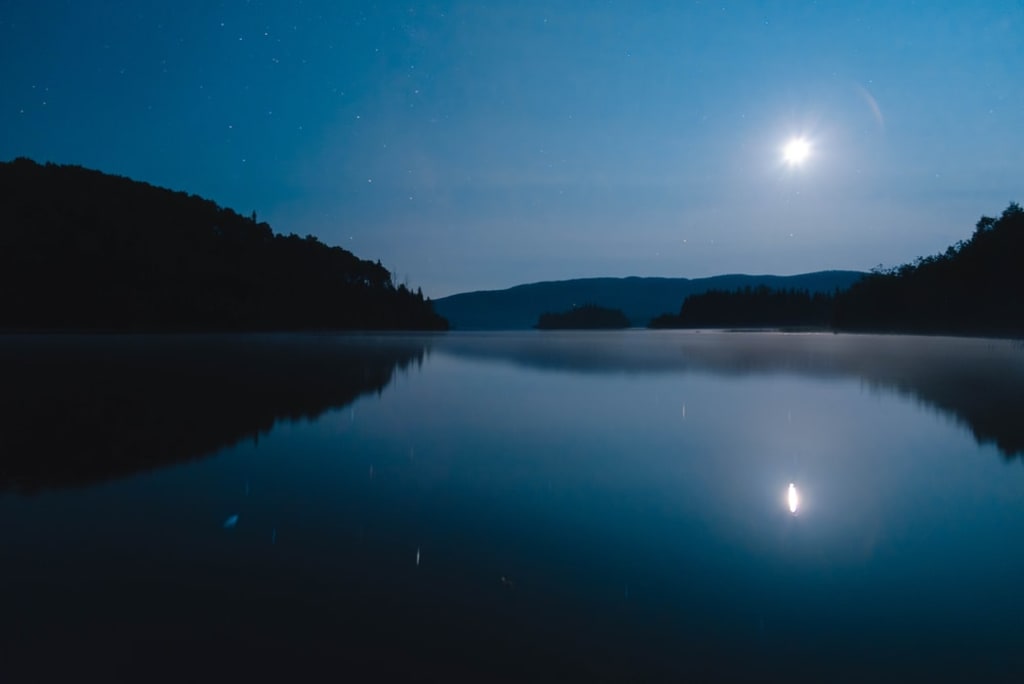
The cabin in the woods had been abandoned for years, but one night, a candle burned in the window. I saw it that first night, only from the corner of my weary eye. I was perched at the bureau in my study, reviewing a set of missives received the same afternoon. I remember it well: the light came to me like a faded star of ochre, whispered across the lake from the shallow promontory on which the cabin stands. A sensation like cold metal clasped the nape of my neck, and as a child, I watched it dance with the blue mist above the water; I watched in bewilderment, nay, allurement, aggravated by some feeling I can neither describe nor forget.
The cabin itself breaches a narrow gap in the pines, no wider than twenty feet. I saw it that night like a nameless watchman stowed in the treeline. Up above, the moon was a crescent aegis; it cast the entire littoral in a silver shimmer. Beyond the trees, the hills slept peacefully, sketched in old, faded ink.
The moonlight air was cool and pure as stone. I regarded the light in the cabin window with such intent, fixed still at the desk, pen between my fingers. Anxiously, I combed the surroundings for sign of activity: there was none. The light glowed lonely in the dark.
Suddenly, a chill wind lashed through my open window, silencing the candle on the bureau. Startled by the darkness, I rose to close the window, then went to the bathroom to wash my face. Yet when I returned, not two moments later, I saw the cabin cower silent in the dark. There was not a light to be seen.
Befuddled, I was ready to dismiss the vision as an error of sight besmirched by fatigue and the low light: indeed, I had almost dozed off at my desk not a few moments earlier. Yet, the candlelight was unmistakable. Wasn’t it? I went to bed with its hollow reproduction in my mind’s eye, nursed to sleep by the haunted narration: where a candle burns, must someone have been there to light it?
…
I should like to present this account as something akin to legal testimony. Since its debut, I have been mindful that the entire narrative is open to imputation of apocrypha, superstition, even outright fabrication. I acknowledge something deep and latent within the race which stirs us to embellishments of even the most unremarkable coincidence. I remember my own brother, several years older than I, who would tease us by lamplight with tales of the unnatural: pitch monsters in the attic and corpses white as chalk beneath the floorboards numbered among his favourites.
Still, the loosest thread in the stitching of such a tale invites its unravelling. I lay claim to the probity of this queer affair only insofar as it is my own recollection constructed at present, unadulterated, several months after the happening. It is for the reader to extricate fact from fiction as he sees fit. I say nevertheless that I have continued to live in this house here on the lake – I dare not return to the cabin now – in spite of all reason’s behest that I leave. Perhaps, if I ever make sense of it myself, I shall explain why.
…
The next morning, the morning after the vision, I awoke in the freshness of sunlight and a fine breeze. I must admit that in the light of day, I had forgotten the phantom events of the previous evening: I went for a short swim in the lake, before readying myself with light feet in the usual routine, joined with the house in acceptance of the resplendent vitality of arriving summer. It was not until I returned to the study bureau to gather missives and various case papers into my briefcase that I looked out across the water to the cabin, huddled there amongst the trees, and felt my wonder to have crystallised in sleep.
I stood for a moment at the window, overlaying the morning’s picture with what had come to me in the moonlight. That image of the light in the cabin window seemed well to take on the character of a dream, and from then on through the day, I held it in that devolved contemplation one reserves for works known to be authored entirely by the subconscious mind. I knew that it would not constitute a stretch of established rationalism to suppose that any figment of wild nature might create the impression of candlelight at that distance – perhaps it is a wonder I had not yet figured many more spectres on that foreign lakeside. Still and all, I left for the office that morning with my fingers on the memory.
The day’s labour passed in an altogether pleasant fashion. I find the business here to go neither too slow nor too quick; it goes with the steady turn of the clock. The majority of cases that make their way to me are exposed as rudimentary by the plainest sense of the laws of property and civil action. Still, I find the banality pleasing in my advancing years. With a wife in the grave and two children grown proud and fledged, I see no issue to observe contently the bed for which I have made myself, and to lay upon it comfortably.
It was ten months ago I took up an offer of partnership at Wiles Salmon – now Wiles, Salmon and Fintry – and settled my dealings in the city, relocating my modest fortune to the small lakeside estate. Certain vagaries of logistics decreed that I should move in the middle of winter – how I must have looked then, stumbling into this empty house, boots drenched in the wild snow!
Those first days were long, filled with charmed and aimless wanderings. The brightness of the place, unobscured by eaves and tepid smog, stymied the sense of dislocation my old colleagues in London feared for me. Before long, the melting snow gave way to a veil of sweet spring rain – I was glad to be out in the country.
The house itself is large, and well built; it is perhaps too commodious for my need, but suitably so for my liking. Indeed, I have made a happy companion of the silence, and I find the profusion of rooms makes for wonderfully itinerant dinner parties – attendance being a tacit condition of partnership’s employment – with physical movement a fine subsidy to set against the tolls imposed by the richness of food and drink to which one is condemned only in the rural townships.
…
Dinner that evening was to be hosted by Salmon. He and his wife, a corpulent ball of rosy mirth, live on the lake’s eastern shore, in a house of identical architecture to my own. The lowering sun, blushed and lawless, poured through the dining room window as we fed. Present there with me were Salmon and his wife, Wiles and his, and the two clerks, Wallace and James. Aside, I never fail to impress where possible the extraordinary fact that James, in a previous life as a serviceman, once survived a shark attack off the west coast of the Red Sea.
Wiles is the senior partner. An older man than Salmon or I, he is good-humoured and idiomatic, and relishes his diminishing responsibility in the firm’s business with senile excitability. Most of dinner was spent with him in a paroxysm of knuckles and gesticulation as he relayed his plans for a novel: a heroic, lurid shamble across the Aegean and Mediterranean seas, to ‘wild and ancient Lycia’, as he put it, set in the first person. Wallace had begun to mutter his polite approval, before pondering the profitability of a work in the Homeric tradition in the current climate, when a rich boom howled down the table:
‘Speak up, man!’
Salmon is a gracious host, but he derides soft speaking, an attitude which he never seems troubled to make known. I find this is perhaps because he himself speaks with the staggered cadence and volume of artillery fire, qualities which might otherwise habitually alarm the uninitiated – perhaps even the initiated – were it not for a dependable joviality, shared by his wife, and recognisable at a distance by reddish hair and the glad curves of his physiognomy.
The evening proceeded with recumbent gaiety: after dinner, a discussion of Ibsen grew riotous, too farcical to tend, and gave way abruptly to thick glasses of port and old songs, performed by the choir of rubicund faces with a fervour in vast outweigh of talent.
A timeous lull in the festivities around nine o’clock stood me to my feet; I shook the sticky blood within my legs. The sun outside had almost set, and the flushed scene in the drawing room window grew replete with the final call of the birds. Inadvertently, irresistibly, my contemplation fell upon the old cabin. The view was not so clear as from my own window, which benefits from direct opposition to the narrow promontory, but I could see well enough that it lay dormant, and that this plainly seemed its natural state.
I called over my shoulder.
‘Does anyone live in that cabin there on the north side?’
‘Which cabin?’ Salmon asked, appearing at my side.
With a forefinger, I directed his inquiry across the water.
‘Not to my knowledge – it’s been empty as far as I can remember.’ The rest of the party variously communicated their agreement.
‘Are you sure? You’ve never seen any sign of activity?’
There was an oppressive stir in my gut at the coincidence of Salmon’s reply:
‘Not so much as a light in the window.’
‘Why do you ask?’
‘Because that’s exactly what I saw last night. Candlelight, in the window.’
A great muddle assumed the collective countenance.
‘What time was this?’
‘Midnight or so. Not much later.’
‘A candlelight? You’re sure?’
‘Not altogether, no. Naturally, I felt sure in the moment.’
Mrs Salmon explained plainly that she had risen for a drink of water around that time and had seen no such light from the bedroom; granted, she had not been looking properly.
James then prodded the optical plausibility of the matter:
‘Might one even be able to see candlelight at that distance?’
‘I would suppose so. I estimate it’s little more than a mile across the lake from where I was standing.’
‘The night was very still,’ said Salmon. I and the others concurred.
‘Might there have been someone using the cabin as a base? For work around the lake?’ I asked.
‘Work? At that hour?’
Salmon encountered the question, scouring the red curls of his beard.
‘It’s not impossible. I once knew a carpenter – strange fellow, mind you – who preferred to work by the light of a lamp, and the moon. He told me there was something about the peace of the air he found amenable to the job. At this time of year anyway.’
‘Is there work to be done on that part of the lake?’
‘That’s where the thing falls down. There’s nothing on the north shore but pines and dirt – not so much as a stream.’
‘Did you see anything else?’
All eyes returned to me. I had a sense then that I was providing the exposition for a scene of a play; around me, they sat, faces gawped in jocose anticipation, waiting for the next line. Yet, of the cast, I saw one face decline its part – it was the face of Wiles. He had been silent for the duration, but now his aspect had become quite discoloured, as if the blood beneath his cheeks were diluted with water. He looked, I thought, like a man just that moment deprived the chance to avenge some eternal wrong against his soul.
‘No – no, nothing else.’
‘Then nothing else for it – an apparition of the country air.’
‘The first of many, I expect.’
A hue of condescension plugged the ranks, but in my confusion, I saw no reason but to acquiesce.
‘Yes, yes, I suppose so.’
A fresh gust then redirected the vane of conversation, and it was not long before song broke out once more. The affair buttoned in my mind, I relaxed quite happily back into bushy merriment.
…
It must have been around two o’clock by the time I returned to my own house. In crapulent disregard, I readied myself for bed. As I stumbled around the empty house, pleasantly surprised at the blur with which my vision was beset, I paused at the door of the study. Through the door, I saw the cabin, dark and silent as it had been hours before. With this nightcap of relief, I wandered off to bed.
Yet the bliss which I find ferries me to sleep in such states declined to arrive. The ceiling steadied itself as I lay there, beneath the covers, bearing the sense of the matter. The fact was now plain, and its evidence corroborated: no one occupied the cabin. I had been mistaken.
But still, I could not rest. Something choked the voice of reason; I couldn’t help but haunt myself with the image of the light, and the thought of how Wiles’ face had turned at its mention. Eventually, and with child-like petulance at my own folly, I resolved to take a final look, on the strength of which the entire case might be closed. I drew my heavy limbs out of bed and, tying the nightgown, left for the study.
As I look back on myself then, trudging through the dark hallway, it occurs to me that there are certain devices of the language, which succeed in outlining the shape of an experience to the callow reader; it is then for the experience itself to shade in colour. To say one’s blood curdled, I have always found particularly evocative, but I shan’t forget the moment in which it was decided I would have my own experience coloured. It happened when I returned to that room.
I stood in the doorway once more; a crack of horror visited upon my spine. There, in the cabin window, was the candlelight once more. Like hemlock, it came to me, a picture of dread. Stunned, I began to creep beyond my own volition towards the window. Pins littered the floor beneath my feet. As I moved, the perspective widened and focus changed depth, and the dull orange light, fixed in the glass, became the component of a more remarkable scene.
A bleak shade of a figure, a human figure, had appeared at the edge of the water, as if risen from the very ground on which he stood. I felt my own breath clammy against the glass; I was pressed to the window. The figure didn’t move under my gaze, not an inch. His very stillness struck me like a danger light.
Before long, I was accosted by a second grim spectre; behind the cabin, a ghostly sway had taken hold of the trees. It was hoisting the pine branches to and fro in the manner of a violent gale. But it could not have been the wind; the night was still as a flat penny. There was something else moving the trees.
At this, the veil of my stupor was pierced. In horror, I recoiled from the scene, upending the chair at the bureau as I went, and fled to the bathroom. I filled the sink with cold water, into which I plunged my face, up to the ear. The cold numbed my mind, and by extension, the memory. Half-drowned, I looked up at the mirror; my features were pallid, panic-stamped. I stood there subdued; I don’t know how long.
On recollection of the senses, I returned to the study as I had done the night before; with appalled confusion, I was met with that same act of disappearance: once more, the cabin stood silent. There was no figure at the water, no light in the window. The trees were unmoved since time immemorial. Frantic with agitation, I flung open the window and peered out into the night air. The glass did not lie: there was nothing there. Humbly the water swelled in the moonlight.
The vision was a dream to me no longer; I had been quite convinced of what I saw. I could draw it clear and lucid on the bedroom ceiling, as I commanded my limbs to be still. I went to sleep in thick resolve that, the next night, I would hunt the light of the candle at its source.
…
It was the first Sunday of June when I went down to the cabin. The final consternations of spring had spiralled into a colossal storm of warm rain which, ripped finally around midday, blasted the earth for furious hours.
Ignorant of the weather, there was never an impression that I might descend upon the cabin before nightfall. In some way, the moonlight seemed key to the entire affair. I spent the day fingering odd jobs around the house in fixed distraction. I tried variously to conjure myself on the promontory, to be faced with that figure which remained only a shadow in my mind – but I could not impose features on the visage. Like this, the day ground away in flashes of impatience.
I set out at dusk. By then, the clouds had exhausted themselves, making way for the sun to light the sky in a blaze of pink quartz as it retired below the hills; the light of my lamp burned brightly as night arrived to smother the scene.
The cabin was not far as the crow flies, but I was not quite a novice of the country, and heeded the rainfall well enough to factor stretches of rough terrain into the calculation. Though my house and the cabin stand on opposing shores, I was sure quicker time could be made along the west side, which runs comparably straight, undisturbed by inlet or firth.
The earth was water-logged and churned unhappily at the instance of my boot. Above, the moon could form its bold flourishes only at the odd interval, otherwise masked by the thick canopy of the pines. I became aware of a certain lack of agency in my step as I walked – it felt as though a force was directing me drone-like through those woods. Stiffened by the dark, I made sure to keep close enough to the water’s guide beside me, straying only at scattered impasses.
One such impasse, a steep cutting in the ground, forced me away from the water. I traipsed inland meticulously, vigilant for a means of crossing. Eventually, I happened upon a shallow stretch of the banking, whereupon I negotiated my way down the precipitate mud, rueing the tardiness with which I spotted a fallen tree which might have forded the gap. Still, I emerged on the far side unbowed and set my boots again towards the water – all roads lead to Rome.
It was in a manner of surprise that the slim jut of the promontory came upon me. It emerged from the trees on my right like mercury rising in a thermometer. I followed its curve – an acute rush of nerves disturbing my stomach – until I broke through the treeline.
Freed from the pines, the picture of the lake was a confluence of stained glass and shadow. I remained there on the shoulder of the promontory for a moment, drunk on its midnight philtre. The air hung loose; quiet limpid waves lapped upon the shore; insects swung in death-toss amidst the thicket, all under that white brilliance of the moon.
The cabin stood alone, soundless. Ten feet or so out from the start of the trees, it bore signs of a life once happily undisturbed, now forgotten, buried under sap and scattered dust. A wooden workbench sat outside the window, and beside it a little stanchion frame, crippled by rust; a few feet out towards the water was a child’s bicycle, splayed on its side, of faded but discernible colour. The cabin itself looked large enough for a menial existence, perhaps that of a small family. A chimney stack crowned the rear wall. On the sill of that great pore of a window, a sole candle, unlit, and a box of matches were perched.
The door of the cabin was open. It seemed that all infernal imagination could be depicted in the dark frame of that doorway; with a ghostly hum, it called out to me. Stirred by what cannot be explained otherwise than as a predetermined courage, a singular air of duty, I made my way inside with deer-like footing.
The air within took on an altogether different quality, polluted and forbidding. Though the wide window, now behind me, supplied plenty of light into the single room, it glimpsed of a world I seemed to have left. Extraordinarily, the cabin was entirely bare. Save for the furnishings on the windowsill and a paltry, lifeless fireplace, the wooden walls were filled with dread and nought else. Dust and dead pine needles covered the floor. Humbled by the poverty of the scene, almost suffocated by that hellish air, I traced a hand along the warped old wood, coming to a rest at the fireplace mantle on the back wall.
THUMP, THUMP, came from outside – the proud gunshots of a rabbit’s hind leg. Wildly, they continued, as if sounding the hour.
But something else had begun to fall upon my ear in addition – a hoarse, staggered modulation. The noise, like the rabbit’s foot, seemed to come from behind the cabin. I pressed my ear to the back wall, grasping in my hand the dusty mantle. By now, the rabbit had ceased its thud, but the second noise was swelling, scratched and barely even. My heart fell to terror when I identified it surely as the sound of footsteps in the dirt.
I stood paralysed, gripped to the wall, listening to the steps diminish as they rounded the corner, and swell again as they approached the window. Moonlight poured through the opening; my fingers went quite cold. Shaking, I fixed my stare over my shoulder.
In a moment, a rounded crown of flesh appeared in the window. Painted blue by the moonlight, it strafed the sill, hobbling, in the direction of the open door. I closed my eyes as if to admonish them for a cruel deception. Two heartbeats passed. The ungodly scrape of feet had stopped. Hardly bearing to look again, I turned towards the door.
There, in the doorway, stood a naked figure. As I write now, it seems to me he must have been a young boy, perhaps nine or ten, evidenced by a lowly height and slender frame. Yet, as I stood there in that cabin, I had never felt so close to the supernatural. I doubt I shall ever come so close again.
It was all his in eyes. Cast against that blazing moonlight, his features were obscured in the shade, but he was in sufficient proximity that I could observe well enough the eyes, whereupon horror twisted my bones. They dominated his visage: shark-black, as wide and smooth as pebbles, inhuman in every aspect but a bare, reverent trust – the look I remember my own children directing toward me.
His naked flesh looked to have been boiled – it was covered by thick welts and pockmarks. His depilated skull was bulbous, unnatural in size. His disposition, it cried to me – it sounds obscene – of a soul coddled in succour from birth, then cast out and abandoned, only to be found again and reclaimed. He stared at me plainly, devoid of reason or gesture, aside from what I saw as a polite smile formed by the two bare strips of pink he had for lips.
I couldn’t utter a word – not as he stood there at the door, and not as he began his limped shuffle towards the window. I realised then that thick splinters of wood were buried all beneath his skin. As he moved, a reek of sulphur, foul to the nostrils, had begun to bleed from the forest, drenched in the damp petrichor. With his back to me, he picked up the box of matches.
I jumped at the match-strike; inertia shattered, I shook the clay from my limbs and ran for the door. I took one glance over my shoulder as I dashed lakeward across the promontory – the candle had been lit. Over the slap of my feet against the ground, I heard a fresh din mount from the trees, like a bass drum dampened in the needles. Still, I ran, until the water hit me like a flurry of daggers, my senses sharpened in shock. With a blind fury, I slashed, heaving the water behind me with outrageous force. I must have been fifty yards or so out when I was compelled again to look on the shore.
I turned onto my back, beginning to wade with one hand as I cleared my vision with the other. The boy was at again the edge of the water, facing the trees, but he was no longer still. My horror renewed at his assumption of what I might only describe as a jagged pagan dance: his feet planted, he had curved his arms into sickles, and with them, he began to carve the air in long motions.
The sway returned to the trees. It began a tremor, rising with each fell swoop of the boy’s arms. In moments, the whole forest was shaking. Pulled down by the shock, only the last reserves of sinew kept my head above the water. Still the noise came from the trees, still the branches were wracked by violence, all building to an awful crescendo. A dark shadow had appeared above the treetops. Finally, the nerves broke – in a fit, I swerved back under the water.
I don’t purport to hide my cowardice in this whole affair: like an animal, I swam, and I did not stop swimming until I again reached the south shore. There, I scrambled onto the shore, breathless, and collapsed. I might have fallen asleep there in the dirt, like a wreck – in the panic, I can’t remember. I only recall peering a final time above my chest, still yet before the morning, over towards the cabin. The light had gone out; all was still once more.
…
The next day was spent in stupor, my heart still possessed by that terrible nightmare. The June heat had tightened the air. I set to work only in fits and starts, my legs restless beneath the office desk. The smallest change in the room – one of the clerks rising to file papers, a breeze from the open window – conjured in my mind a scene from the story, painted by nervous pangs. My brain was wracked with frantic inquiry into the unfolding of events. I scarcely remember a day less productive.
Evidently though, my fraught visage had not gone entirely unnoticed. By six o’clock, only Wiles and I remained in the office. As I was doing all I could to put the finishing touches on a letter, he appeared at the foot of my desk, gaunt and raven-eyed.
‘You saw the boy?’
I was taken aback by the directness of his approach, and could only stammer:
‘The boy?’
His face was unchanged.
‘By the lake.’
In a rush it all came to me.
‘Yes! Yes! Twice I saw him, in the flesh. But… you’ve seen him too?’
‘Not more than a handful of times.’
I asked who he was, and what was his purpose there. In that moment, the same discolouration had appeared in his face, the very same as when I had first broached the subject at Salmon’s house.
‘I know as much as I care to know.’ An aspect of stern obduracy formed like a girder inside of him. Still I probed:
‘It wasn’t just the boy – there was something else there. In the forest.’
His grave regard looked over my shoulder, transfixed.
‘Yes. There has always been something in those trees.’
At this, a sightless covenant seemed to form in the air between us – we will never again speak of the matter, I understand that well enough. He left me there in the office, with the afternoon sun across my face.
…
The needles have fallen now. Winter will soon be coming over the hills, ready to cover the ground once more in thick snow. Perhaps I shall return to London for Christmas – I have the offer from a friend to stay the festive month – but in any event I shall return by spring. I maintained at the outset: it is for the reader to take from this entire account what they will. I have no desire to influence anything beyond my own mind on the matter. I must admit though, that as I have been putting it all down now, for first time, into writing, I have been tinged by the portent of something unfinished. Doubtless you will ask why I haven’t yet left this place. What keeps me here? There, in that dark portent, may be the rub.
The clouds above shall give me no answer; quietly, they patrol this dominion of lawless spirits. Yes, I think I shall wait, for the moon to rise on its stage once more at the turn of summer, for the candle to burn again.
About the Creator
Keep reading
More stories from Jonnie Walker and writers in Fiction and other communities.
A Party
Sometimes you go to a party and you don’t know what the fuck to do with yourself. Hell, sometimes you’re on the way to a party and you don’t know what the fuck to do with yourself. There was me, in the middle of winter, haunting the booze aisle of a Tesco Metro like a spectre, not knowing what the fuck to do with myself.
By Jonnie Walker5 years ago in Fiction
Gorgon's Purgatory
A tingling sensation fills my head. A deep pressure builds into agonizing pain as the serpents swallow their midnight meal. They move their jaws in synchronized contractions, forcing the bodies of mice down their gullets. The mice wiggle within the snakes for what feels like an eternity, brushing the scaly, cold skin in a ballet of torture.
By Tas The Artist about 14 hours ago in Fiction


Comments
There are no comments for this story
Be the first to respond and start the conversation.