
The Gospel of Gumption
She came to write a punchline. She stayed to find the point

The assignment from her editor was a footnote, a punishment for having annoyed a major advertiser. “Go to Gumption, Vermont,” the email read. “Cover their ‘Fall Furnival.’ Yes, with a ‘U.’ File 500 words on the quirky local color. Try not to poison the well.”
Maya Thorne, an investigative journalist whose byline was usually found above exposes on political corruption, packed her cynicism and her warmest coat. She arrived in Gumption with a mission: to clinically document the absurdity. The “Furnival” was a three-day event leading to the autumnal equinox, celebrating the town’s founding by a failed furniture maker named Horace Gumption.
Her notebook filled with deliciously sardonic observations. “Main street draped in flannel. Smell of cider and forced merriment.” “Event #1: Competitive Whittling. Prize: a ‘Whittle Trophy.’ The pun is the real crime.” “Town’s mascot is a cartoon beaver in a tool belt. ‘Get Your Gumption!’ signs everywhere. I feel less gumption by the minute.”
She interviewed the mayor, a cheerful woman in a squirrel-print sweater. “The Furnival isn’t about furniture, dear,” the mayor explained, undeterred by Maya’s deadpan expression. “It’s about making something useful, or joyful, from what you have. Horace didn’t make great chairs, but he made a great community.”
Maya’s pen hovered over the phrase “hokey existentialism.”
Her clinical distance began to crack during the “Great Pumpkin Parade.” It wasn’t a parade of floats, but of people. Families marched down Main Street, not with uniform, perfect pumpkins, but with the pumpkins they had grown themselves. They were lopsided, knobby, tiny, or garishly painted. One little girl proudly carried a green pumpkin with a single orange stripe, beaming as if it were the Hope Diamond. The crowd didn’t just cheer for the biggest; they cheered for the most creative, the most enthusiastic, the most tried. Maya’s note simply read: “No judges. Just applause.”
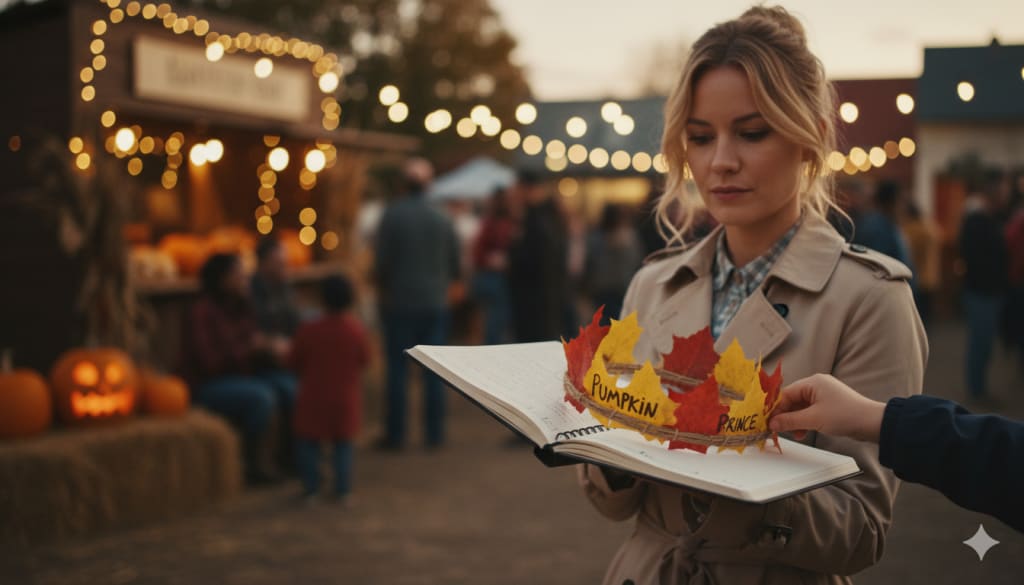
The breaking point came at the “Crowning of the Pumpkin Prince.” She expected a beauty pageant for toddlers. Instead, all the children in town gathered in the park. An elderly man, introduced as the previous year’s “Prince,” a retired carpenter, stood with a crown made of woven vines, golden leaves, and one perfect pheasant feather.
“The crown doesn’t go to the fanciest pumpkin,” the old man announced, his voice gravelly but clear. “It goes to the kid who showed the most gumption this week. Who helped without being asked. Who tried something hard. Who was a good friend.”
A little boy named Leo, who Maya had seen patiently helping his younger sister fix a wobbly wheel on her pumpkin wagon, was called forward. His face, lit with shock and pride, was luminous. The old carpenter knelt, placed the crown on his head, and whispered something that made Leo grin. The entire town erupted in a cheer that felt utterly unforced.
Maya’s cynical shield shattered. This wasn’t a silly festival; it was the town’s living, breathing constitution. It was a shared story they told themselves every year: that effort matters more than perfection, that community is built in small, silly acts, and that everyone, from the oldest carpenter to the smallest child, has a role to play.
That evening, she sat in the town’s only café, her laptop open. The 500-word snark piece was deleted. She stared at the blank screen, then out the window at the fairy lights twinkling in the town square, where people were dancing to a bluegrass band, teenagers and seniors alike.
She began to type a different story.
Her editor’s email chimed the next morning. Subject line: “Where’s the Gumption piece?”
Maya attached her new article, titled “The Furnial of Us: How a Town Redefines Value.” It was 1,200 words. It talked about competitive whittling as an act of meditation, the pumpkin parade as a celebration of unique effort, and the crown as a symbol of intrinsic worth. She quoted the mayor, the old carpenter, and Leo, who said being Prince meant “you have to help hold people up, like the crown helps hold the leaves.”
Her editor wrote back five minutes later: “Thorne. This is soft. It’s not your brand. But… it’s good. It’s really good. Running it Sunday.”
Maya didn’t reply. She was already packing, not for her return to the city, but for the Furnival’s final event: the community bonfire, where they would burn scraps of wood to warm the town square. She had a notebook full of quotes, but she was going back this time without it. She just wanted to feel the heat of the fire, hear the crackle of the wood, and stand for a moment in the uncynical, gumption-filled light.
About the Creator
Habibullah
Storyteller of worlds seen & unseen ✨ From real-life moments to pure imagination, I share tales that spark thought, wonder, and smiles daily
Keep reading
More stories from Habibullah and writers in Fiction and other communities.
The Season of the Honkers
Kael was born for the high, silent corridors of the sky. A Sandhill Crane, his life was a map of ethereal places: the tundra of Sibéria, the marshes of Nebraska, the skies in between. His world was one of graceful, deliberate movement and low, rattling calls that echoed over wetlands. He flew in a neat, arrow-shaped formation with his own kind, a symphony of coordinated wings.
By Habibullah3 months ago in Fiction




Comments
There are no comments for this story
Be the first to respond and start the conversation.