
The Golden Age
In a game between Man and sentient mushrooms, who would prevail?
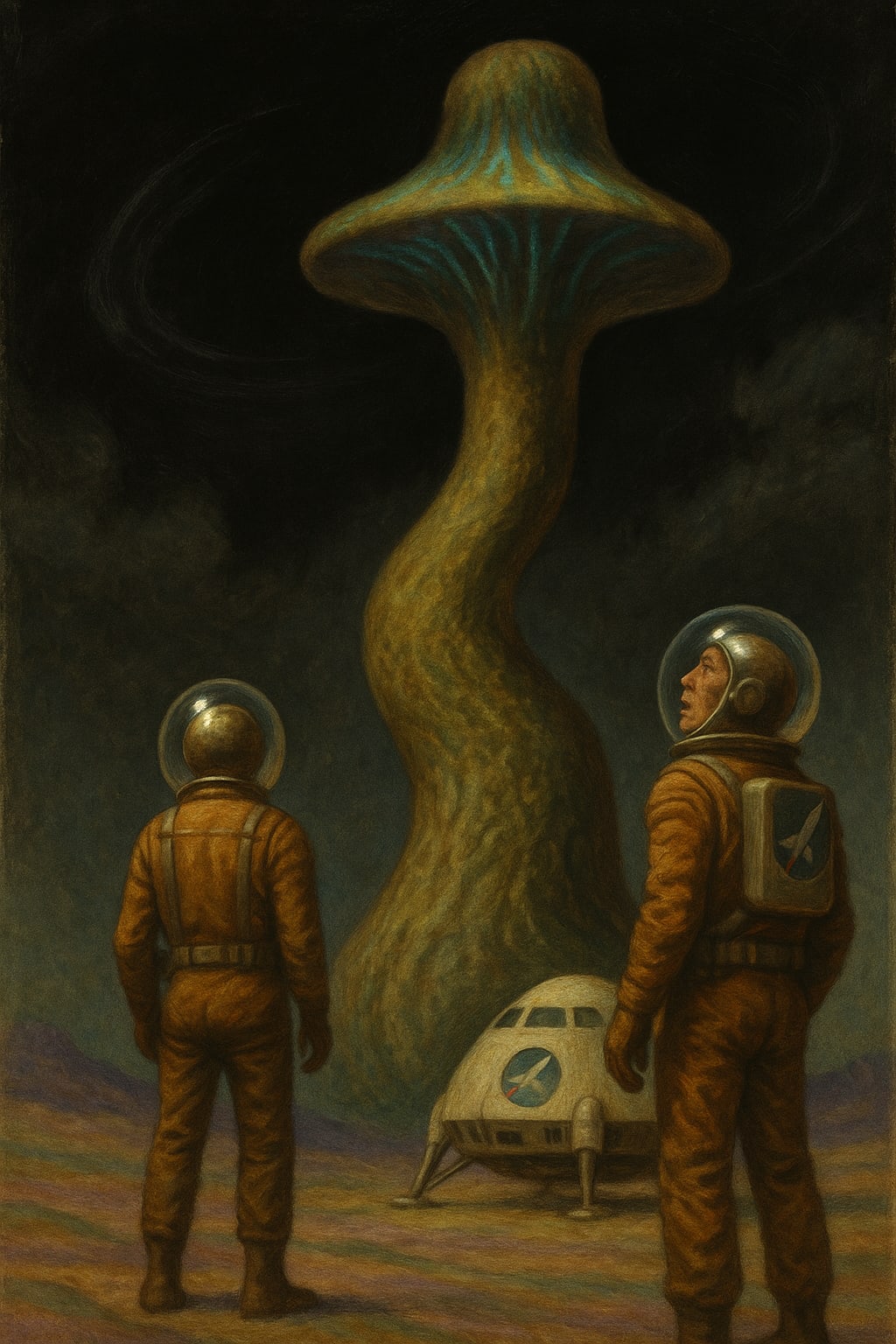
ESS Prometheus still shuddered with residual vibration as the last vestiges of the Alcubierre warp bubble dissolved around it. Captain Lim, still groggy and cotton-mouthed, grimaced as the familiar nausea seized him. Since his cadet days, he had detested the inexorable misery of reawakening from hibernation. It always felt as if his insides were pushing up into his throat, and bolts were being screwed into his temples. The human body simply wasn’t meant to endure such conditions, he thought for the umpteenth time, as his physiology slowly adjusted to its normal function.
The navigational computer’s status message could hardly penetrate through his congested ears, but he already knew what it was going to say. The CAH drive had powered down thirty-three hours ago, and orbit had been established.
“You awake yet, Harry?”
“Unfortunately,” came Dr. Wales’s scratchy voice from his open g-pod. “Though I’m not entirely convinced that we are not still dreaming. What do you think, Pavel?”
“The Buddha taught that all existence is but a dream within a dream.” Dr. Levin was too chipper for Lim’s headache. “Maybe we simply woke up into a different layer of illusion.”
Lim smiled despite himself. Three years of hibernation, and his crew changed not a whit. Despite pretending otherwise, he looked forward to listening to them bicker about worldviews.
* * *
Through the observation deck’s viewport, a tiny pale dot could be just discerned in a star-scattered void - their destination, catalogued as Heraclitus-7.
“Stan, you need to see this,” Wales called. “The atmospheric readings are peculiar.”
Lim made his way through narrow corridors to where Wales stood before banks of monitors.
“The atmosphere is almost entirely methane,” Wales said, highlighting spectral data. “Thick enough to breathe if you were a Titan microbe. You would expect it to be opaque, but look – complete visual transparency from up here.”
He switched to visual feed from the ship’s atmospheric probe. The planet’s surface was shrouded in roiling black fog, dense and impenetrable, swirling in ever-changing patterns that resembled paisley, or perhaps the Starry Night. The patterns occasionally lit up in ominously-colored glowing brushstrokes, that just as quickly faded.
“Extensive subsurface volcanic activity,” Wales observed. “Significant thermal energy coming from the upper mantle, but weirdly no magnetic field at all. And no free surface liquid.”
“A world of fire and gas,” Levin said, joining them. “Yet the biosignatures are unmistakable, just as the Heraclitus probe had reported.” He scratched his head. “It seemed impossible, the planet orbiting at such a distance from its sun… It would be like finding life on Pluto!”
* * *
The three men were gathered around their usual Go board, their favored way to fill the long days of waiting for results from surface probes. As usual in orbit, Lim could not give the board his full attention, distracted by the occasional demands of the ship’s sensors.
“Your move, Pavel.” True to form, Wales drummed his fingers on the table with impatience.
Levin studied the board with a pensive squint. “You know, I’ve been thinking about our mission. If we do stumble on intelligence, true alien intelligence, what are the chances that we’ll be able to comprehend it?”
“Define what you mean by comprehending,” Wales rejoindered, as Levin placed another white stone with exaggerated care. “Hello, how do you do? Or something deeper?”
“Any of it.” Lim cut in. “We three humans can barely understand each other half the time. What hope do we have with lifeforms that evolved completely differently?”
Wales positioned a black stone. “You seem to be assuming these lifeforms here think at all. Biosignatures could just mean microbial mats, Stan.”
“But what if they do think?” pressed Levin. “What if we found intelligence that had transcended base concerns? Plant-like beings, maybe, rooted in one place, not needing to compete like animals. Their intelligence might be contemplative rather than competitive - pure thought without aggressive drives.”
Wales grunted skeptically. “And how would such beings survive, exactly? Evolution doesn’t favor contemplation. It rewards effectiveness.”
“Unless they had evolved beyond the need for survival in the traditional sense,” Levin curved his lips, as if he had just scored a decisive point. “An enlightened species might have found harmony with their environment rather than won dominance over it.”
“You’re describing paradise, Pavel,” Wales chuckled. “But remember, even plants compete - for sunlight, nutrients, for space.”
“True. But think about the scale. A tree does not wage war - it simply grows toward the light. There’s a serenity to plant life, unlike the animal.”
A soft chime interrupted them. “Surface survey data incoming.”
* * *
The first detailed images appeared on the main display. Pushing through the atmospheric interference, the surface probe’s synthetic aperture radar painted a detailed picture of the world below.
“No structures or artificial environmental features detectable of any kind,” Wales observed. “Plenty of volcanic activity, some mineral formations, but nothing suggesting sentient life, unless it’s very primitive or hidden underground.“
“Hang on,” Lim pointed to a patchwork of regular shapes that was just visible near a geothermal field. “What are those?”
Roughly spherical objects of various sizes dotted the landscape in seemingly random patterns around heat sources.
“Geological formations?” Wales suggested. “Mineral deposits from volcanic activity?”
Levin leaned closer, with growing excitement. “The distribution isn’t random. Look at the spacing, the positioning. There’s a pattern here.” He touched the comms button. “Surface probe, approach the formation in quadrant six.”
The image shifted, revealing greater detail of the pattern.
“Surface probe, zoom out to kilometer resolution.”
The spherical objects, hundreds of thousands of them, were scattered across the surface in strangely geometric patterns. Where they clustered most thickly, biosignature readings were strongest.
“Those aren’t geological formations,” Lim said quietly. “They’re alive.”
* * *
“These lifeforms look remarkably like mushrooms,” Levin announced during their daily briefing. “Their morphology is very similar to fungi.”
“Mushrooms the size of buildings,” Wales added. “Some approach fifty meters in diameter.”
“The biosignature readings are quite substantial,” Levin continued. “These aren’t just alive – in fact, it is the first time I have seen metabolic activity on such a scale.”
“Processing what?” Lim asked. “The atmosphere is mostly methane. There’s no apparent food source.”
“Unless they’re chemosynthetic,” Wales suggested. “Drawing energy directly from volcanic activity.”
As they conversed, Levin was absorbed by the live feeds. The “mushrooms” weren’t static - they showed subtle movements: expansions and contractions in rhythms that suggested regularity.
“Stan, Harry - you need to see this.”
On screen, one of the larger organisms was transforming. Its bulbous body contracted into a gourd shape while its cap expanded into what looked like a bell or funnel. At length, the gourd’s neck started to rotate and tilt.
“What could it be doing?” Wales breathed.
The bell-shaped cap moved with apparent purpose, tilting and rotating until it pointed in its chosen direction: thirty-five degrees elevation, twenty degrees rotation. The motion was deliberate and almost mechanical.
“Hm, curious,” Lim muttered. “It’s moving like a gun turret.”
The bulbous lower portion of the organism’s body suddenly contracted, and a dark projectile, about the size of a human fist, shot from the bell-shaped opening. The projectile arced high into the atmosphere and disappeared beyond their sensors’ range.
“Reproduction,” Levin said with satisfaction. “It’s firing its spores or seeds.”
“Hell of a delivery system,” Wales chuckled. “That thing traveled at least twenty kilometers.”
* * *
“It’s time to head down there,” Levin said that evening. “For direct surface observation. We need samples, detailed measurements.”
“The atmosphere is toxic,” Wales said. “And ground temperatures are quite high near the clusters.”
“The suits can handle it,” Lim reminded him. “The real question is not environmental. Suppose they can fire those pods offensively?”
“That’s exactly why we need to go,” Levin insisted. “If these organisms are intelligent, and I suspect they might be, we need to find a way to understand them.”
“Intelligence?” Wales placed a white stone. “They’re launching projectiles, Pavel, not composing poetry.”
“But look at the coordination,” Levin argued, pulling up observational data. “The launches aren’t random. There’s timing, sequence, pattern. Some organisms wait while others fire, as if they’re taking turns.”
“Could be chemical signaling,” Wales conceded.
“Or conversation,” Levin said quietly.
* * *
Two days later, Levin and Wales descended through the planet’s atmosphere in the landing shuttle as Lim monitored from orbit.
“Visibility near zero,” Wales reported. “It’s like flying through black ink.”
The shuttle’s landing system guided them to a large clearing close to a cluster of the organisms. As it settled on its landing gear, both men felt the weight of the moment – they could be the first humans to make contact with extraterrestrial intelligence.
“Atmospheric pressure one-point-two atmospheres,” Wales read. “Air temperature minus fifteen Celsius.”
Carefully inspecting one another’s fittings, they donned their bulky surface suits, checking and rechecking seals and life support.
“Radio check,” Lim’s voice crackled in their helmets.
“Loud and clear, Stan,” Levin replied. “Commencing surface EVA.”
* * *
Slowly, they walked toward the nearest stand of mushrooms, taking observations. The landscape was like nothing they had ever seen. Spongy, organic-seeming ground the color of ripe plums, covered in patches with dark moss-like growth. The mushroom organisms loomed like alien architecture, surfaces glistening with corrosive moisture through dim, filtered light.
“They are magnificent,” breathed Levin as Wales set up his ground penetration probe.
Soon, the initial readings started coming back as the probe surfaced. “Soil composition is unusual. High organic content, almost like compost, but not just carbon. pH is neutral, strangely. Strong indications of tectonic activity.”
Picking up the probe, he noticed fragments of barely visible filament-like strands clinging to the drill head. Without warning, two of the nearest mushrooms puffed up as if taking a deep breath, and then, all of a sudden, shriveled to small husks like exploding balloons. Appalled, he watched them quickly decompose to fine gray dust.
“Harry,” he called out, shaken. “I… I think I killed them!”
Levin hurried over. “Great going, H.G.! First contact, and what do we do?” He chuckled bitterly. “It’s like that old joke – join the Space Fleet, travel the galaxy, encounter new species, and then kill them…”
He pondered. “It has to be mycelium. These mushrooms aren’t individuals – they’re probably the fruiting bodies of a fungal network.”
Wales sighed. “Let’s hope it wasn’t so bad then. Terrestrial mycelia can easily survive such local damage.”
“I bet you’ve pissed it off through,” laughed Levin.
No sooner than he said that, a nearby mushroom started to change shape. The transformation was slow but unmistakable - contracting into the familiar gourd shape, cap expanding into bell configuration.
“It’s taking aim at us,” Wales said tensely.
“No, I don’t think so,” Levin answered thoughtfully, as he moved closer. “I am not sure it is responding to our presence.” He looked up. “Look at the angle - it’s not aiming at us, it’s aiming past us.”
The mushroom completed its transformation and fired with a whoosh. The projectile arced overhead, vanishing into the murky atmosphere. Almost immediately, the organism relaxed back to its original shape.
“Incredible,” Levin murmured. “The precision is remarkable. That wasn’t instinct – that was calculation.”
* * *
Wales and Levin took stock as the shuttle’s hull was decontaminating in the docking bay. Their samples of mycelium made it clear that it possessed nothing resembling DNA – it was more like a hybrid of silicate chains with transition-metal coordination complexes embedded in fairly simple carbon chain structures. Levin’s dissertation topic was about the possibility of silicon-based life, but he would never have imagined that it could take this form.
They gathered in the bio lab, impatient to compare notes.
“Look!” Levin exclaimed, beaming. “Look at the microscopy! The structure of the filaments is really quite something - multiple channels, redundant pathways, even switching nodes.”
“It’s far more sophisticated than they’d need for simple reproduction,” Lim observed.“
Looking again, he added, “Methane and sulfur compound biochemistry, organized in patterns suggesting information processing rather than simple metabolism.” Then his face changed. “The 'spore' projectiles contain much more than I would call reproductive material. Look at the molecular structure of these packages.”
“If anything, they look more like compressed data files,” Lim interjected, fully engaged now.
“Like a biological computer network,” Levin added. “This makes mammalian nervous systems look quite primitive.”
“They’re not just reproducing,” Lim replied. “They’re communicating. Those projectiles are almost certainly some kind of messages.”
“Messages traveling enormous distances,” mused Wales. “A planetary-scale communication network by way of ballistic delivery.”
Levin looked up from the screen, eyes bright. He turned his head to look at Wales.
“I don’t think we’re looking at a communication network,” he said quietly. “I think we’re looking at a mind. A single, planetary consciousness using these mushroom structures as neurons and the projectile system as synapses.”
“One organism covering an entire planet?” Wales shook his head. “The coordination requirements alone...” He was thoughtful. “I think I recall something like that from this classic book I’ve read in school once. What was it called? ‘So’… ‘Sola’… Was it ‘Solaris’?”
“Is it impossible?” Levin challenged. “We’ve established that the network spans the planet. What if consciousness did emerge at such a scale? What if intelligence, for this species, is a property of the entire planetary system?”
Working nearly around the clock now, they launched observation satellites and surface probes, one after another, hoping to get a better picture. Bit by bit, a map of mushroom distribution was emerging, together with a few surprises. The biggest one was that some of the pods traveled several thousand kilometers, apparently hitching rides on atmospheric currents. This was strange enough – the currents were nothing if not chaotic – it also appeared that the pods could steer, albeit it wasn’t clear how.
“Here, look at this,” Levin pointed to the screen. “Not all of the mycelia we found have the same structure. We might be looking at more than one network, each slightly different.” Peering more closely, he added, “And, each network appears to have planetary reach.”
“There are hundreds of them,” Wales added. “It looks like each network occupies specific territory, and they do not overlap.”
Levin touched a few controls. “Here, I have color-coded them. Look, they are evolving as we speak!”
* * *
Levin was obsessed. This was the most exciting discovery of his long career. He made sure that the distribution map was displayed in every compartment and spent every moment staring at the shifting patterns.
“Harry, I’ve been thinking,” he buttonholed Wales as the latter passed by the lab. “The mushrooms… I mean, the readings are suggesting that their networks might be cluster symbionts. If they are sentient, can such beings possess individual consciousnesses or a sense of self?”
“Maybe,” Wales answered cautiously, suspecting that Levin was about to head down a rabbit hole. “What are you implying?”
“Well, we keep saying that it’s the illusion of self that drives conflict and resulting suffering…”
“It’s you who keeps saying it, Pavel,” Wales interrupted.
“No, no, listen! This is the very picture of enlightenment! It is a planet that the Buddha would have made. How happy must their lives be…”
“How can they be happy without selfhood, Pavel? No, I wouldn’t say that. I think, rather, that the minds of beings forever trapped in place must be too different from anything we can conceive of.” He looked Levin in the eye. “I will bet you anything you like that we will never find a way to meaningfully communicate.”
“I’ll take that bet!” Levin fired back. “I’m sure that we have a lot to learn from them.”
“Yeah, sure, Pavel… I just don’t believe that we can ever know if they are or aren’t your paragons of this Buddha-like enlightenment.”
* * *
“Enough now, Pavel,” Lim called out as Levin poured over the map in the wardroom, absently chewing on a tomato sandwich. “As your captain, I strongly advise you to take a breather. I don’t need my crew collapsing.”
“Right! It’s been days since we’ve had a game,” said Wales, already reaching for the Go board.
“Okay then, I suppose… It is so damn exciting though! I can’t wait to see the faces of the stuffed shirts at the Academy.” Levin turned away from the map and lowered himself into his usual chair. “I think I will take white today.” He placed a stone.
For a time, they played in silence as Lim watched pensively.
“You know,” he finally spoke, “I think we should name this planet Kronus.”
“Why Kronus?” Levin seemed put out. “I was thinking about something more like Flora. You know, a planet populated with perhaps sentient plant life. What do you think?”
“Well, Kronus was the god of plant life also, wasn’t he?” asked Wales.
“Not quite,” Lim countered. “He was a god of harvest. Not exactly the same thing. Besides, the planet has no sky at all – and he did overthrow Ouranos the Sky.”
“Mm, maybe I can see it,” Levin drawled, warming up to the idea. “Wasn’t his reign also the Golden Age? This place sure looks like it’s golden age personified. No wars, no strife, no desires, no killing – not at least till Harry got here!” He chuckled.
Wales’ tight smile revealed that he was still bothered by what had happened. “Do you remember how it was that Kronus became the god of harvest? He used a sickle to castrate his father. Golden age or no, that sure sounds violent to me,” he said with irritation, but then grinned widely, joining in the joke. “Still, it is a good name, I think. Let’s do it.”
“We should name the mushrooms while we are at it,” Lim suggested. “Don’t they also deserve names that people can pronounce? I, for one, never remember all that Latin.”
“Yeah, sure,” Wales answered. “What are you thinking?”
“Well, how about Borgs?” Lim quipped, holding up a bottle of Kronenbourg beer, from which he had been sipping.
“Yeah, how about it?” Wales piped in, reaching for another stone. “I like it.” He stopped, frozen, looking alternately at the board and the screen where color patches continued their dance. “Wait a minute, guys. I thought those patterns looked familiar. What do they remind you of, Stan?”
They gathered by the screen, tracing the patches with their fingers. “You see it, don’t you?” Lim nodded.
“They are goddamn playing Go!” escaped from Levin as he kept swiveling to look at the board and the screen. “Look, whenever a patch is encircled by another color, it just disappears! I don’t believe this!” He turned to Lim. “Stan, I’ve got to go back down there, I have to see what happens on the ground during a capture. Will you authorize it?”
Behind him, the last remaining patch of yellow suddenly faded from the map.
* * *
“It boggles the mind, you know, Harry!” Levin adjusted his harness around his suit’s awkward bulk. “What level of intelligence would be required to play Go in hundreds of dimensions? We struggle with just two… And, like in the Seventh Seal – remember that one? – they are playing for their very lives…”
“Ignition!” Wales shifted in his seat. “It’s those damn self-steering pods that bother me. I don’t see how they could house sentience. This means they must be piloted remotely, but I will be damned if I can figure out how they are communicating.”
“We still don’t know how they steer,” Levin added. “None of my analyses came up with anything that I would hang my hat on.”
They landed, having found a suitable clearing near a group of purple Borgs that was nearly encircled by their black cousins. “Now we have to wait and pray that we’ll get to see a pod touch down,” Levin rubbed his gloved hands together.
“I just hope it will happen before we all asphyxiate in our suits here,” Wales came back. “I hate wasting all that time decontaminating every time we go back into the lander.”
As it happened, it did not take long at all. With a wet plop, a pod landed with precision between two large mushrooms that had been color-coded as purple. For a short while, nothing happened. Then, the ground began shifting, as if a giant mole was digging its way out of its tunnel. Soil particles sliding off, the domelike top of a new Borg slowly started to emerge. By the time it was free, it was already fairly large, at least three meters. Levin raced to drop drill probes at its base and the base of the nearest purple.
They waited.
“Half an hour remaining,” announced Wales, looking at his air mix. No sooner had he said that, the purple mushrooms suddenly collapsed, all of them at once, exactly as ones he’d “killed” the last time.
Levin was already scanning the probes’ readings. “The purple mycelium is no longer present,” he announced, stunned. “They’ve really killed it.”
“That can’t be right, Pavel. There are other purple patches on the planet.”
“That would imply that there is no contiguous connection among the patches of mycelia of the same color,” Levin would have scratched his head if he could reach it. That means that they are communicating in a way we have not detected.”
“If you remember, some of the colors appeared to gang up on others. I remember puzzling over such a Go strategy. That implies that they communicate cross-color also, but we have seen that their mycelia never come in contact.”
“More work to do then. I asked Stan to activate all-spectrum scanning before we headed out, so maybe we will have our answer when we get back aboard.” Levin was busily collecting his equipment.
“So much for your peace, love, and understanding!” Wales elbowed Levin as they waited for suit decontamination to be over. “Buddha’s own planet! A Golden Age!”
“Maybe this isn’t really warfare,” Levin bristled, “maybe it’s just rapid evolution – you know, the weak disposed of to make room for the fittest. Are wolves at war with goats, or are they just surviving?”
“They were superintelligences not six hours ago, my friend! And now they are just animals? Which way do you want to have it?”
* * *
“Oh fuck, oh fuck, oh fuck,” Lim muttered, his hand already groping for the all-hands alarm switch. The clog in the hydroponic tank filtration system consisted of a tangle of familiar thin filaments. “Greenhouse 6 on B deck, on the double,” collecting himself, he barked into the intercom.
Wales, face pale, was already there when Levin burst through the compartment hatch. “It can’t be,” he breathed, staring, horror and fascination alternating on his face. “We did everything we were supposed to for decon…”
“We have no choice now,” came from Lim. His jaw was set. “We have to commence internal decontamination protocols. You know what that means for our work here.”
“No choice is right, Stan,” Wales said quietly. “But we also have to know how it got here, and before we scrub out every surface.”
“We might be dead before we are finished if we don’t,” Levin’s face was grim.
“Be that as it may. It wouldn’t only be for science. We can’t develop a response unless we know what properties the Borgs possess to let them get through our defenses.”
“Agreed,” Lim nodded. “I will take decks A through C. Pavel – check D and E. Harry, I want you to scour the suits, the lander, and the docking station. Communicate your findings as they happen. Go.”
They raced off.
“Nothing on D and E,” hissed the intercom at length. “Nothing in the engine room.” “Spores on the bridge and in the wardroom!” came Lim’s voice after a few minutes. “Harry?”
“I can’t believe this, Stan. The dock is clean, our suits are clean, the shuttle hull is clean, but you will never guess where I found spores. In the engine nozzles and combustion chambers!”
“Complete ship decon protocol, now!” Lim ordered. “Go get scrubbed down and into your g-pods, on the double.”
* * *
They slept in hibernation while the ship’s systems went through their litany of cleansing measures. They scrubbed every surface and refiltered all the air. Greenhouse robots gently sterilized the roots and leaves of their charges. The food stores in the pantry were jettisoned – emergency supplies were kept in airlocked deep storage outside the hull for just this reason. The g-pods’ med systems examined the crew’s skin, lungs, internal organs, mucosal surfaces, their eyes and ears, their interstitials, and their circulation systems down to the smallest capillary.
Decon completed, and the crew awake, they gathered in the wardroom to decide their course of action.
“This is a life form that not only can survive in space – it was completely unfazed by aerospike plasma and hard radiation.” Levin struggled not to show his excitement. “Can you imagine?”
“I appreciate your scientist’s enthusiasm,” observed Wales dryly, “but what does this mean for us, here, on this ship?”
“Depends on whether the decon was successful,” Lim answered. He drummed his fingers. “Our duty is to make sure no contamination can endanger Earth.”
“The systems show that it’s clean now,” came from Levin. “I am optimistic.”
“Optimism is all well and good, Pavel. No further surface forays. I am putting us in quarantine,” Lim said firmly.
“For how long?”
“Ten days. It took three days to discover filaments since the last SEVA, so ten should be sufficient.”
“How do you know it was the last outing? Maybe they hitched a ride here on the first one.” Wales was grim. “That makes it thirty.”
“Good point, Harry. Sixty days then.”
“I will go start my write-up,” sighed Levin, getting up. “Might as well do something useful while we are waiting.”
* * *
Wales was on KP when he noticed that one of the rows of plants in hydroponics appeared to be somewhat off-kilter. Curious, he went to get a better look, and blanched. Between two root systems was lodged a small brown sphere. Even as he stared, it was expanding. Slamming the alarm button on his way out of the door, he set off toward the bridge as fast as he could manage.
“It survived.” Pavel could not suppress his awe. “It survived our every measure.”
“A species armored well enough for any war,” Wales chuckled bitterly, looking straight at Levin.
“This is not the time, Harry,” Levin dropped with some annoyance. “We have to do something, now, not be arguing philosophy. We can do that later.”
“There might not be a later,” Lim said quietly. “We’re out of defenses. You know what this means.”
“Jettison the hydroponics,” Levin said flatly.
“Yeah, we can do that, but then we’ll have to reenter hibernation in just hours.” Wales looked from one of his crewmates to the other. “They recycle all the oxygen, remember?”
“Better hibernation than becoming carriers.” Lim’s eyes were hard. “It is our duty to protect Earth’s biosphere.”
“But how do we know that this would be sufficient? Post-decon scans detected nothing, and look at the size of this Borglet now!” Wales pointed to the monitor. The sphere was noticeably larger.
“We have to try. If nothing else, we’ll buy the time to write up our results and inform the Fleet base,” Levin looked at him levelly. “That also is our duty.”
* * *
Tanks jettisoned and emergency life support online, the scientists got busy with their writeups. Lim’s report being shorter, he retreated to his cabin to update his log.
He’d flown with this crew for more than a decade now. He knew them better than he’d known anyone. They were his family. He pulled up their personnel files on his monitor, side by side, and gazed at their covers for a time. Then he opened one.
Levin, Pavel Efremovich, MD, PhD. Senior exobiologist and ship’s surgeon. Moscow State University graduate with two gold medals. Johns Hopkins doctorate. UCSF postdoc. Space Force since 2240, as they all were. Six missions. A long list of publications. Unmarried, like all the astronauts, their professions not being too conducive to familial endeavors. No other relations.
Wales, Henry Gordon, PhD. Senior planetologist. BS from Oxford and a Cambridge PhD. Credited with a good number of discoveries, some major. No relations.
His eyes glistened, against character. But this was the job. He pulled up the log.
“ESS Prometheus, Captain Log,” he read the title out loud. “Earth Space Ship. Another hoary tradition started by the British Navy, when? Three or four centuries ago? And we still use it.”
* * *
They gathered in the wardroom for the final time. No Go board this time, just grim faces. There was little time remaining.
“Welcome to our final resting place,” quipped Wales with a tight smile.
“Shut it, Harry.” Levin wasn’t in the mood. “The base knows. They will pick us up.”
Wales was unconvinced. “And then what? How long before they find a way to get us out without danger? Centuries? There will be nothing left of our Earth if we do manage to get back.”
“What does that matter, Harry?” Lim looked at him. “Our lives are this, here.” He made a sweeping gesture. “This and the base. And further missions.”
Grimly determined, they set out for the hibernation chamber. As the scientists were settling into their g-pods, Wales turned to Levin. “It isn’t just us apes, you know, it is all life. Resources are always finite, but life’s imperative is to keep expanding, everywhere it can. By any means necessary.” Levin said nothing in reply.
Having double-checked the systems, Lim strapped himself in, the last man out, as was the Captain’s duty. Life support systems slowly wound down, leaving only the comms gear, defense, and orbit maintenance computers operational. The softly glowing system status indicators and the backlit crew identifiers on the pod doors were the only remaining signs of life. According to an old tradition, the identifiers showed their rank, initials, and surnames. And nothing else.
Undisclosed location, 2025
About the Creator
The Myth of Sysiphus
Sisyphus prefers to remain anonymous as he explores the vicissitudes of the human condition through speculative fiction.
Keep reading
More stories from The Myth of Sysiphus and writers in Fiction and other communities.
The City That Sleeps for One Hour
Nerath was a city of contradictions. A jewel in the desert, its towers gleamed like glass spears piercing the sky, its streets pulsed with neon veins, and its people thrived in a rhythm of commerce and culture. Yet beneath its brilliance lay a rule whispered from cradle to grave:
By Salman Writes5 days ago in Fiction


Comments
There are no comments for this story
Be the first to respond and start the conversation.