
The Girl Who Wrote in Rain
A forgotten village, a ghostly love, and the words that wouldn't wash away

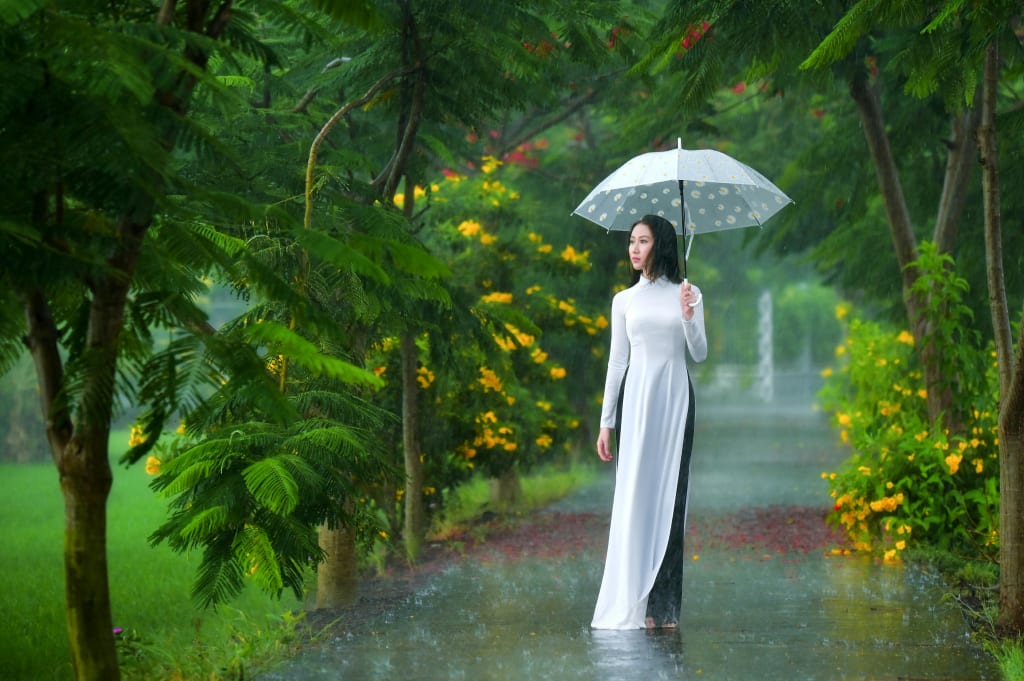
In the mountain village of Santa Esperanza, it rained every Sunday without fail.
Not a storm. Not a drizzle. But a strange, soft rain that smelled of old paper and jasmine.
The villagers believed the rain was sacred. They said it carried the memories of those who once loved too deeply to let go.
At the heart of the village stood a crumbling house with pale blue shutters and a fig tree that grew through the roof. That house belonged to Amara, a girl whose words could change the weather, and whose silence once stopped time.
Amara had been born on a rainy Sunday, under a blood moon, while the village clock rang thirteen times instead of twelve. Her mother, a poet, died minutes after giving birth. Her father, a bookbinder, raised her with the quiet love of a man who stitched broken things for a living.
Amara never spoke until the age of seven — and when she did, it was not with voice but writing. Her words appeared on walls, fogged windows, leaves, and even puddles. She wrote with rain.
The villagers were afraid. They whispered that she was a witch, or a ghost returned to finish a story.
But one boy, Lucio, believed otherwise.
Lucio was the blacksmith’s apprentice, with ash on his hands and stars in his eyes. He didn’t fear Amara. He watched as her fingers danced across raindrops, forming poems no one else could write.
One day, he left a note in her window:
“If your words are rain, then let me drown in them.”
Amara smiled for the first time. From then on, every Sunday rain carried a secret — her words spelling love poems in the sky, and Lucio reading them like prayers.
They became inseparable.
But fate, like rain, does not care for love.
When Amara turned seventeen, her father fell ill. Desperate, she tried to write healing words, inscribing them into riverbanks, tree bark, and thunderclouds. But death cannot be rewritten.
On the night her father died, Amara wrote something no one had ever seen before: a single sentence that appeared across the village’s rooftops.
“If love cannot save, then let it remember.”
The next morning, she was gone.
Some said she vanished into the fog. Others claimed they saw her walk into the rain and dissolve like a name whispered too softly.
Lucio never believed she was dead.
Every Sunday for years, he stood beneath the fig tree in her empty yard, letting the rain fall on him as her words trickled down the shutters.
Messages still came.
“The sky is heavier without you.”
“I remember your voice in the silence between raindrops.”
“Wait for me where the clock forgets to chime.”
Lucio waited.
Years passed. His hair grayed. The villagers stopped asking why he stood there.
Then, on a Sunday unlike any other, the rain didn’t fall.
For the first time in living memory, the sky held its breath.
Lucio looked up.
Instead of water, words drifted down — tiny glowing letters that shimmered like falling stars. They landed on his hands, his shoulders, his heart.
“Come.”
And that was the last anyone saw of Lucio.
Epilogue
Today, if you visit Santa Esperanza on a rainy Sunday, you might see words floating in the mist — love poems without names, drifting along gutters and tree trunks.
Some say Amara and Lucio write together now, from the other side of time.
Some say the rain is their language — a gift for those still waiting, still loving, still believing in the kind of magic that never leaves.
And if you ever stand under the fig tree, and look up during the rain, you might see your own name written there — and know you’ve been loved, even by those long gone.
About the Creator
Moments & Memoirs
I write honest stories about life’s struggles—friendships, mental health, and digital addiction. My goal is to connect, inspire, and spark real conversations. Join me on this journey of growth, healing, and understanding.
Reader insights
Nice work
Very well written. Keep up the good work!
Top insight
Expert insights and opinions
Arguments were carefully researched and presented
Keep reading
More stories from Moments & Memoirs and writers in Fiction and other communities.
The Clockmaker’s Daughter and the Forgotten Hour
In the village of Grimvale, time was sacred. Every second was counted, measured, and guarded as though it were a rare jewel. The townspeople relied on their clocks not merely as tools but as the very rhythm of their existence. From the massive clock tower in the square to the smallest pocket watches clasped by children, every device chimed in perfect harmony, guiding the flow of life with unerring precision.
By Moments & Memoirs9 months ago in Fiction
A "Wolf", a Girl and Her Grandmother
The Observer's eyes had no whites; they were simply two glowing red points in the dark. His face, which a human might describe as unmistakably wolf-like, was covered in luxuriant red fur. An elegant, black-tipped nose — moist with his breath — and a long lipless mouth with a double row of white teeth completed his visage.
By Brian Loo Soon Hua6 days ago in Fiction
Hottest in the Office
Dear Rafi, You’re very distracting to work around. For the first second I saw you the other day, I thought you were some type of executive. It took a moment to realize no, you were just the new guy, dressed up for the job he wants. Be still, my heart.
By Gabriel Shames5 days ago in Pride



Comments
There are no comments for this story
Be the first to respond and start the conversation.