
“The Girl Who Painted Feelings”
Art that reveals hidden truths.

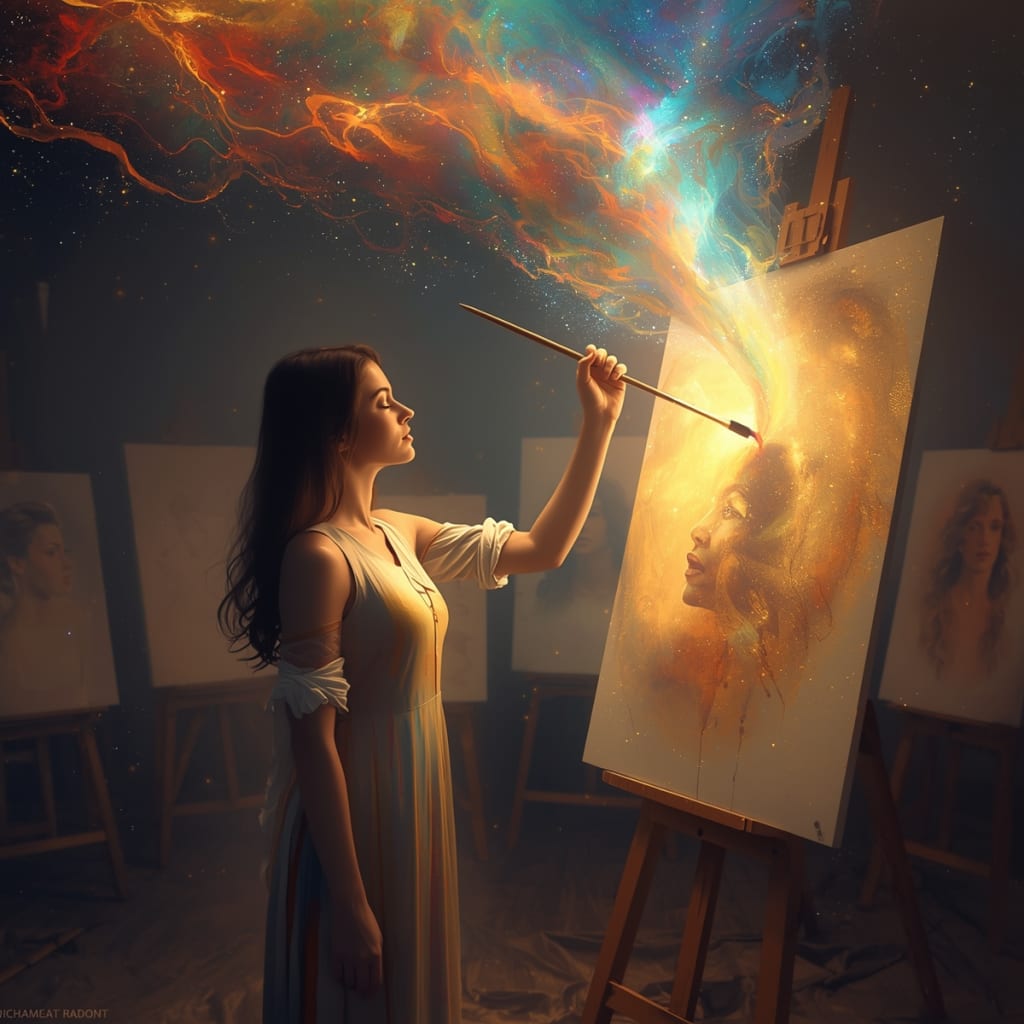
The Girl Who Painted Feelings
By [Ali Rehman]
A story about art that reveals hidden truths
They called her Lila, the girl with colors in her veins. She didn’t paint landscapes or portraits like the others in her art class — she painted emotions. Not the kind you could name easily — not joy, sorrow, or love — but the unnamed shades between them. The trembling feeling before goodbye. The ache of laughter that hides a tear. The silence between two people who used to know each other well.
No one understood how she did it. Not even Lila herself.
When she was little, her mother often found her sitting in front of blank walls, tracing invisible lines in the air. “What are you drawing, sweetheart?” her mother would ask, smiling gently.
“The air is crying today,” Lila would whisper. “I’m painting it better.”
Her mother laughed the first time, then worried the next. But as Lila grew older, her strange gift became undeniable. Her paintings were not just beautiful — they felt alive. People said they could feel something stir inside them when they stood before her work. Sometimes, those feelings were beautiful. Other times, they were terrifying.
When Lila was seventeen, she won her first gallery showcase — The Colors Beneath. It was a small, quiet room filled with canvases that seemed to breathe. Each painting glowed faintly under the soft light, colors pulsing like living things.
A woman stood before one titled Father’s Silence. It was a swirl of dull gray and bruised blue, with faint streaks of gold trying to escape from beneath the layers. After several minutes, the woman began to cry — not a soft, polite cry, but deep, uncontrollable sobs.
Later, she confessed to Lila that she hadn’t spoken to her father in twenty years. That night, she called him.
That was when the whispers began. “Her art sees the truth,” people said. “She paints what your heart hides.”
At first, Lila tried to ignore it. But one night, as she was preparing a new piece, something strange happened.
She had been painting in her attic studio, the only place where she felt free. A storm rolled outside, thunder rumbling like a heartbeat. She dipped her brush into a shade of deep violet — but when she looked down, she realized she hadn’t chosen that color. The brush was moving on its own.
It dragged across the canvas, creating waves of dark red and black. She tried to stop, but her hand refused. When it was over, she stepped back and gasped.
It was a portrait — but not of anyone she knew. The face was half in shadow, half bathed in golden light. The eyes looked haunted, pleading, alive. She could almost hear the pain coming from the painting.
Three days later, she saw the same face on the news. A local teacher — missing for a week — found unconscious but alive in the forest near her town. The exact colors from Lila’s painting matched the bruises and sunlight that surrounded the man when they rescued him.
Lila realized then: her art didn’t just express feelings — it revealed truths.
The more she painted, the more dangerous her gift became. People began coming to her — not for art, but for answers. A grieving widow. A cheating husband. A girl who wanted to know why she couldn’t stop dreaming about drowning.
Lila painted them all. Each time, the canvas revealed what words couldn’t: a hidden betrayal, a memory buried deep, a fear unspoken. But with each truth unveiled, a little piece of Lila dimmed.
She started seeing flashes of emotion even without her brush — colors leaking from people as they spoke. A boy in the café glowed pale blue — guilt. A woman on the bus shimmered with fading pink — heartbreak. Her own reflection was a storm of gray and silver — confusion, exhaustion, loneliness.
One night, she decided to paint herself. Just once. Just to see.
When she began, her hands trembled. She painted with slow, cautious strokes — soft yellows for hope, muted blues for longing. But as the canvas filled, a darker shade crept in on its own. Black, thick, unstoppable. It spread through every color, consuming it until the painting was almost gone.
At the center of it all, one faint light remained: a tiny streak of white, like a crack in the dark.
She understood then — she had been carrying everyone else’s emotions but never her own. Her art had been a mirror for others, but she had forgotten to look inside herself.
That night, for the first time in years, she didn’t paint for anyone. She painted for herself.
No hidden meanings. No messages. Just her — messy, alive, imperfect.
She woke to sunlight spilling across her canvas, illuminating the soft swirl of colors — gentle pinks, forgiving blues, and quiet gold. The painting looked like a sigh of relief.
And when her mother came upstairs, she smiled through tears.
“It’s beautiful,” she whispered. “What do you call it?”
Lila looked at her creation and finally understood.
“Forgiveness,” she said softly. “It’s the only color I never learned to paint until now.”
Moral:
Art reveals truth — but the most powerful truth is the one we accept within ourselves.
About the Creator
Ali Rehman
please read my articles and share.
Thank you
Keep reading
More stories from Ali Rehman and writers in Fiction and other communities.
“Between Two Worlds”
Between Two Worlds By [Ali Rehman] Lena had always lived between two worlds. By day, she was grounded in the familiar rhythms of reality: the hum of the city, the blur of faces rushing past, the sharp click of keyboard keys in her small office. But by night, everything changed. When sleep claimed her, she slipped into a realm where reality twisted and stretched, where dreams painted scenes more vivid than any waking moment.
By Ali Rehman4 months ago in Fiction



Comments
There are no comments for this story
Be the first to respond and start the conversation.