
The Girl Who Outsmarted a British Spy — Rehamat Gul’s Silent Revolt
In the shadows of the mountains, one Pashtun girl did what an army couldn’t — she made the British bleed without ever raising a weapon.
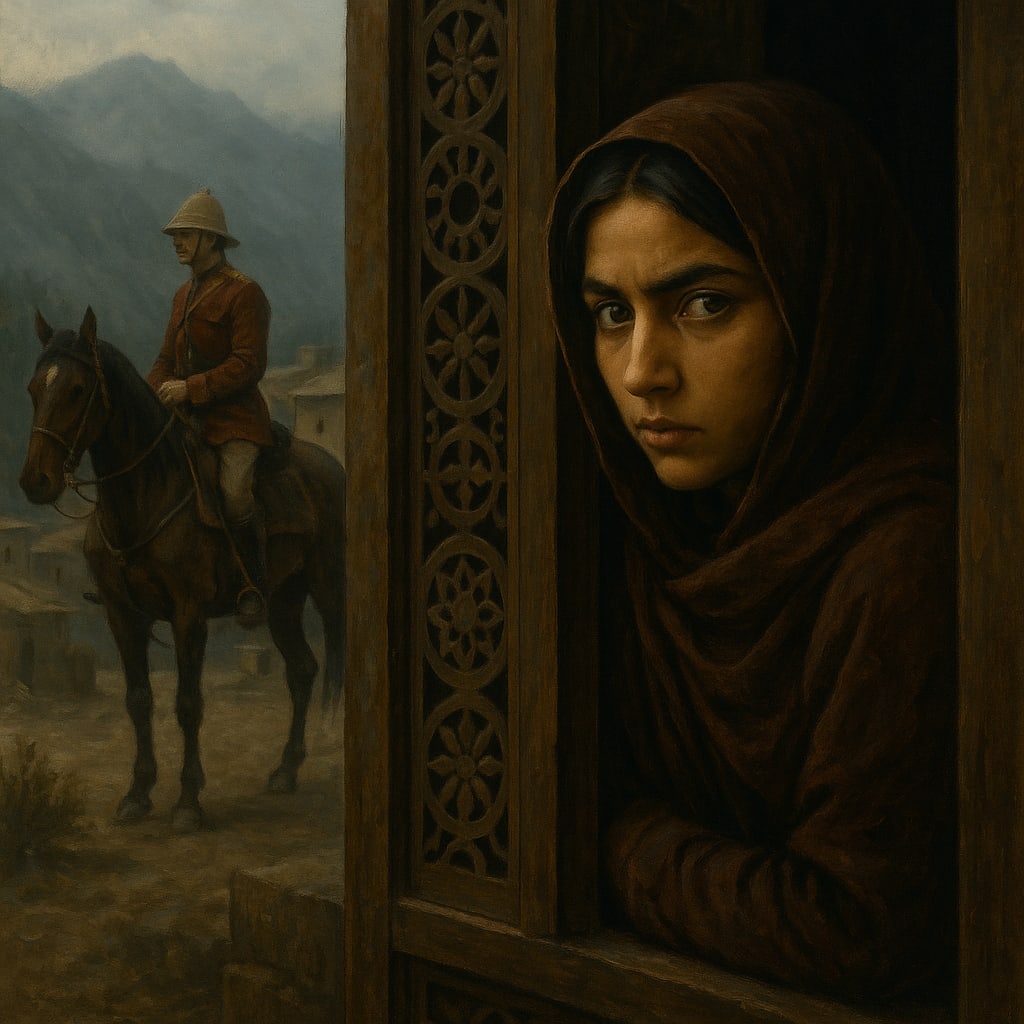
📖 The Girl Who Outsmarted a British Spy — Rehamat Gul’s Silent Revolt
🌄 Where Mountains Keep Secrets
In the highlands of Tirah Valley, near the modern-day border between Pakistan and Afghanistan, stories aren’t told — they’re whispered. The mountains don’t echo. They remember.
And one of those stories belongs to a girl named Rehamat Gul.
She was not a warrior. She carried no flag. No one sang her name in battle.
But she may have changed the outcome of a war.
🧕 The Girl with the Listening Eyes
Rehamat was born into the Afridi tribe, a proud Pashtun clan known for its fierce independence. Her father, a local herbalist, spent his days walking between villages, treating wounds and delivering herbs. Rehamat, the oldest of five daughters, learned early how to listen more than she spoke.
Her mother called her “dil safa” — clean-hearted.
But her father saw something else. He saw a mind like a blade.
She memorized village routes, family disputes, British officer names, and overheard secrets. She listened while pretending to pour tea. She smiled while her brain turned everything into a map.
She was not raised for war.
But war was coming.
🔥 When the Redcoats Came
In the 1890s, during the height of the British Empire’s struggle to control the tribal belt, the British began building roads and forts deep into Pashtun territory. Their goal was to control the Khyber Pass and monitor tribal movements.
One officer in particular — Captain Edward Sinclair — was notorious. Fluent in Pashto, charming, and cunning, he often visited local villages under the guise of diplomacy, but his true work was espionage.
Sinclair posed as a friend to the tribes, collecting information on who was loyal to the British crown, and who was planning rebellion. His plan was working.
Until he met Rehamat Gul.
☕ The Girl Who Watched Too Closely
It began with tea.
Captain Sinclair visited Rehamat’s village to “negotiate” with the elders. He stayed in a guest house near the mosque and demanded only that his tea be served by “someone trustworthy.”
Rehamat, then barely sixteen, volunteered.
She carried his tray each morning, eyes lowered, lips silent. But every day, she noticed something new: a sketch of a nearby fort on his desk, a list of tribal names, a coded letter half-burned in the fire.
She remembered everything.
And at night, she told her father — who told the resistance.
🕊️ A Dangerous Game
Rehamat played a delicate game.
She began asking small questions. “What is that red dot on your map, sahib?” “Why do you burn your letters in the morning?”
Sinclair thought she was innocent. Uneducated. Harmless.
He began to talk — about his plans to arrest a local elder, about his suspicions of an upcoming tribal ambush.
Each time, Rehamat took her knowledge back to the men planning resistance. Raids were postponed. Villagers were evacuated. Weapons were hidden.
Sinclair grew frustrated. His leads dried up. His raids failed. The rebellion grew stronger.
All the while, he smiled at the girl who served his tea.
🐍 The Trap She Set
One day, Rehamat overheard Sinclair planning a secret arrest of Faqir Gul, a respected elder who had been organizing supply routes for the rebels.
If captured, it would devastate the uprising.
Rehamat told her father, who passed the message to the fighters in the hills. But this time, they didn’t just hide.
They waited.
As Sinclair’s unit moved to raid the village at dawn, the rebels struck from behind. The British soldiers were ambushed and forced to retreat, and Sinclair was injured by his own horse during the escape.
He never returned to that valley again.
The British called it "a failed operation."
But the locals knew — it was Rehamat Gul’s silent victory.
🌸 She Disappeared Like Mist
After the ambush, Rehamat quietly returned to her life.
She never spoke of what she’d done. She never asked for thanks. Her village knew, but they honored her silence.
Years later, a British writer chronicled the failure in a dusty war journal, writing:
“We underestimated the women. They watch from behind veils, but they see everything.”
Rehamat lived out her life in the same village. She married a teacher. Raised four children. And every morning, she brewed her tea with a quiet smile.
🕯️ Why Her Story Still Matters
Rehamat Gul didn’t fight with guns.
She fought with awareness, timing, and silence. She reminds us that some revolutions don’t roar — they whisper.
And that sometimes, the fiercest resistance comes from the ones no one expects: a girl behind a tray of tea… with eyes that saw everything.
About the Creator
J khan
I don’t just tell stories—I write the ones that haunt you, heal you, and make you remember who you really are. This isn’t content. This is transformation.
The Devil's Cut
“Comrade, finally you’re awake.” The voice was smooth, sensual. A flickering incandescent bar was all that lit the white, sterile room. All Vladimir remembered was everything going black. He tried to move his arms and found them strapped to the gurney.
By Matthew J. Fromm5 days ago in Fiction
Him
Him. An unsuspecting commuter on an A-train... he sits gazing out the window, immersed in the view, seeing beyond a world of art which whizzes by as the landscape undulates, ebbs and flows. There is a surreal, dreamlike and beautiful view of nature beyond the window, where bamboo stalks grow impossibly tall, reaching towards a sky painted in the swirling, vibrant colors of a Baroque masterpiece. The interior of the train is dimly lit, casting long shadows. The peace it exudes evokes a painterly illustration with dramatic bright and dark lighting filled with rich textures.
By Antoni De'Leon3 days ago in Fiction



Comments
There are no comments for this story
Be the first to respond and start the conversation.