
The Girl at the Window
She watched the world, but no one ever saw her. Until I did
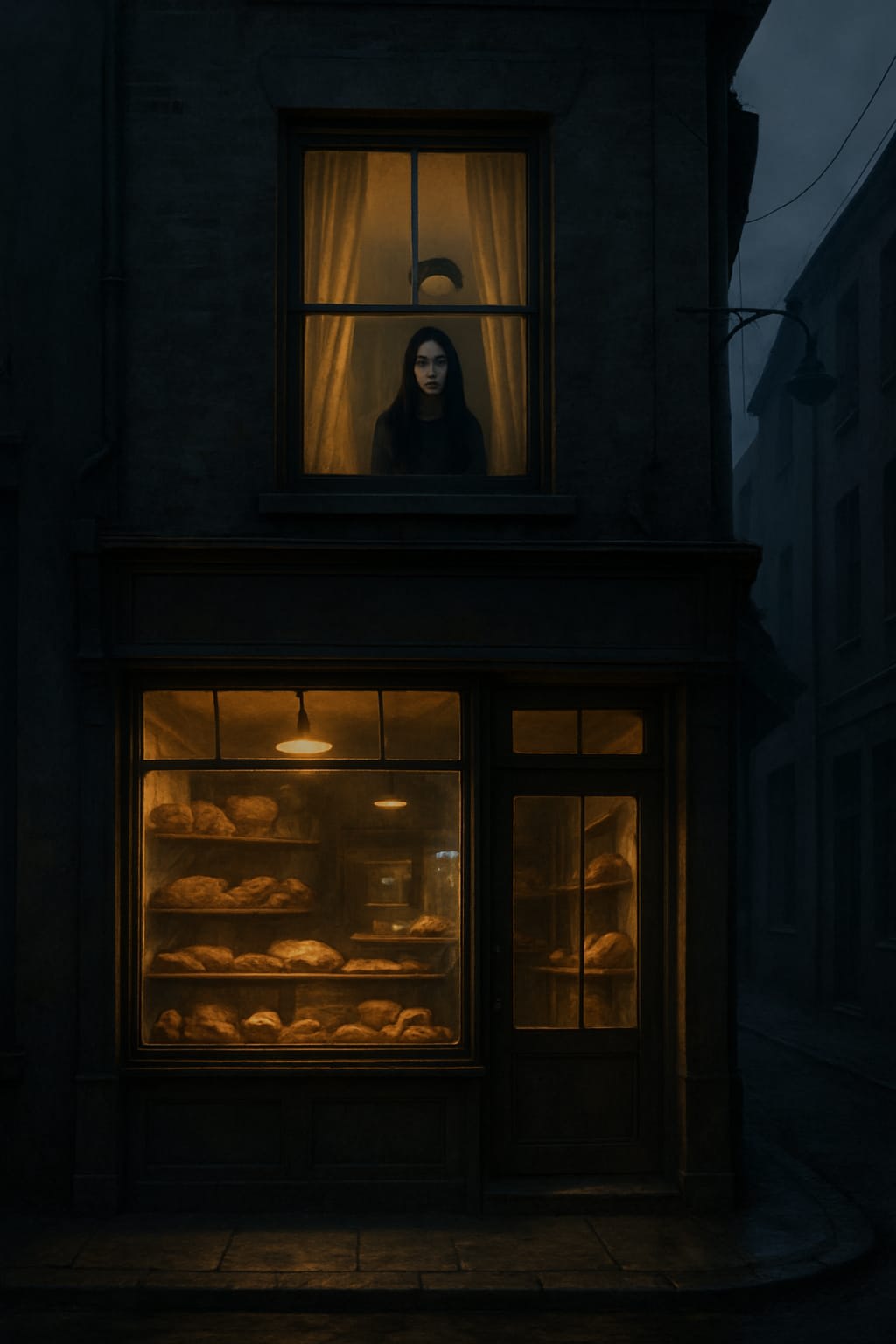
The first time I saw her, she was framed by a dusty second-story window above the old bakery on Maple Street.
I didn’t think much of it then—just a silhouette against soft yellow curtains, a girl maybe fifteen or sixteen, unmoving, watching the world roll by beneath her. Her window was half-cracked, like her presence was meant to be noticed but never questioned.
The second time, I paused. I was walking home from work, and the day had left its weight in my shoulders and shoes. But something about her stillness cut through the noise of a busy Tuesday evening. People rushed past her window without a glance. She never looked away.
That became a routine.
I started walking a longer route home just to see if she’d be there. Some days, the window was empty. Other times, she stood like a question I didn’t know how to ask.
Then came the day she wasn’t alone.
A man—older, heavy, with hair like rusted wire—stood behind her. He wasn’t touching her, but the air around him was wrong. Thick. I stopped across the street and pretended to tie my shoe, but her eyes—dark and wide—met mine for the first time.
I don’t know what I saw in them. Fear, maybe. Maybe resignation.
She didn’t wave. She didn’t smile. But I knew, in a way words couldn’t explain, that she wanted to be seen.
I asked around, casually. No one knew who lived above the bakery. The owner said the upstairs was rented, but the tenant always paid in cash, left no forwarding address, and never complained—ideal, really.
“She’s got a daughter, I think,” the baker said, wiping flour off her hands. “Keeps to herself. I wouldn’t worry about it.”
But I did.
Every day, I checked the window. Some days, the curtains were drawn tight. On others, they fluttered like a quiet SOS.
Then, suddenly, the window stayed empty. A week passed. Then two.
I called the non-emergency police line, reporting a “concern.” They thanked me and took my name. I never heard back.
I went to the bakery, ordered a cinnamon roll I didn’t want, and asked again. The owner looked uncomfortable.
“They moved out last week,” she said. “Left overnight. Landlord said the place was empty by morning.”
My stomach dropped. “Did you see the girl?”
She hesitated. “I don’t think she was ever really there. Only saw the man come and go.”
I left the bakery and stood in the street, staring at the window one last time.
Months passed. Life carried on.
Then one morning, I was riding the 6 AM train when I saw her again.
She was sitting three rows ahead of me, head down, hoodie up, clutching a plastic grocery bag like it held all her tomorrows. My heart skipped.
It was her. A little older, maybe. Thinner. More real.
I almost didn’t say anything. I was afraid—what if I was wrong? What if she didn’t remember me? What if she did?
But I moved up the aisle slowly, sat down beside her. She didn’t look up.
“Hey,” I said softly. “I remember you. From the window.”
She didn’t flinch. Her fingers tightened around the bag.
“I didn’t think anyone saw me,” she whispered after a pause.
“I did,” I said. “You were always there.”
We sat in silence. The train rocked gently beneath us, pulling us both forward into something new.
“I ran,” she said after a while. “One night, when he passed out. I didn’t even take shoes.”
“You don’t have to explain,” I told her.
“But I want to.”
And so she did.
Her name was May. The man was not her father. She had lived behind that window for almost two years, never allowed to leave except for late-night errands. She had no phone, no friends. Her world was four yellow walls and whatever she could see through the glass.
“I thought maybe I imagined you,” she said. “That I made you up so I wouldn’t go crazy.”
“I thought the same thing,” I admitted. “Some days, I wasn’t sure you were real.”
She smiled—small, unsure, but real. “Well,” she said, “here I am.”
I don’t know what happens next.
She got off the train before I did. I gave her my number and told her she didn’t have to be alone anymore.
Maybe she’ll call. Maybe she won’t.
But I know now that sometimes, the people we think we imagined are the ones who needed us most. And sometimes, just being seen can be the beginning of everything
About the Creator
Pandora’s Burden
“My brother warned me to not accept gifts from the one who commissioned you,” said Epimetheus to the woman clad in silvery raiments standing at the entrance to the temple. Her silver tiara and the silver rings on her fingers and toes glinted in the firelight cast by torches set on either side of the doorway. Lingering in the shadows, beyond the reach of the flames as she was, he could not tell what she held in her hands. At first what appeared to be a box was perhaps a funerary urn, or maybe merely an apple.
By J. Otis Haas2 days ago in Fiction
Seeking The Facts Behind a Myth
Each individual alone judges what they have faith in from what life has taught them. Faith arrives when there is an interplay between mind and body, that forms a strong framework laid on strong foundations. Faith that information, from something larger that can transcend to the depth of the heart and enhance a spirit with confidence in a soul that sees past blindly believing in the causes of wars fought in the name of religious idealism or a way of life that imposes restrictions based on race, caste or the gender one is born into, often stems from the dignity of science, church and community. Through the nature of alchemy, astrology and theory, the brain sorts through what is repressed, unknown or ignored then disassociates preconceived ideas to bring honor and respect to the dead.
By Katherine D. Graham2 days ago in Fiction
My First Time Skiing and I Got Lost, Alone, in the French Alps
Looking back, I can trace some of my life’s biggest adventures to a simple action from my sister. She’d introduced me to Tommy (a very long time ago), a colleague of hers, who had overshared his penchant for Italian-looking women, and I ticked that box.
By Chantal Christie Weiss2 days ago in Humans




Comments
There are no comments for this story
Be the first to respond and start the conversation.