

Alissa watched the sunlight recede from the surface of the lake, and the shadows settle in. The insects had begun their chorus and a rustling in the fallen leaves heralded the stirring of the nocturnal creatures. She drew her cardigan in closer, overlapping it across her chest, drawing in against the dampening chill. Her hands receded into her sleeves, and she drew her knees up, hugging them, tucking her bare feet onto the bench.
The tea beside her had long gone cold, it had been brewed in an effort to busy her hands and quieten her mind. Fidgeting had so far only achieved raw cuticles and bitten nails. The yearning for a cigarette was still gnawing and having none with her in isolation was the only reason she hadn’t given into the craving. Alissa had quit smoking years before, but stress, boredom and restlessness brought the urges back.
The night encroached as the light withdrew, ceding the territory for another day. Gradually the stars appeared, her eyes adjusted and a dim fireplace glow was the only indication that the lakeside cottage was inhabited. Sighing, Alissa planted her feet firmly on the covered deck and stood. She tossed the cold tea over the railing onto the grass and entered the dry warmth of the cottage.
Now that it was dark, Alissa allowed herself a glass of wine, a rich deep Shiraz. Usually, she sat staring into the flickering of the fire each evening, dwelling on her circumstances, all of which were her fault. She still wasn’t sure what she felt was regret. Tonight, she relented to turning on the lights and switching the television to the news.
Standing in the middle of the living space, she sighed. She did a lot of that these days. Perhaps it was a recognition of her fate and her body telling her to accept it. Alissa wasn’t a quitter, and she kept her promises. ‘The road to Hell is paved with good intentions,’ who had said that? There was a brief smile on her lips as Alissa realised how well that fit her situation. Sipping the Shiraz, Alissa felt unhinged, agitated. She was unsure of what to do for the evening, how to settle for the night and how to sleep.
In the past six months she had thinned. The toll on her body, mind and soul had been immense. So Alissa retreated, cloistering herself at her parent’s lake cottage, emerging as required for appearances at court and meetings with her lawyers.
Court had been a process – mentions, adjournments and finally the trial. The media was relentless. It was a ‘landmark’ case and interest was high across the country. Reporters crushed around her every day as she entered and left the courthouse. She had been lucky to get bail and not be held in a prison, ferried in and out every day in a metal box that reeked of body odour, urine and despair. The cottage was her refuge, fresh air, space to walk and enjoy her remaining freedom. Each day of the trial was a day closer to a decision from the jury and tomorrow was the last day.
Alissa relived the past two years over and over on those days. Prior to that she had a good life, a marriage and a career. They were in a good place financially and discussing having children. Her work was talking of promotions and more responsibility. Then her father called with the heart wrenching news of a cancer diagnosis. He had been doing well since the early passing of Alissa’s mother, his wife and soul mate five years before. Alissa was their only child and she had grieved alongside her father in the weeks and months following the sudden passing of her mother.
Gradually her father had improved, and he was spending time with friends, fishing, golfing and enjoying life again.
The emotional blow of the news was then overshadowed by a rush of appointments, treatments, chemotherapy, and supporting her father’s battle. It was hard for him. He had been in the military, he was always strong and healthy, fit and lean. He didn’t drink to excess, had never smoked and actually had regular check ups with his doctor.
Eventually, it became apparent that the treatments were not helping. The cancer stubbornly remained, then spread, seeping into his organs and bones, crippling him in pain and breaking Alissa’s heart as she watched her once strong and lively father shrink into himself. His skin yellowed and sagged, he aged well beyond his years, becoming gaunt and hollow cheeked with a sadness in his eyes each time Alissa saw him.
The pain her father was experiencing increased and in a moment of clarity he had gripped her arm and asked for her to end it for him. She was shocked at his request. He begged. That evening they talked until her father was exhausted. He rested, then they talked more on and off throughout the night. He was still at home, able to walk to the bathroom, carers came during the day to help with medication, showers, and meals. By morning they were both exhausted, emotionally wrought, and nothing was left unsaid between them. As the morning dawned, Alissa agreed to help her father end his pain, to pass with dignity at his home.
That day the nurse came and checked him. He was under palliative care, making sure he was ‘comfortable’ as the doctor had put it. He was never really comfortable now, how could anyone be comfortable as a disease raged through their body? The nurse refilled the automated morphine syringe pump that gave small, metered doses through a port into his chest. The pump then sat in a cloth bag and was pinned to his pyjamas, a little pain-relieving passenger walking the final days with her father.
That evening, they sat together again. The room was hot for Alissa, but her father felt the cold, so she tolerated it. She tucked a blanket around her father as he shivered. He had asked for his favourite caramel swirl choc-chip ice cream. They shared the tub, digging with their spoons into the softening dessert, mock fighting over a particularly large deposit of caramel, Alissa letting her father claim the victory.
Alissa wanted to continue the night forever, her heart was breaking. Saying goodbye to her father was not something she had ever wanted to do. Silent tears ran down her cheeks when he gently held her hand and told her it was time. Alissa had asked if he was sure. Her father nodded and laid back, resting against the pillows that propped him up in his favourite armchair.
Alissa had taken the morphine pump and disabled it. She had watched the nurse adjust and refill it enough times. She looked again at her father; vision blurred from her tears. He nodded at her and whispered ‘Please, my love. It hurts so much. I need peace. I want to see your mother.’ He put a hand on hers and motioned for her to depress the plunger on the syringe. She began to push, gently, forcing the morphine into her fathers emaciated body. He breathed a faint thank you and closed his eyes.
Once the plunger was fully depressed, Alissa had lost control of her tears and evolved into full body sobbing. She held her father’s hands and felt his grip loosen as he slipped into unconsciousness. His breathing slowed, then stopped as in the darkness he passed. Alissa thought she could feel the moment his soul left a body that had become unrecognisable. She had sat with him for hours, knowing he wasn’t actually there anymore but unable to let go. As she witnessed another sunrise, Alissa put the pump back together, wiped it down and tucked it back into its little bag and pinned it under her father’s clothing where it rested, empty against his now cold skin.
When she deemed it a reasonable hour, she called the palliative care service and informed them her father had passed. There was a flurry of activity for the rest of the day. The care staff were in and out, equipment removed, and the body taken away. There were innumerable phone calls informing relatives and friends the inevitable had occurred. Funeral arrangements were made.
Somewhere in all of the activity, someone had determined there was a problem with the way her father died, and the Police were contacted. A week after the funeral they knocked at her door. The following questioning, asking for a lawyer, being charged and getting bail could have been the same standard scenes in any crime drama. After she made bail and returned to the house, her husband had asked her to leave. He felt she wasn’t the same person he had married. She wasn’t. Alissa had performed a great act if mercy. Her own freedom now rested upon her lying and saying she was innocent. She had not released her beloved father from his pain. She packed her bags and went to the cottage.
The trial part of all the proceedings had been blessedly brief, relatively speaking, there were no witnesses to what had happened that night and she had not taken the stand. Experts came in and out and the morphine pump was discussed in detail. There were the general character witnesses, her supervisor at the accounting firm she worked at, friends, and her father’s sister. Tomorrow was the last day, and the lawyers on each side had ‘closing arguments.’ This was apparently where each lawyer got to grandstand on their important trial points and win the jury over to their side. Then the jury got to deliberate over the matter and decide her fate.
It came down to whether the jury believed it was an accident where the morphine pump had malfunctioned, or a deliberate act. Then her lawyer had muddied the waters further with suggestions of others that could have been responsible had it been deliberate. Even if they believed she had done it (since she had) Alissa hoped that the jury saw it as a mercy, an act of love. Perhaps they would have done the sane in her position and thought she should not be punished. The media was keen to see the result of the ‘mercy murder’ trial.
Alissa’s lawyer had been reassuring. That the case of the prosecution was circumstantial at best. Given the amount of money she had spent on the lawyer, she hoped he was correct. Her savings were quickly disappearing in legal fees and living expenses since work was currently out of the question.
A heavy thud shocked Alissa from her deepening thoughts. A greasy mark on the window showed the point of impact from whatever had disturbed her unpleasant reverie. There was little concern or caution on her part, at this point an axe-murderer would be a welcome distraction from her troubles. She placed the half-full wine glass on the table, flicked on the outside deck lights and ventured out into the cold night air.
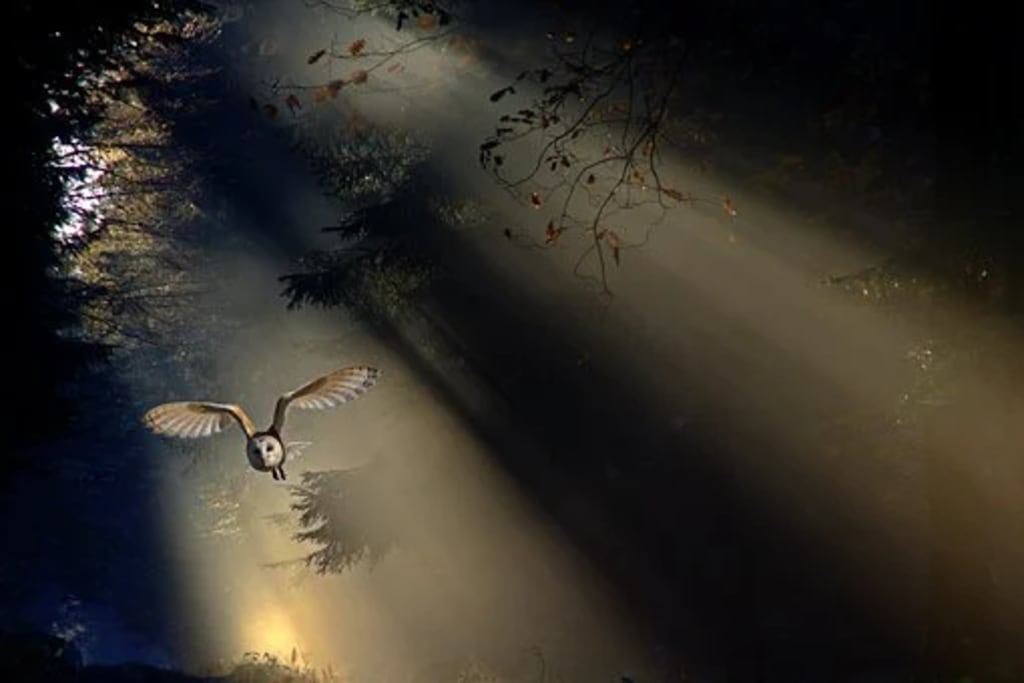
A barn owl sat on the deck, clearly stunned from its unexpected collision with the window. It shifted nervously at Alissa’s approach, but lacked the confidence to fly away. Its large eyes fixed on her and Alissa sat, sinking slowly onto the timber decking, crossing her legs beneath her and watching the owl in silence. She had never seen one this close before. They could often be heard calling, in the woods around the lake, and a silent shadow would glide between trees. On occasion she had captured one for a fleeting moment in her car headlights before it took off, prey clasped in its talons, or it turned on the wing back into the darkness.
Alissa had a sudden longing to reach out and stroke the smooth feathers of the large bird. The fear of being bitten meant she kept her hands to herself. No-one was going to believe she had sat this close to an owl. She wished for her phone to take a picture but didn’t want to move and break the spell the bird had cast. Unaware of its power over her the graceful creature spread one wing, testing itself. The long flight feathers spread out and the decking lights highlighted the markings on each one. Clearly defined lines of brown and white, perfectly aligned, and stunning.
Some would have called the colours of the owl drab, in its muted tones of brown and white, but Alissa was transfixed, marvelling at the natural perfection of each feather. The owl drew the wing back in and shook itself. Alissa was disappointed the sight of the spread flight feathers had been taken away. The owl stretched its other wing as briefly as the first, and Alissa was again awed by nature’s gifts.
The owl blinked its large, wise eyes and turned its head to the darkness beyond the reach of the deck lights in a forlorn longing of its true place. It wished to be in the dark, gliding on silent wings in search of prey, preferably a mouse. The motion that had drawn it to the window was unexpected, and the light that now pooled around it was uncomfortable and too revealing. The owl called out, and Alissa was not prepared for the noise. She was so entranced in watching the bird, the insect noise had faded into the background and all her senses were sharply focused on the creature on the deck in front of her.
The large barn owl shifted again, back and forth on its feet, a bobbing hop, then it shook, and in a flap of wings that Alissa couldn’t hear, it was gone. She felt the sweep of air from it passing and then nothing. Her heart dropped, for those few minutes, Alissa had been focused on something other than her trial and the possibility of her freedom being taken away.
In that she envied the owl, able to spread its wings and fly above the trees, guided by it’s simple desires for food and mating. So uncomplicated. Alissa continued to stare into the void of inky black the bird had disappeared into. She listened, hoping it would call again, acknowledging her and the time they had shared in the cold, both sitting on the deck in artificial light watching each other. She sat frozen, gazing into dark nothingness, in her tiny island of light, waiting. With no idea as to how much time passed for her sitting there, staring into nigh time’s abyss, Alissa stood only when she started to cramp in her legs from the cold.
No owl call came. The noise of the insects increased now she was aware of them, and a dog was barking in the distance, the sound carrying over the water of the lake. Alissa turned, looking into her cottage sanctuary, the warmth of the fire that needed stoking and more wood added. The television flickered with a reality show as the news had long passed. Her wine sat partially drunk on the table.
She looked down at her bare feet, her toes numbing as the temperature dropped further. On the deck, in the place the owl once stood was a feather. A long perfect flight feather, shed in the minutes it stood there, or when it shook. No blood darkened the tip to suggest it was the result of trauma from the window crash. The downy barbs towards the base shifted fluidly. To Alissa the air was still, but the slightest breath moved those, the softest and lightest barbs.
Alissa took this gift, and ran her fingertips along the vane, admiring the smoothness of it. Shivering now, she went back into the closeted warmth of her sanctuary, taking the feather with her. Inside, she sat the feather gently on the table, trading it for her glass of wine. Raising a silent toast to the owl, she sipped.
For the first time since her father’s diagnosis Alissa felt at ease, calm. Sinking into the sofa, she pulled a blanket over her legs, turned off the reality television trash and accepted that no matter her fate in the coming days she would be alright. A part of her had shifted in the cold night air on the deck, staring into the big eyes or that barn owl. She had found a peacefulness there. Her father told her everything would be fine, and she trusted him, even after he was gone.
About the Creator
Amber Yozelle Barber
A country girl, living on the stunning NSW coast. Working to live in a job I adore, my passion for writing, photography and nature finds me outside watching for the creatures visiting my back yard. Otherwise is couch and doggo time.
Keep reading
More stories from Amber Yozelle Barber and writers in Fiction and other communities.
Amil After the Wars
There weren’t always dragons in the Valley. They had existed, deep within the mountains, crouching in caves and venturing out to steal wandering sheep at night. The fishermen of the coastal hamlets reported seeing them fishing on nights when the moon was almost full, and the fish could be seen in the cold azure waters of the Blacksmiths Sea.
By Amber Yozelle Barber4 years ago in Fiction
The Sucker Punch
While the weather grew miserable and the city turned sullen, a lone lightpost oscillated under the weight of the incessant rain. Kine stood in the downpour, her polycarbonate skin slick and cold, watching as his shadow inched closer with a hollow step.
By Caitlin Charlton3 days ago in Fiction


Comments
There are no comments for this story
Be the first to respond and start the conversation.