
The Garden of Words
A Masterpiece of Japanese Animation by Makoto Shinkai
A decade ago, Netflix’s Anime division introduced one of the most captivating and exceptional Japanese productions of recent years: *The Garden of Words*. Although only 48 minutes long, this remarkable film touches on profound themes and offers deep reflections on human emotion and connection.
*The Garden of Words* is directed by Makoto Shinkai, a renowned and rising figure in Japanese animation, whose work debuted in 2013. Despite entering a realm of anime that had already been extensively explored, this film successfully immerses the viewer in a world that feels strikingly real. It invites the audience to perceive life differently, where even a rainy day can be seen not as gloomy, but as a moment of solace, offering a breath of fresh air amidst the depths of sorrow.
Shinkai, born in 1973, is a young director with a relatively modest body of work, yet he has garnered widespread acclaim. Some critics have even heralded him as a potential successor to the legendary Hayao Miyazaki. Japanese animation, known for its ability to inspire dreams, often allows audiences to interpret its stories in highly personal ways, and *The Garden of Words* is no exception. Shinkai weaves a tale that resonates deeply with viewers, revolving around themes of love and alienation, without succumbing to clichéd sentimentality.
Beyond the love story, or emotive evasion, between the two protagonists is relatively important, the dominant theme that emerges is one about loneliness and alienation from reality. A reality which troubles particularly with younger generations who often retreat into their own personal worlds. However, Shinkai’s narrative also touches on universal feelings of isolation which affect adults as well, as embodied by Yukino, the female protagonist.
The narrative also includes sub-themes which are deep to the author, such as Takao's dreams and desires for fulfilment, and Yukino's desperate quest for self-identity.
The story revolves around two characters, seemingly different yet united by their shared sense of solitude. Takao, a 15-year-old student, harbors dreams of becoming a shoemaker. He is introverted and withdrawn, often skipping school on rainy days to draw in the Shinjuku Gyoen National Garden. Yukari Yukino, a 27-year-old woman, she is enigmatic, struggling with her own existential crisis. She appears burdened by stress and indulges in peculiar habits, like drinking beer and eating chocolate for breakfast, a subtle hint at her inner turmoil. According to her, she is still hesitant to walk alone in society and strives tirelessly to find inner peace.
Though they appear to be opposites—Yukari, an adult woman still grappling with her place in the world, and Takao, a confident and determined adolescent—their connection deepens as they discover their shared loneliness. Takao’s passion for shoemaking intrigues Yukino, and through their encounters in the garden, he opens up to her, revealing his aspirations. Moved by his earnestness, Yukino gifts him a valuable book on shoemaking, further strengthening their bond. However, upon discovering the girl's malaise, Takao vowed to make her shoes comfortable enough to wear in public without fear of falling.
As they shelter together under the gazebo during the rainy days, a tender relationship blossoms, built on mutual understanding and affection. Despite their age difference, their connection never feels inappropriate; instead, it is depicted with a sensitivity that avoids trivialization. The film delicately explores their emotional journey without veering into overt sentimentality.
Indeed, a romantic relationship between a fifteen-years-old and a twenty-seven-years-old may appear uncomfortable for many; it is marked by an evident immaturity, and it may be socially condemned due to the perceived age gap. Nonetheless, there are remains of aspects which undeniably aligns with occurrences found in everyday life. Said this, the narrative continues without becoming too trivial or too heavy.
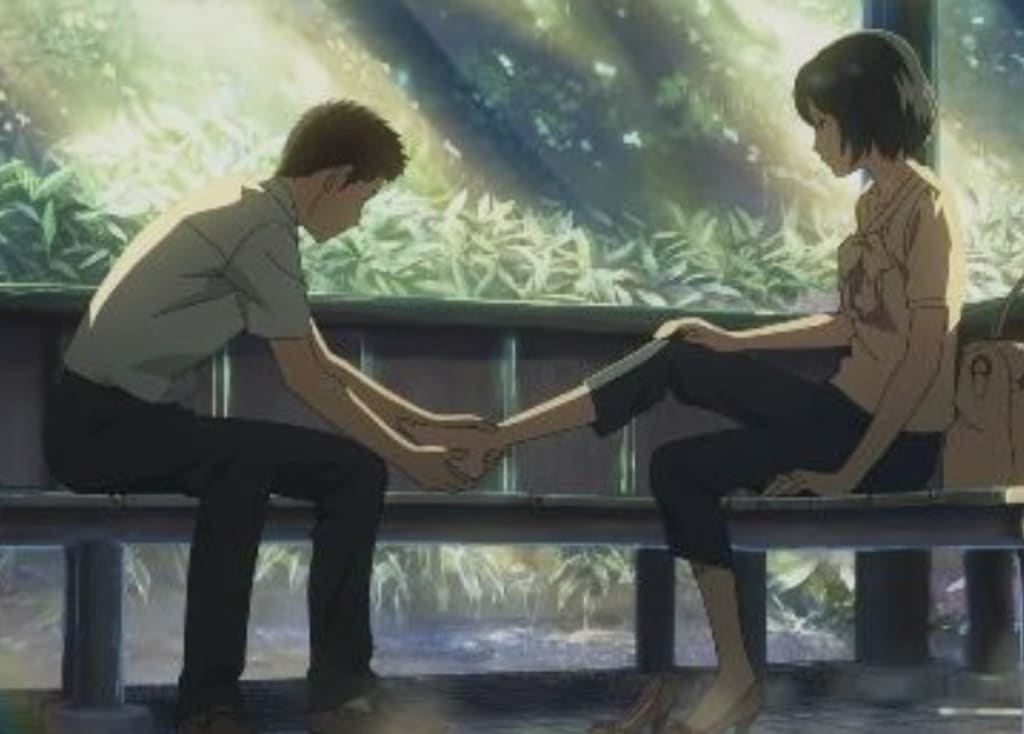
The setting of *The Garden of Words* is quintessentially Japanese, with the lush greenery of the garden meticulously rendered in stunning detail. The gentle rain falling on ponds, the sun filtering through the trees, and the reflections of leaves in water create an atmosphere of serene beauty. Every detail, from the oriental-style gazebo to the traditional homes of the characters, is captured with such precision that the audience is transported into the scene, as though walking alongside the protagonists.
The accuracy of the details is so impressive that the spectator is posed in front of the vibrant green of the vegetation take over, and the fragments mirrored in puddles or rain- stirred water offer a bucolic microcosm.
The film's visual fidelity extends beyond the garden, with several scenes set in real-life Tokyo neighborhoods, places likely significant to the director himself. The dialogues are sparse, yet each word is carefully chosen to convey deep meaning. One particularly memorable exchange is when Yukino recites a tanka poem:
*The sound of thunder,
In the distance as the sky
Darkens overhead.
If it rains, will you stay here
With me, until the rain stops?*
The scene where Takao takes the measurements of Yukino’s feet to make her shoes is imbued with a sweet melancholy, emblematic of Japanese culture’s subtle emotional expression. The film’s artistry is so exquisite that it becomes difficult to remember that the characters are animated, not real.
The gentle piano score that accompanies much of the film enhances its emotional resonance, with Motohiro Hata's *Rain*, the closing song, leaving a lasting impression. The music perfectly complements the film’s meditative tone, making the ending a poignant and emotional experience for even the most stoic viewers. The song's lyrics highlight the rain's therapeutic impact, reinforcing the film’s theme of rain as a symbol of healing.
It is highly recommended to watch the film in its original Japanese, as the nuances of the language and voice acting cannot be fully captured in a dubbed version.
At its core, the moral of *The Garden of Words* suggests that achieving one’s dreams requires perseverance and resilience. Much like crafting shoes that become stronger with time and experience, life demands that we continuously push forward, overcoming new challenges along the way. The film encourages viewers to look at the world with fresh perspectives, a message that may be difficult to convey to everyone but remains universally relevant.
The garden in the film is a place of melancholy but also of happiness—a sanctuary where two lonely individuals find solace in each other’s company. It becomes a place of unspoken words, shared moments, and ultimately, poetry. While the ending may seem unresolved, Shinkai leaves us with the idea that meaning in life often lies in how we choose to view the world, even if it cannot always be easily explained or understood by others.
Whether or not Shinkai decides to continue this story in the future, *The Garden of Words* stands as a beautifully crafted film, filled with quiet reflection and deep emotional insight.
About the Creator
Reader insights
Outstanding
Excellent work. Looking forward to reading more!
Top insights
Compelling and original writing
Creative use of language & vocab
Easy to read and follow
Well-structured & engaging content
Excellent storytelling
Original narrative & well developed characters
Heartfelt and relatable
The story invoked strong personal emotions
Keep reading
More stories from Simone Nunziata and writers in Fiction and other communities.
Do social media platforms offer a new way of connecting, or are they just narcissistic?
Social media platforms are unquestionably a modern track to connect and communicate with others in real time with a wide audience. Nonetheless, exactly like other tools, how they are used diverges from person to person. When individuals use platforms to promote themselves, trying to seek approval, or interacting with others sharing interests, it can lead to ambiguous or narcissistic behavior.
By Simone Nunziata2 years ago in Critique
Becca
"Everything is so... flat." Denille said stupidly as she looked around her new neighborhood. She looked around at the muted desert where even the smallest sign of life seemed to have given up. The plant life was shrubs that were half cooked by the heat and where there should have been a lawn, a mess of white rocks laid glistening in the sun. Even the sky looked stretched thin, like the sun had ironed it smooth. She’d moved from Riverside, where at least there were hills, but here in Barstow, everything felt baked and brittle.
By Sara Wilson8 days ago in Fiction
Whispers of the Veil
The rain hadn't stopped for days. It drummed against the windowpane like it was trying to break in. Elena sat in the last corner of her apartment that still had warmth, knees drawn to her chest, her phone screen black and cold beside her.
By Banas Authorabout 2 hours ago in Fiction



Comments
There are no comments for this story
Be the first to respond and start the conversation.