
The Forgotten Shed
The Weight of What Was Left Behind


The wind blew through the trees and battered against my face as I stood before the shed. The house was cleared of everything important; this was the last room. One that had been forgotten, or perhaps ignored, by everyone.
We all knew the wave of feelings that would come flooding at us the moment we opened that door. Taking a deep breath, I knew I had to open it. I reasoned with myself that there was not long left: the house had been sold, and soon new people would be making their own memories there.
Leaving it for the new owners felt like a betrayal. Not just to them, but to him.
Didn't I owe it to him, and to myself, to face that door? To sort the final memories I had of him before they faded entirely?
I reached for the handle several times, my hand hovering, before I finally summoned the courage to open the door. It swung easily on its hinges, creaking slightly, but opening all the same to lead me in.
All I had to do was put one foot in front of the other and enter. Nothing would happen to me. I just needed to move. I stepped over the threshold slowly, the scent of old oil, dried timber, and faintly sweet pipe tobacco hitting me.
This room had once been so familiar; now it felt like an alien spaceship.
Everything that had made it what it was had gone, along with the vibrant man who used to inhabit it.
Looking around, I tried to work out where to start. Reaching into my pocket, I felt the black sacks there to throw away a lifetime; it didn’t seem fair.
“Just start,” I said out loud. My voice echoed around the cold space, mocking me.
Kneeling in the dust, I pulled out the first drawer and took a deep breath.
After two hours, things were going better than expected. Four full black bags lay around me. I sat on the floor, fine dust covering my hands and clothes.
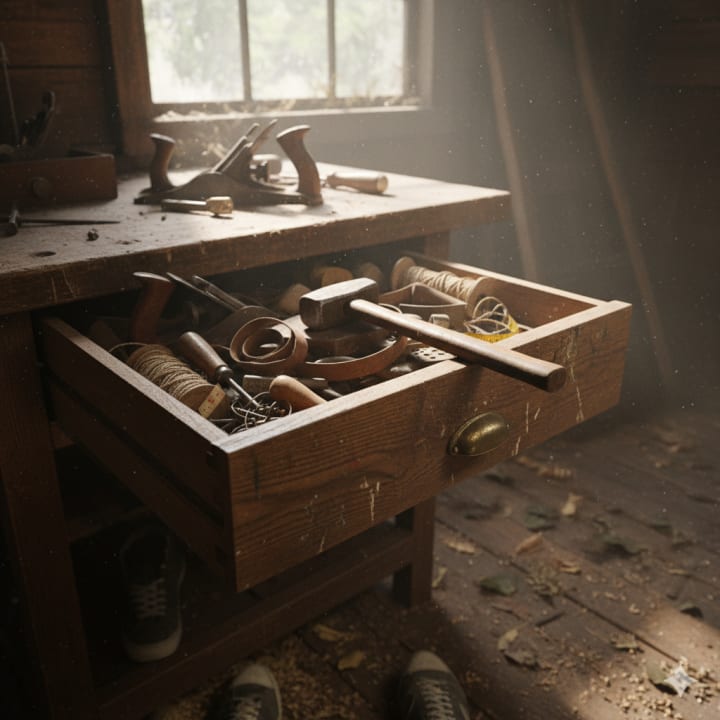
One more drawer to go. I pulled it; the oak drawer seemed hesitant before giving up its treasures.
The carpentry tools. Well, compared to some of the other stuff, this would be easy.
I was proud I had managed a full two hours without crying. His gardening gloves had undone me first, soft leather stained with soil and memories, but I stuffed the sob back down and carried on filling my black bags.
Most of the stuff was gone when I reached down and my hand closed around the hammer. Pulling it slowly, I turned it over in my hands, looking at it. It was built in an age where everything lasted, solid and true.
If this hammer could talk, what a tale it would tell. I hear his voice as I look down at its solid wooden handle and metal head. I caught my reflection in the shiny metal and saw the woman I have become.
The handle was smooth, rubbed down by the hand that had gripped it firmly. Dirt clung stubbornly around the edges. But the central part, where his hand always held it, was still shiny and sleek, the grit rubbed away by the years of heavy work.
He had used this hammer to pass his apprenticeship. It remained by his side through the decade of struggling to become a carpenter.
When we renovated the first house, it worked harder than him. He put up shelves, built new kitchens, and repaired furniture with it.
The same hammer put toys together. Then, in later life, he used it to build furniture for us as we grew. Later he could be found, hammer in hand, knocking the dents out of our cars.
Years went by, and this loyal servant stayed by his side. Through new businesses and houses, it was his constant companion.
Then it started to accompany him on his weekly trips to another house. Again, it supported him through renovating a new home.
We had worked together with his trusted companion, building kitchens, knocking walls down, and building furniture. It supported us both in turning a shack into a home.
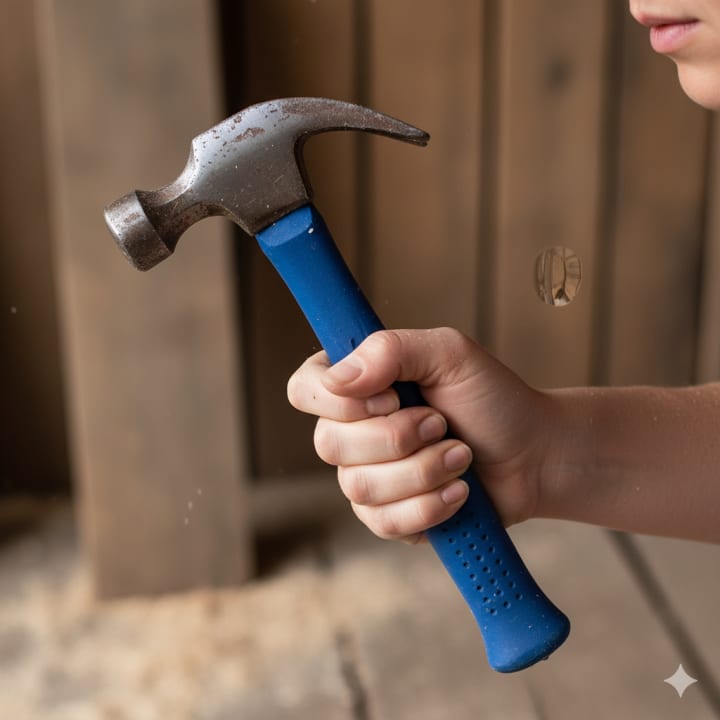
The weight of the hammer in my palm was immediately familiar, a grounding presence that starkly contrasted with the feeling of floating I’d carried since he left.
It wasn’t just a tool; it was the tangible result of his focus, patience, and dedication to creating. Every nick in the metal head, every dark grain in the wood of the handle, was a silent timestamp of a project completed, a problem solved, and a memory forged. Holding it now, I could almost feel the phantom pressure of his thumb resting near the claw, a habit I'd watched a thousand times as he paused to measure or contemplate his next strike. I realised I wasn't clearing junk; I was dismantling a history written not in words, but in sawdust and sweat, each piece a witness to his unwavering character.
There was a profound, almost terrifying finality to boxing up these instruments, these extensions of his own skilled hands. The true grief, I knew, wasn't about the absence of the man, but the absence of his future work, the unbuilt birdhouses, the unhung shelves, the final projects that would now never materialise. It struck me that this hammer was the last physical object he had actively wielded, the very last thing his strength had controlled. The thought was a sudden, sharp intake of breath, a recognition that the narrative of his life, which had always felt so robust, was truly finished.

“Why, why did you take this amazing, strong man from me?” I yelled, the question lost in the dusty air.
Why had he been the statistic that didn’t survive? All those things I thought I had time to say but hadn’t. I should have told him how much I loved him. How much I measured my life by making him happy.
The pain was too much, radiating from my heart like a burning hole. Tears streaming down my face, I left the shed with my friend in hand. I felt safe, knowing that with this hammer he would always be beside me. I would have to build furniture alone now. It is my turn to make toys from Santa with it. In time to come, it will be mine to hand down to the next generation.
Taking one last look back at the empty, dust-filled shed, I muttered the words I had wanted to say all day as tears spilt down my cheeks: “Happy Father’s Day, Dad.”
About the Creator
Sam H Arnold
Fiction and parenting writer exploring the dynamics of family life, supporting children with additional needs. I also delve into the darker narratives that shape our world, specialising in history and crime.
Keep reading
More stories from Sam H Arnold and writers in Fiction and other communities.
The Keyhole Marriage
I was that kid who used to sneak glimpses of her friends and family through the keyhole, to see what they were up to. I would put my eye against the hole and catch a glimpse of their world, like a tiny television that never revealed the complete story.
By Sam H Arnold3 months ago in Fiction
The steps to losing a child
Step One: Lose a child. Not what anyone wants to happen and nothing you can do to change it, but you can go through steps to becoming happy again. You can go through steps to loving again. You can go through steps to become a new you because after losing a child you will never be the same person you once were.
By Tabitha Hinkley2 days ago in Fiction
The Day Everyone Stopped Looking at the Sky
On the morning the sky changed, no one noticed. Cars moved through traffic like obedient insects. Coffee cups steamed in bored hands. Notifications buzzed, chimed, and blinked like impatient fireflies demanding attention. Heads were bowed—not in prayer, not in reflection, but in devotion to glowing screens.
By Yasir khan2 days ago in Fiction


Comments
There are no comments for this story
Be the first to respond and start the conversation.