

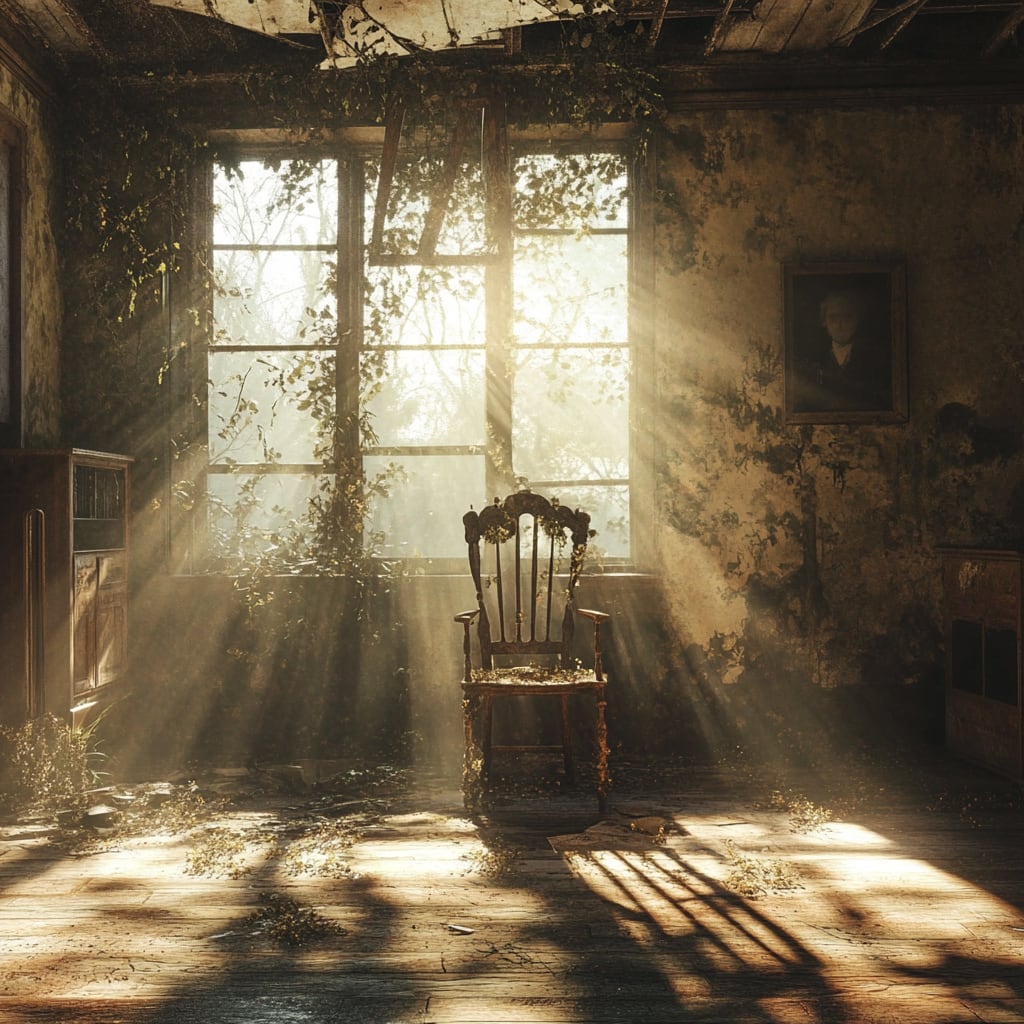
For as long as Mara could remember, the room at the end of the hall had been off-limits.
Her mother never locked it, but she might as well have chained the door in iron. It was a rule spoken only once—“We don’t go in there”—and never discussed again. Children have a way of accepting the mysterious borders adults draw around certain places; Mara grew up treating the door like part of the architecture, something solid and quiet and unimportant. A blank piece of the house.
Years passed. Her mother died. The house fell silent.
And the door stayed closed.
After the funeral, Mara left the house untouched for six months. She returned only when the property began demanding adult things—taxes, inspections, decisions. She wandered from room to room in a daze, the walls still carrying the shape of her mother’s absence. She made lists, scheduled repairs, opened windows for the first time in years.
Eventually, inevitably, she found herself standing at the end of the hallway.
The door looked the same as it always had: pale, unadorned, a tiny notch in the paint where someone had once bumped it with a laundry basket. Nothing threatening. Nothing significant. Yet she felt the familiar childhood discomfort rise in her chest.
We don’t go in there.
But she was forty years old now, and the house was hers. The past had no authority over her anymore.
She pressed her hand to the door.
It was cold.
When the hinges creaked open, a wave of dry, stale air drifted out, carrying the faint smell of old books, pressed flowers, and something harder to identify—something metallic, like a memory rusting.
The room was small. A square of dust-coated sunlight slanted through a single window. The floor was strewn with stacks of boxes, all labeled in her mother’s looping handwriting: WINTER, LETTERS, DOLLS, FATHER.
Her heart hitched at the last one.
Her father had vanished when she was six. There had been no funeral, no explanation. Only the sudden absence of him—his mug left on the counter, his coat still hanging by the door. Her mother had locked herself in the bedroom for nearly a week. When she came out, she had said only one thing about it:
We don’t go in that room.
But Mara had never connected the two memories until now.
She stepped inside, the dust swirling around her ankles like disturbed ghosts. The room swallowed her without protest, as though it had been waiting.
The air was heavier here. Or maybe it was the silence. The rest of the house creaked and hummed with old plumbing and shifting wood, but this room… this room held its breath.
Mara knelt by the box labeled FATHER. Her hands hesitated over the lid. She could turn back. She could close the door forever. She could pretend this room contained nothing but old junk.
But her mother was gone, and the past had grown restless.
She opened the box.
Inside was a neatly folded flannel shirt. A watch. A cracked leather wallet. A stack of notebooks tied with twine. And, at the very bottom, a photograph.
She lifted it carefully. Her father stood smiling at the edge of a forest, one arm raised as if waving to someone behind the camera—behind her. She recognized the trees. They were from Blue Hollow State Park, the place their family visited every summer before everything went strange.
The date on the back was written in her mother’s handwriting: June 14, 1989. But her father disappeared in 1987.
Mara blinked.
Her mind scrambled through memories, trying to make sense of the impossible. Was the photo mis-dated? Was it someone who looked like him? But no—there was the little scar across his left eyebrow, the one he always said came from rescuing a turtle. There was the watch he wore every day. The same watch that now sat inside the box.
She picked up one of the notebooks. Her father’s handwriting filled the first page, frantic and slanted:
If you’re reading this, the room is open.
That means she’s gone.
And that means it’s your turn.
Mara froze.
Her breath came shallow and fast as she flipped through the pages. The words inside were a map of paranoia, a tangle of love and fear and warning. Every few pages, phrases appeared in all capital letters:
DON’T TRUST THE DOOR.
TIME BEHAVES DIFFERENTLY THERE.
IT LET ME OUT ONCE. IT MAY LET ME OUT AGAIN.
A chill crawled up Mara’s spine.
She turned toward the door—her only exit—and noticed something she hadn’t before. The hallway light outside flickered, and the edges of the frame shimmered faintly, like air above a flame.
That wasn’t normal.
She rose slowly, clutching the notebooks. The room felt smaller now, the walls tilting minutely inward. She took one step toward the doorway.
The air resisted her.
Not metaphorically. The air pushed back, like a soft unseen palm against her chest.
She stumbled, startled, and the notebooks slipped from her hands, fanning across the floor. The pages fluttered open, and the words stared up at her like eyes:
DON’T LET IT CLOSE WHILE YOU’RE INSIDE.
The door behind her groaned.
A thin, sick sound.
Mara lunged for it, slamming her palm against the wood before it could swing shut. Panic surged through her—animal, instinctive, hot. She shoved it open and spilled into the hallway, heart pounding.
The air felt normal out here.
The house creaked in its familiar old-bones way. Light fell like it always did. The hallway smelled like dust and varnish and nothing else.
Mara stood still for a long moment, chest heaving, eyes fixed on the open doorway.
The room looked ordinary again.
The shimmer was gone.
She stepped back inside cautiously, ready to flee at the slightest sign of anything strange. But the air no longer resisted her. The walls felt still. The dust settled quietly.
Only one thing had changed.
On top of the boxes—neatly placed, as though arranged by careful hands—was a second photograph.
Mara hadn’t seen it before.
Her throat tightened as she picked it up.
It was her mother. Standing in the doorway of the very same room. But she looked younger than Mara had ever seen her—twenty, maybe. Her expression was wary, tense, almost afraid. Her hand was on the doorknob.
The back of the photograph read:
October 4, 1962.
My turn.
Mara’s knees gave out.
She sank onto the floor, the picture trembling between her fingers. A pattern began forming in her mind—her mother before her, her father after, and now… now her.
The room wasn’t a place they avoided.
It was something they endured.
Something passed down like a dark inheritance.
She felt a pressure at her back again, barely perceptible, like a breath on the skin. She turned sharply, expecting the door to be swinging shut—but it was still open.
Instead, the pressure seemed to come from deeper inside the room, near the far corner where a trunk sat beneath a sheet.
Mara’s pulse hammered as she approached it.
She lifted the sheet.
The trunk was carved with strange patterns—not symbols, exactly, but shapes that made her eyes water if she looked at them too long. The metal latch was rust-flecked but intact. Her fingers hovered over it.
Don’t open it, she thought.
So she did.
Inside were more photographs—dozens, hundreds—each depicting different people standing in the doorway of this room. Some wore clothing from decades past. Some from centuries, if she guessed right. Men, women, children, all with the same strained expression, all captured in the same moment: entering.
On the very top was a photograph of Mara herself.
It was dated tomorrow.
She felt the world tilt.
Her breath stuttered.
The silence in the room pressed against her like a heavy fog.
Something moved.
No sound, no shape—just the unmistakable sense of something shifting, waking, stretching after a long sleep.
Mara bolted for the hallway.
She crossed the threshold just as the door slammed shut behind her with a force that rattled the walls. The sound boomed through the house like a gunshot.
Then everything went still.
Her hands shook violently. She clutched the photograph of herself and backed away, step by step, until she reached the living room. Only then did she realize she was crying.
She didn’t go back to the room that night. Or the next. The door remained closed, silent, perfect in its stillness.
But sometimes—when the house settled in the evening, or when she walked past the hallway on her way to bed—she felt a faint pull, like gravity bending in the wrong direction. A tug on her thoughts. A whisper at the edge of hearing.
The photograph of her dated tomorrow sat on the kitchen counter.
She checked the timestamp constantly.
When tomorrow came, nothing happened. The sky stayed blue. The house remained quiet. The door didn’t open on its own.
But the pull grew stronger.
She resisted for three days.
On the fourth, just as the sun began to set, she found herself standing at the end of the hallway again, photograph in hand.
The door was slightly ajar.
Not wide enough to see inside.
Just wide enough to invite.
Her pulse thrummed in her throat. She wanted to turn away. She wanted to burn the house down. She wanted to scream.
But she also wanted answers.
She pushed the door open.
The room breathed.
A deep, slow inhale.
As if recognizing her.
As if relieved.
The air shimmered faintly, the sunlight twisting into odd angles. Something pulsed inside the trunk. The dust hung in perfect suspension, unmoving, like stars frozen in the fabric of space.
Mara stepped across the threshold.
The door swung shut behind her.
And this time, she didn’t reach for the knob.
She let the room close around her, swallowing her into the quiet, into the shimmer, into the strange, waiting pull of it.
It had been her turn all along.
About the Creator
Atiqbuddy
"Storyteller at heart, exploring life through words. From real moments to fictional worlds — every piece has a voice. Let’s journey together, one story at a time."
https://shopping-feedback.today/authors/atiqbuddy%3C/p%3E%3Cp class="css-1923z11-Text">
The Letters of Deceit
This is a story I wrote in about 30 minutes (on paper) for my writing group last week. The task was to use three ‘exercise sticks’ to create a short story - we just picked one from each category and went with it. It took me a minute to figure out how to connect them, I think it came across how I wanted it to. Here’s my sentences:
By Maddy Haywoodabout 23 hours ago in Fiction


Comments
There are no comments for this story
Be the first to respond and start the conversation.