
The Forgotten Name
My Grandmother’s Final Words Were a Name No One Knew—So I Followed It


The name was her final breath. A soft, sighing word that hung in the sterile hospital air after she was gone.
“Arlo.”
We all heard it. My parents, aunts, and uncles exchanged confused glances over her bed. A prayer was resumed, but the question lingered: Who was Arlo?
He wasn’t in the family Bible. He wasn’t in any of the old, black-and-white photos with names scrawled on the back. He was a ghost, a single, whispered word that had escaped a lifetime of silence.
For weeks, the name haunted me. “Arlo.” It felt solid, kind. It didn’t sound like a secret lover or a buried scandal. It sounded like a missing piece.
I started in the attic, the keeper of all old things. Past the Christmas decorations and my old ballet recital costumes, I found a trunk from my grandmother’s childhood home. Beneath a moth-eaten wedding dress that wasn’t hers, I found a tin box.
Inside wasn’t treasure, but a quiet, heartbreaking collection: a small, hand-carined wooden boat. A faded ribbon. A brittle, yellowed letter from the War Department, informing a Mrs. Eleanor Davies that her son, Private Arlo Davies, was missing in action. Presumed lost.
My breath caught. Arlo wasn’t a secret. He was a sorrow.
I showed the letter to my father. His face, usually so sure, crumpled with confusion. “I… I had an uncle? Why didn’t she ever speak of him?”
That’s when I knew I had to find him. Not the soldier, but the boy. The brother my grandmother had spent seventy years mourning in silence.
The letter had a serial number. Online veteran archives and a helpful volunteer at the historical society provided the final, tragic clue. Arlo wasn’t buried in a military cemetery overseas. His remains had been returned home in 1946 to a small, private plot in a cemetery near where they grew up.
The Willow Creek Cemetery was on the outskirts of a town that had all but vanished. I walked through rows of markers, the air thick with the smell of damp earth and old stone. I almost missed it.
Tucked under the low-hanging branch of a willow tree was a small, plain headstone. It was weathered nearly smooth, but the carving was still faintly visible.
ARLO DAVIES
1925 - 1944
Beloved Son and Brother
He was just a boy. Nineteen years old.
I knelt in the grass, tears welling in my eyes. The weight of my grandmother’s silent grief pressed down on me. She had buried her brother and then, it seemed, had buried his memory too, locking it away with a pain too deep to ever speak aloud. He had become the forgotten name.
But a name shouldn’t be forgotten.
I came back the next week. And the week after that. I brought garden shears and cleared away the ivy threatening to swallow the stone. I brought a soft brush and gently cleaned the moss from the letters, making them visible again. On my third visit, I brought a small, potted sunflower and placed it at the base of the stone. It was the least I could do.
As I stood to leave, an elderly man, a volunteer groundskeeper, ambled over.
“Haven’t seen anyone tend that plot in years,” he said, his voice raspy but kind.
“He was my great-uncle,” I said. “I only just found out about him.”
The old man nodded slowly, a look of distant recognition on his face. “Davies. Yes. A sad story. Their mother—your great-grandmother—she never recovered. Forbade the family from speaking his name. Said it was too painful. I suppose the habit just… stuck.”
The truth settled over me. It wasn’t one person’s grief. It was an inheritance of silence, passed down through generations until the memory of the person was completely erased, leaving only a ghost of a word on a dying woman’s lips.
I wouldn’t let it stick with me.
That Sunday, at our family dinner, I placed the tin box in the middle of the table. I told them about Arlo. I showed them the letter, the little boat, the ribbon that might have been a sweetheart’s. I told them about the grave under the willow tree.
There were tears. There was a long, heavy silence. And then, there were stories. My father, hesitantly, recalled a strange, sad look his mother would get sometimes when a certain old song played on the radio. An aunt remembered a mysterious wreath that would sometimes appear on their parents’ grave on Memorial Day, a tradition they never understood.
Now they did.
We went to the cemetery together the following month. My father placed a veteran’s flag by the stone. My aunt planted perennial flowers that would come back every spring.
Arlo isn’t a forgotten name anymore. He’s a part of our family story again, a bittersweet chapter of loss and love.
My grandmother’s final word wasn’t a mystery. It was a mission. She wasn’t whispering a secret; she was passing a burden, trusting one of us to finally, finally lay it down. And by speaking his name aloud, we did.
About the Creator
Habibullah
Storyteller of worlds seen & unseen ✨ From real-life moments to pure imagination, I share tales that spark thought, wonder, and smiles daily
Keep reading
More stories from Habibullah and writers in Fiction and other communities.
The Fisherman’s Net
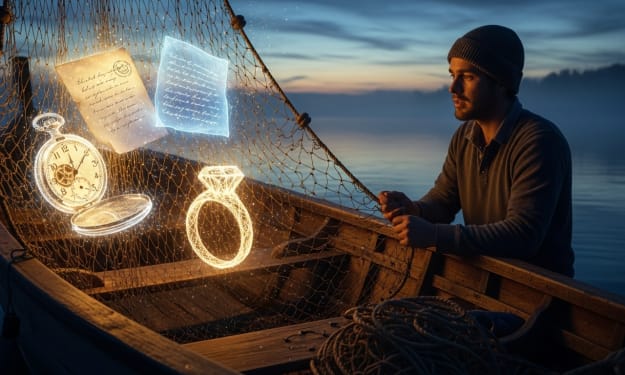
The Fisherman’s Net The net was my grandfather’s true legacy. Not the small cottage, not the rickety boat, but this twenty-foot span of hand-knotted cork and twine. It smelled of salt, seaweed, and a lifetime of hard work. After the funeral, it was the only thing I wanted.
By Habibullah6 months ago in Fiction
Lightning Never Strikes Twice
The distant rumble, the sudden deluge, the crescendo of sound, the flash of light, the explosive energy — it never gets old. I became an amateur storm chaser about two years ago. My wife, Cindy suggested it. Sort of. She said, "Alex, you know this cancer is killing me. I've come to terms with that, but you're smothering me. Go join a band, write a book, or become a storm chaser, for all I care. I love you, but you need a hobby."
By Julie Lacksonen7 days ago in Fiction
The rule everyone knows
I recently rewatched The Truman Show yesterday amidst all the chaos of the crazed media story that Jim Carrey was cloned. I give that rumor no credence to my own sensibilities, however, when I saw him in that French award ceremony, I had to do a double take. It wasn’t so much that I actually believed he was cloned or anything crazy like that, but, I had a weird gut reaction that made me think, “Someone or something got to him,” because he just doesn’t act like that in most celebrity or movie award ceremonies. You all saw must have seen those interviews where he made fun of Hollywood, being evil that is made to feel real but is really mocking us all. All that Illuminati talk. I was like, “That boy is going to get himself killed.”
By Melissa Ingoldsbya day ago in Fiction


Comments
There are no comments for this story
Be the first to respond and start the conversation.