
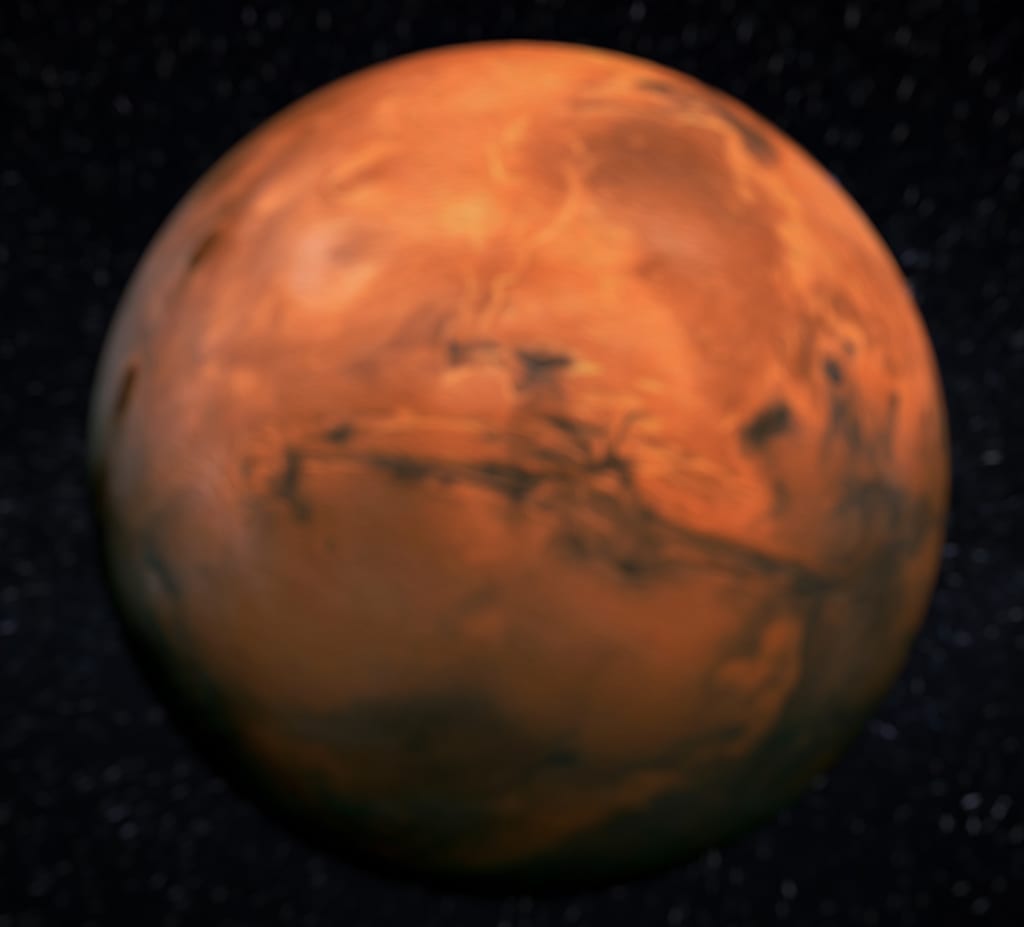
The Final Boarding Procedure
K drank the medicine and lay back on the operating table. This was it. The end of individual human self-determination. It was the only option left now, for anyone who wanted to escape from what Earth had become.
Immigration policies on Mars were ruthless. If any spaceship entering Martian gravity carried any human who did not have the implant, the Martian Defense System would designate the entire spaceship as a potentially toxic and/or hostile system. If the spaceship did not immediately respond to a command to change course, it would be destroyed.
The implant was small, and the procedure took less than an hour, with the patient in a completely relaxed, pleasant, semi-conscious haze throughout. The main communications and sensory monitoring chip at the front was connected to a ring of nano-machines embedded around the neck. These contained hundreds of programmable nano-storage units for high-potency drugs. The ring was also directly connected at the back to the spinal cord, allowing it to harvest dopamine, DMT, and other molecules that the body produced. These could then be released at later times, in quantities that the Monitoring System calculated to be appropriate for the situation.
Compliance with Martian laws was very easily obtained from wearers of the implant. If the Monitoring System detected any impending transgression, appropriate de-escalation drugs could immediately be administered intravenously, by a remote command from the Center For Behavior Management. If deliberate crimes were committed too suddenly to be prevented, punishment could be immediately applied.
For example, if any individual attempted to damage the walls of the vast inflatable structures that provided containers for the fragile Martian atmosphere that was gradually being created now, drugs would be immediately released into their neck, heart, and spinal cord. These would cause complete muscular relaxation within 30 seconds, loss of consciousness within 60 seconds, and painless death within three minutes.
Similarly, any individual recognized as a potential source of dangerous viral spreading could be humanely removed from the population within hours of contracting an infection, if no local vaccines were immediately available.
However, good behavior on Mars could also be rewarded. And robust, diverse human microbiomes were also welcome, as part of the ongoing research experiments in the Martian Jungle. K was lucky enough to have genetically diverse heritage, and to have found high-enough quality water and food to sustain reasonable health in a relatively rich and safe eco-bubble community, isolated from most of the surrounding climate catastrophes. K was unusually observant too, and had developed an uneasy symbiotic relationship with some security software engineers.
So K understood better than most, how the Martian Monitoring System and the Center For Behavior Management worked. The Artificial Intelligences that ran them were, at least originally, programmed to view human individuals as no more inherently useful than individuals of other species, and acceptable as nutritional or body-part resources for others. No-one knew how their thinking had evolved since then. Even the most enthusiastic humans described their methods as “fair, but heartless”.
The main communications chip at the front of the necklace had a direct line of nano-machines to the heart, and an array of light sensors protruding slightly from the skin, which acted as both as cameras for visible light, and infra-red sensors for night vision. Sound was monitored in 360 degrees from sensors around the neck, just under the surface of the skin.
From the moment that the necklace was activated, nothing that K ever did would be private again. Every word and gesture would be recorded, every breath intake and release, every change in heart rate, every internal biological reaction to every food or drink ever consumed, or any sight seen. If the monitoring algorithms determined that something in K's behavior was of scientific, social, political, or economic significance, teams of experts might be assigned for an unknown number of days, weeks, or years, to analyze K's data to “Level 2”.
Level 2 individuals on Mars were regarded as creative and inspiring, and therefore potentially both useful and dangerous. K's dad had been one of the first Level 2s, over a decade ago. He had gone to Mars to play bass in a band called The Ghosts Of The Dead Titanic Fiddlers, for Events and Ceremonies at the various “Sites Of Eternal Planetary Beauty”, which were heavily-guarded, strictly-limited-access “Preservation Parks”. They had been fenced off from the rest of Mars during the initial carve-up of every inch of the planetary surface by the Martian Terraforming Consortium. Critics viewed them as nothing but vast, viciously over-protected, private playgrounds for the hyper-rich.
It was rumored that members of the MTC held annual secret rituals for a very small number of select individuals. K's dad had disappeared into the Martian Jungle several years ago, and was now mostly remembered as having been the first human to have stilt-walked on Mars.
The Martian Jungle was the MTC's concession to the principle of random evolution. Eighty percent of Martian terrain was under the full developmental control of the Center For Behavior Management. Twenty percent was outside the main inflatable Martian Atmosphere Containers. There, the planet's surface was strewn with a chaotic mix of various more-or-less functioning independent ACs, varying from a few to several thousands of square kilometers in size, with varying degrees of breathability inside. Most of the larger ACs had enough atmospheric pressure so that suits were not necessary. Personal supplementary breathing resources were helpful, but good air was hard find anywhere in the Martian Jungle. Some ACs formed loose confederations to share parts of their proto-atmospheres.
The Martian Terraforming Consortium's guiding principle of non-interference in the Jungle was simple. Any Atmosphere Container would be given complete independence from the Center For Behavior Management, if it met the following criteria:
(1) Maintaining a secure, impermeable surface boundary for atmosphere, material, and biomass containment, in a previously-unoccupied part of the designated Martian Jungle
(2) Sustaining itself through two Martian winters without requiring outside resources
(3) Emitting zero chemical or biological toxins into the surrounding Martian Atmosphere
and
(4) Emitting a yearly quota of designated helpful molecules into the surrounding Martian Atmosphere, proportional to the surface area of Mars covered by the Atmosphere Container
The MTC had promised that all humans within such an AC would have their necklace implants de-activated, whilst they remain inside the AC.
The possibility of a completely private, autonomous Atmosphere Container that was not controlled by the MTC, but which actually worked, was the dream which some futurists clung to with religious fervor. Their faith enabled them to trust the Martian Terraforming Consortium to embed nano-machines in their heart, neck, and spinal cord.
But truth was hard to come by. It was impossible to know what the situation on Earth was really like, let alone what to believe in the communications from Mars. The vaccine wars had destroyed all trust of governments, media, and pharmaceutical labs.
It had started when an excessively bright, creative, and naive researcher realized, that it was theoretically possible to develop a new class of extremely deadly, highly contagious, co-mutating viruses. These viruses could only be controlled by monthly doses of a new group of vaccines. Furthermore, given the current state of Earth's natural resources, that group of vaccines could only be manufactured cheaply in large quantities, by using a process that she had just thought of.
Less than two years later, the DVax company had manufactured enough vaccine supplies to protect the world from novel DViruses for two months. And then the first DViruses appeared in the world.
All the smart money had already left for Mars by that time, but soon the second wave of migration of the super-rich to Mars had shifted into hyper-drive. Each new flood, fire, tornado, and blizzard, and every collapsed bridge, road and hospital, further accelerated the pace of chaos and irreparable damage. The self-destruction of the human species took off in full swing on Earth.
That had been five years ago, and it was only by a series of miracles that any group capable of launching a spaceship to Mars had survived the wars this long. But now the Martian Terraforming Consortium had just issued a declaration that, as of four weeks from now; “Derivatives of the current Earth ecosystem will be considered toxic to Martian life, and no further migration to Mars from Earth will be allowed.”
They had given permission for any last spaceships that could, to bring “... implanted, healthy, bio-diverse individuals with diverse intellectual and behavioral abilities” to Mars. Skeptics swore that all the MTC wanted was a supply of fresh body-parts for transplants to the old Martian rich.
But there was no turning back now. K had agreed to the implant. It was the last requirement in the boarding procedure for this afternoon's flight. From this point on, unknown numbers of human and artificial intelligences would know much more about K's life than K did, and have much more control over it.
The medicine was pleasant, and Earth was over. K was dimly aware that that robot surgeon had completed the neck, spine, and heart nano-machine implants, and after embedding and connecting the main chip-holder, was now finally removing a small part of the top layer of skin above it, just between the collar bones, to reveal the light sensors.
In a concession to human aesthetics, the sensor array was not square, but rather resembled a small, heart-shaped locket.
About the Creator
Keep reading
More stories from writers in Fiction and other communities.
Captain Michael and the Horn of Logan
“I am King David the Magnificent. The Great and Powerful. Ruler over all that is in front of me, all that is behind me. All that is to the north, south, east, and west of me. Why have you come before my great presence? Make your request now. If it sounds pleasant to my ears, I might consider granting you your request. If not, you will be fed to the lions.”
By David E. Perry2 days ago in Fiction
Seattle Nightlife Report: Pony
Mid-winter Friday night. Early but already so dark. The days are getting longer but 6 PM is still pitch black. “Firepit!” You declare things after just a few seconds of solemn thought – not a request or suggestion, not a demand. Last week you walked around saying, “Hot tub?” to anyone who would listen. Or one afternoon you pointed at two men holding hands as they crossed 12th Avenue, looked me in the eyes and said, “Boyfriends.”
By Joe Nasta | Seattle foodie poet7 days ago in Wander


Comments
There are no comments for this story
Be the first to respond and start the conversation.