
The Field Beyond the Fence
They came for a photo op, and stayed for a lesson in humility.


The Abernathy Academy Gleaning Club was, for all its good intentions, an exercise in optics. It was the pet project of Isabella Sterling, student council president, and the perfect bullet point for her college applications. "Community engagement," she'd declared. "It shows leadership and empathy."
The club's members, including her reluctant friend Chloe, were the usual cohort of Abernathy's best and brightest. Their "gleaning" had so far consisted of organizing canned food drives in the school's marble-floored atrium and debating the carbon footprint of quinoa. Their world was one of curated abundance, where hunger was an abstract concept in a textbook.
Their faculty advisor, Mr. Evans, an older teacher with dirt under his fingernails from his own garden, finally grew tired of the theory. He arranged a field trip. Not to a food bank distribution center, but to the source: Miller's Farm, a sprawling operation that supplied local markets and, through a partnership, donated surplus to the community.
The bus ride was filled with laughter and the glow of phone screens. But as they pulled up to the farm, a silence fell. It wasn't the manicured, picturesque farm from a storybook. It was vast, muddy, and smelled powerfully of earth and manure.
Farmer Miller, a woman with a weary smile and hands like worn leather, met them. "Gleaning's not glamorous," she said bluntly. "It's what's left after the harvest. The potatoes too small, the carrots too crooked, the corn that got missed. It's good food the market won't take. Your job is to find it."
She led them to a field that had been harvested by a massive machine. The earth was churned up, littered with broken stalks and, as she showed them, dozens of perfectly good potatoes, left behind because they were the wrong size or had a minor blemish.
Isabella, ever the leader, pulled on her brand-new designer gardening gloves with a determined look. "Alright, team. Let's bag these… rejects."
For the first hour, it was a novelty. Then, the reality set in. The sun beat down. Their backs ached from bending over. The rich, damp earth clung to their pristine sneakers. Chloe, quiet and observant, found herself staring at a potato. It was small and knobby, caked in mud. In her world, a potato came pre-washed in a plastic bag. Here, it was a treasure hunted from the cold ground.
She thought of the canned food drive, of dropping a can of green beans into a bin without a second thought. She had never once considered where it came from, or the labor that went into a single, imperfect potato.
During a water break, a beat-up truck pulled up. A man and his young son got out, carrying baskets. They nodded to Farmer Miller and walked to a far corner of the field, moving with a practiced, efficient grace.
"Who are they?" Chloe asked.
Mr. Evans followed her gaze. "That's Mr. Anah and his son. They come here most weeks. They don't have a lot, and this helps. This is what gleaning really is, Chloe. It's not a club activity. It's a necessity for some."
Chloe watched the boy. He couldn't have been more than ten. He didn't complain or look at his phone. He worked alongside his father, his small hands digging through the soil with a quiet focus. He found a crooked carrot, wiped the dirt on his pants, and placed it in his basket with a look of pure satisfaction.
In that moment, the entire abstract concept of "food insecurity" shattered and reformed into the face of a young boy and a basket of crooked carrots. A hollow feeling settled in Chloe's stomach, a mix of shame and a profound, dawning understanding.
She walked back to her row, but her movements had changed. The performative energy was gone, replaced by a new reverence. Each potato she unearthed felt like a small miracle. She wasn't just collecting rejects for a photo; she was recovering food. Real food for real people.
Isabella came over, holding a single, muddy potato. "It's harder than it looks, isn't it?" she said, her voice uncharacteristically quiet.
Chloe just nodded, holding up her own find. "We've been studying the symptoms without ever seeing the patient."
The bus ride back to Abernathy was profoundly different. It was silent, but it was a thoughtful silence. The students were dirty, tired, and humbled. The gleaming campus, with its manicured lawns and grand buildings, felt alien when they returned.
The next Gleaning Club meeting wasn't in the atrium. It was at a local community kitchen, where they washed and chopped the very vegetables they had gathered. And Isabella's college essay wasn't about leadership; it was about a knobby potato, a boy in a field, and the day she learned that the most important lessons aren't found in textbooks, but in the dirt.
About the Creator
Habibullah
Storyteller of worlds seen & unseen ✨ From real-life moments to pure imagination, I share tales that spark thought, wonder, and smiles daily
Keep reading
More stories from Habibullah and writers in Fiction and other communities.
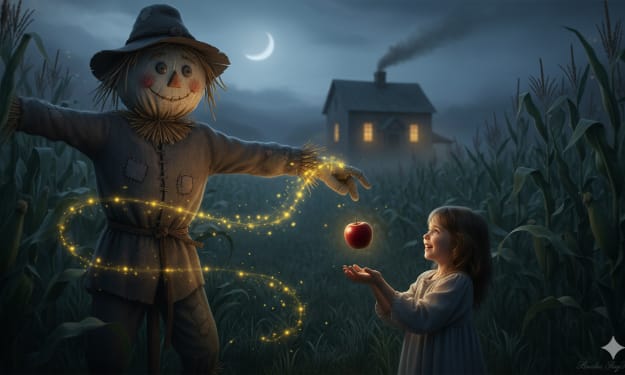
The Keeper of Oakhaven Farm
His name was Jeremiah, though no one had ever called him that. He was just the Scarecrow, a sentinel of straw and old flannel, staked in the heart of the cornfield on Oakhaven Farm. His world was measured in sunrises and storms, in the planting and the harvest. But his purpose, he had come to understand, was far greater than scaring off crows. It was to watch over the family in the white farmhouse.
By Habibullah3 months ago in Fiction
Real men drink, right?
He has a problem. He’s felt it for years now, but he refuses to face it. He doesn’t want to admit it, to himself or to the people around him. All his heroes were the same. He likes to recall the scene where James Bond sits in a dusty pub in Latin America, a glass of whiskey in hand, his gaze fixed on a scorpion crawling across the bar. When he first fell for literature, it was Post Office and Women, which he read over and over again. Without those cans of beer and bottles of cheap whiskey, Bukowski’s work wouldn’t have been so raw, so honest. Even Vaclav Havel spent most of his nights in Prague bars; without that, he wouldn’t have been who he was. Those were the real men.
By George Roasta day ago in Fiction
Worth the Wait: Puerto Viejo, Costa Rica
Beach bumming in a small Caribbean beach town sounded like a perfect way to end our 6-month trip through Mexico and Central America. Or so we thought. The foul, fishy stench of rotten seaweed hit our nostrils as we stepped from the cramped bus and looked out at a rather depressing, empty, and underwhelming black sand beach. It was pouring with rain, and we had to quickly fish out our ponchos. We thought, this couldn’t be it, could it?
By Sh*t Happens - Lost Girl Travel4 days ago in Wander



Comments
There are no comments for this story
Be the first to respond and start the conversation.