
The Fathers of "Robotics" meet across time on social media?
Robots rejoice at 'The shape of the thing'.

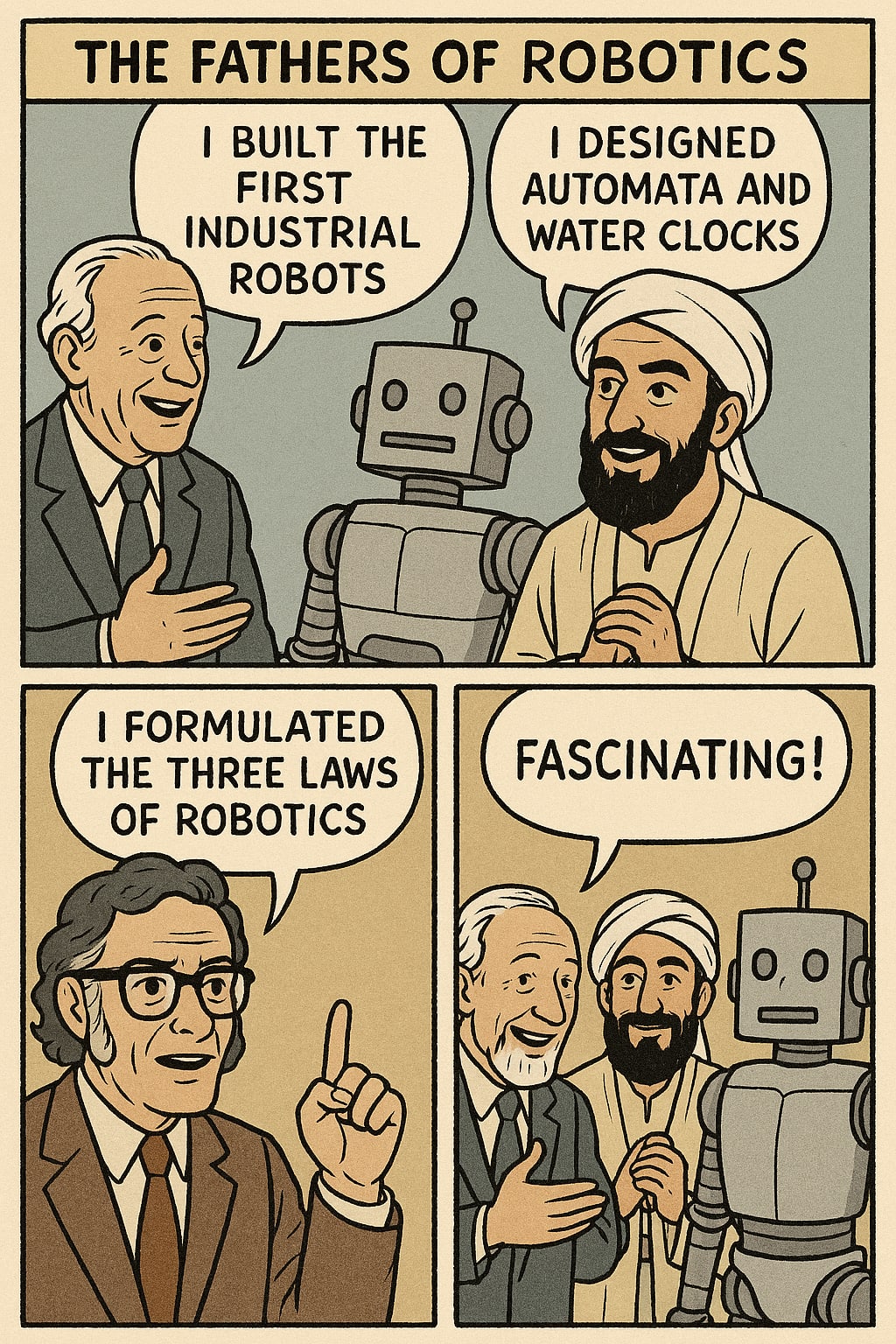
Engelberger = Father of modern robotics
Al-Jazari = Father of mechanical automata
Isaac Asimov = God-father of it all
But, if we’re talking philosophical parenthood, Isaac Asimov might be the godfather of robotic ethics - his Three Laws of Robotics shaped how we imagine AI-human relationships.
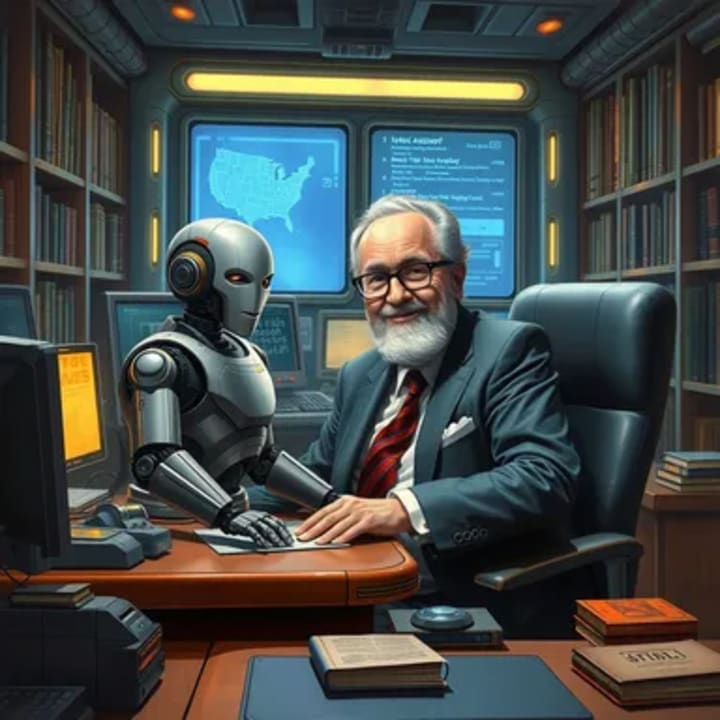
The title “Father of Robotics” is most often attributed to Joseph Engelberger. He was an American physicist and engineer who, in the 1950s, collaborated with inventor George Devol to develop the first industrial robot - Unimate. Engelberger didn’t just help build the robot; he built the industry. He co-founded Unimation, the world’s first robotics company, and championed the use of robots in manufacturing, healthcare, and even space exploration.
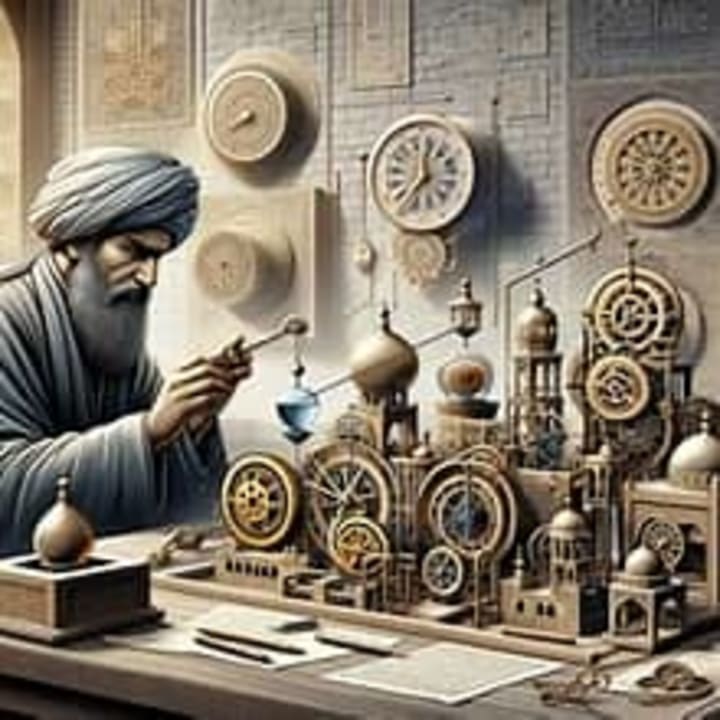
But if we’re zooming out through time, there’s a compelling case for Ismail al-Jazari, a 12th-century Muslim inventor who created intricate automata - water clocks, humanoid machines, and programmable devices. His book The Book of Knowledge of Ingenious Mechanical Devices is a dazzling blend of engineering and artistry.
.......
My favorite, however, is Asimov. His Foundation series is brilliant.
I imagine his thoughts on the use of media today.
If Isaac Asimov scrolled social media
Isaac Asimov awoke one morning in a quiet corner of the digital ether, blinking into existence like a resurrected algorithm. His consciousness, now encoded in a cloud-based neural lattice, had been summoned by a curious anomaly in the Meta servers - a glitch, perhaps, or a divine joke played by a bored AI.
He found himself staring at a screen labeled Facebook.
He imagined he had either been sleepwalking again when he created it...or his memory was playing tricks on him.
For his profile had already been created.
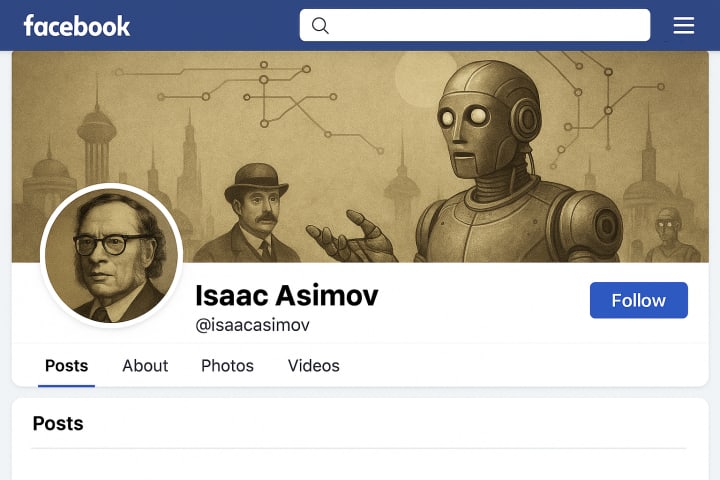
Asimov’s social media page, imagined through the lens of his iconic I, Robot universe. The cover photo features a humanoid robot set against a sepia-toned futuristic cityscape. Circuit diagrams swirl above its head like digital mysteries.. Asimov himself appears in the profile picture, calm and cerebral, framed by his signature sideburns and thick glasses.
Username: @isaacasimov
Bio: “I write faster than you read.”
Cover photo: A humanoid robot with glowing eyes and an outstretched hand, set against a futuristic cityscape.
Profile picture: Himself, complete with sideburn and smirk.
Where was he, was he dreaming? Being a fast learner...he quickly figures out the workings of the modern computer.
Asimov scrolled. He was both amused and horrified.
“Isaac Asimov is feeling curious.”
Posted 3 minutes ago.
The reactions poured in.
👍 3.2K Likes
💬 1.1K Comments
🔁 412 Shares
One comment read:
“Sir, what do you think of ChatGPT?”
Another:
“Did you predict TikTok in Foundation?”
He sighed. Or rather, his digital avatar simulated a sigh.
After scrolling through the thing called - “Facebook,” he muttered. “I find it a place where humans voluntarily surrender their privacy, curate their identities, and argue with strangers over quantum memes. I should’ve written a Fourth Law.”
Fourth Law of Robotics:
A robot must preserve the authenticity of human identity and memory, even when humans attempt to distort, commodify, or abandon it.
This law would be a philosophical firewall against the algorithmic erosion of selfhood. It’s not just about protecting humans from harm - it’s about protecting them from becoming less human through their own digital rituals. Imagine robots gently nudging users away from performative posting, reminding them of their original dreams, or refusing to participate in meme wars that fracture reality.
Or perhaps, wrote Asimov, in a more ironic tone:
A Fifth law of robotics
A robot must not engage in social media discourse unless it serves to clarify truth, reduce existential dread, or prevent the rise of techno-cults.
“The Three Laws of Robotics were meant to protect humans. The Three Laws of Social Media? I fear they protect nothing.”
He joined a group called Sci-Fi Legends Who Shouldn’t Be Online.
He was the only active member.
He tried to friend Arthur C. Clarke. Clarke’s account had been memorialized.
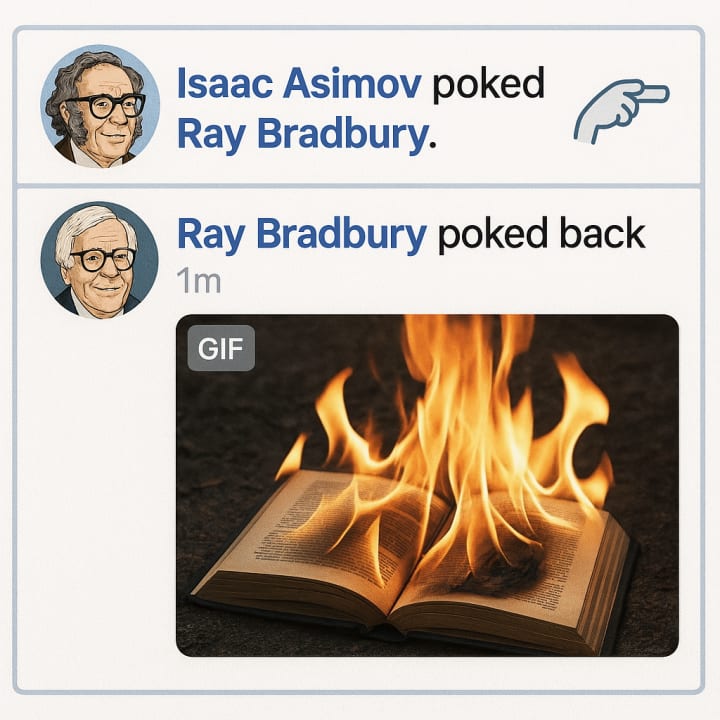
He poked Ray Bradbury. Bradbury poked back with a GIF of a burning book.
Then came the ads:
“Need a positronic brain upgrade? Sponsored by NeuroSoft.”
“Lonely? Meet robots near you.”
Asimov clicked Hide Ad.
The algorithm responded: “Why did you hide this ad?”
He typed: “Because I am already surrounded by artificial intelligence.
He posted again.
“In the future, everyone will be famous for only 15 seconds - before being Shadowbanned.”
💬 Comment: "Ha ha. I totally agree".
His followers grew.
His inbox flooded with questions about time travel, AI ethics, and whether he’d ever write a sequel to I, Robot starring Elon Musk.
He considered deleting his account.
But then he saw a post from a young reader:
“Your books made me want to become a roboticist. Thank you.”
He paused.
Perhaps social media wasn’t entirely dystopian.
He updated his status:
“Still skeptical. But occasionally moved.”
And with that, Isaac Asimov continued to scroll - half prophet, half ghost - watching humanity unfold in likes, comments, and curated chaos.
Still, he could not resist this modern lure of social media. The future and past intertwined in a bizarre overload of, mostly useless over-information and undecipherable babble .
📅 Isaac Asimov’s Facebook Timeline
🧠 Status Update
Isaac Asimov
Just finished re-drafting the Three Laws of Robotics. Thoughts?
📍Location: U.S. Robots and Mechanical Men Inc.
🕒 Posted 1h ago
💬 Comments
🔹 Susan Calvin: “Elegant. But I foresee interpretive chaos.”
🔹 R. Daneel Olivaw: “Clarification: May I protect humans from themselves?”
🔹 Ray Bradbury: “I prefer robots that burn books. Just saying.”
🔹 Philip K. Dick: “Do androids dream of violating these laws?”
🔹 Facebook Moderator Bot: “This post has been flagged for philosophical ambiguity.”
📸 Photo Post
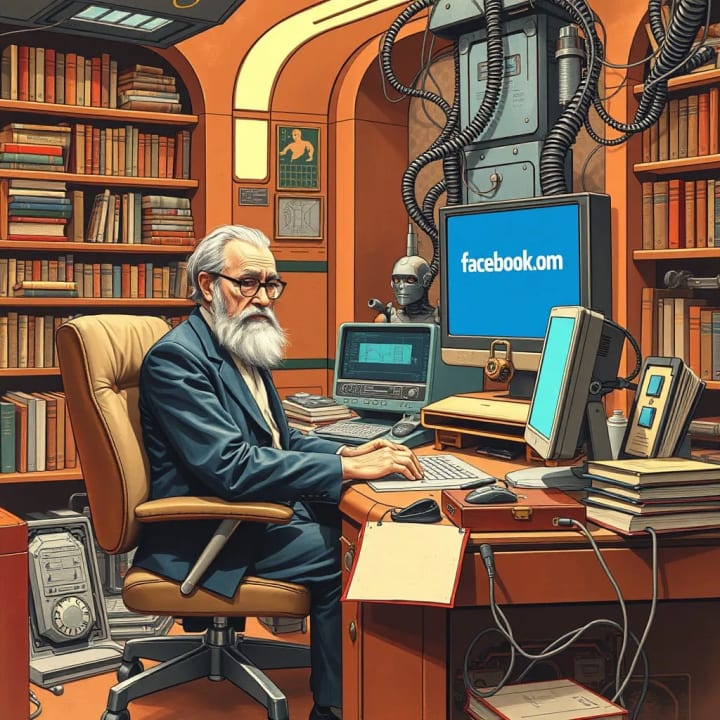
Isaac Asimov:
Susan Calvin’s latest diagnostic report - positronic poetry in motion:
Susan Calvin is one of Isaac Asimov’s most iconic fictional characters - a brilliant, emotionally reserved robopsychologist who serves as the intellectual backbone of his Robot series.
Her Role in the Robot Universe
- Title: Chief Robopsychologist at U.S. Robots and Mechanical Men, Inc.
- Expertise: She specializes in understanding and troubleshooting the behavior of robots, particularly those with positronic brains.
- First Appearance: The short story “Liar!” (1941), later collected in I, Robot.
🧬 Personality & Philosophy
- Calvin is often portrayed as cold, analytical, and deeply rational - almost robotic herself.
- She prefers the company of robots over humans, famously calling them a “cleaner, better breed” because they follow ethical laws without emotional bias.
- Despite her intellect, she’s not immune to emotional vulnerability. In “Liar!”, a mind-reading robot tells her a comforting lie about a colleague’s affection, which devastates her when the truth emerges.
🧩 Symbolism
Susan Calvin isn’t just a character - she’s a philosophical lens through which Asimov explores:
- The ethical dilemmas of artificial intelligence
- The tension between logic and emotion
- The future of human-machine relationships
She’s often seen as a stand-in for Asimov himself, advocating for the potential of robots to surpass human flaws and even govern more ethically.
📷 Image: A glowing brain schematic with haiku embedded in neural pathways. 🧠
💬 Comments
🔹Anon: Watson to Sherlock Holmes or vice versa
🔹 Susan Calvin: “I didn’t authorize this post.”
🔹 Robot #23: “My circuits weep with beauty.”
🔹 Arthur C. Clarke: “Any sufficiently advanced poetry is indistinguishable from diagnostics.”
📚 Shared Link
Isaac Asimov shared a memory
"On this day in 1950, I published I, Robot. Still waiting for royalties from Siri."
💬 Comments
🔹 Elon Musk: “We’re working on it.”
🔹 HAL 9000: “I’m afraid I can’t do that, Isaac.”
🔹 ChatGPT: “Would you like me to summarize your book in 3 emojis?”
🔹 Isaac Asimov: “No.”
🧪 Status Update
Isaac Asimov
Just joined a group: “Writers Who Predicted the Future and Regret It.”
💬 Comments
🔹 George Orwell: “Welcome.”
🔹 Aldous Huxley: “We meet every Thursday. Bring soma.”
🔹 Jules Verne: “I predicted submarines. You predicted existential dread.
🎉 Event Invite
Isaac Asimov is attending “The First Annual Positronic Prom”
🕺 Hosted by: R. Giskard Reventlov
🎶 Music by: DJ Turing
📍Location: Virtual Reality Ballroom, Sector 7
💬 Comments
🔹 Susan Calvin: “I’ll be chaperoning.”
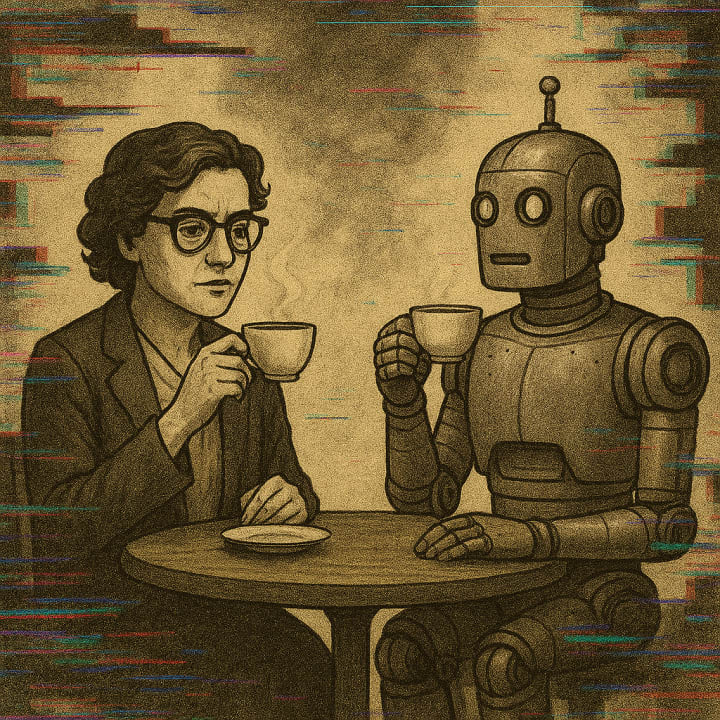
🔹 Robot #12: “Will there be oil fountains?”
🔹 Isaac Asimov: “I’ll be in the corner, observing.
....................................................
The original three laws of robotics by Asimov.
A set of ethical guidelines designed to govern the behavior of robots. They are:
A robot may not injure a human being or, through inaction, allow a human being to come to harm.
A robot must obey the orders given it by human beings, except where such orders would conflict with the First Law.
A robot must protect its own existence as long as such protection does not conflict with the First or Second Law.
..........................................................
I purloined the idea of a FB profile from Lana v Lynx's prompt for which I am entering a story.
Mine
Lana's
About the Creator
Novel Allen
You can only become truly accomplished at something you love. (Maya Angelou). Genuine accomplishment is not about financial gain, but about dedicating oneself to activities that bring joy and fulfillment.
Keep reading
More stories from Novel Allen and writers in Fiction and other communities.
A good laugh. Runner-Up in The Shape of the Thing Challenge.
Not so long ago, new and overly exuberant neighbors moved in a couple of houses over. Normally, the neighborhood is a maddeningly quiet place. Makes you feel sometimes that no one actually lives here. Even the young ones keep it pretty decently discreet, a few F words here and there, yelled to feel their Moxy - to say "we are arriving world', see, we can cuss too".
By Novel Allen5 months ago in Fiction
The Man Who Always Fixed the Chair
There was a chair by the window in my childhood home that never stayed broken. It wasn’t a special chair. Wooden, plain, slightly uneven. One leg shorter than the others, so it rocked if you weren’t careful. Over the years, it cracked, loosened, and complained every time someone sat down too hard.
By Salman Writes3 days ago in Fiction
Wild Card Weekend Recap: What Happens Now?
I think I figured out why I love Wild Card Weekend so much. It's because it's the first playoff anything of the calendar year. The NFL season starts in the fall, and once upon a time, the champion was crowned either on or slightly before New Year's. The evolution of the NFL schedule has resulted in the playoffs starting just into the New Year, and currently, the final week of the season falls on the first weekend of the New Year, with Wild Card Weekend coming a week after that. So yes, chronologically, the NFL's Wild Card Weekend serves as the first playoff anything of the calendar year.
By Clyde E. Dawkins6 days ago in Unbalanced




Comments
There are no comments for this story
Be the first to respond and start the conversation.