
The Father of Modern Genetics
Gregor Johann Mendel
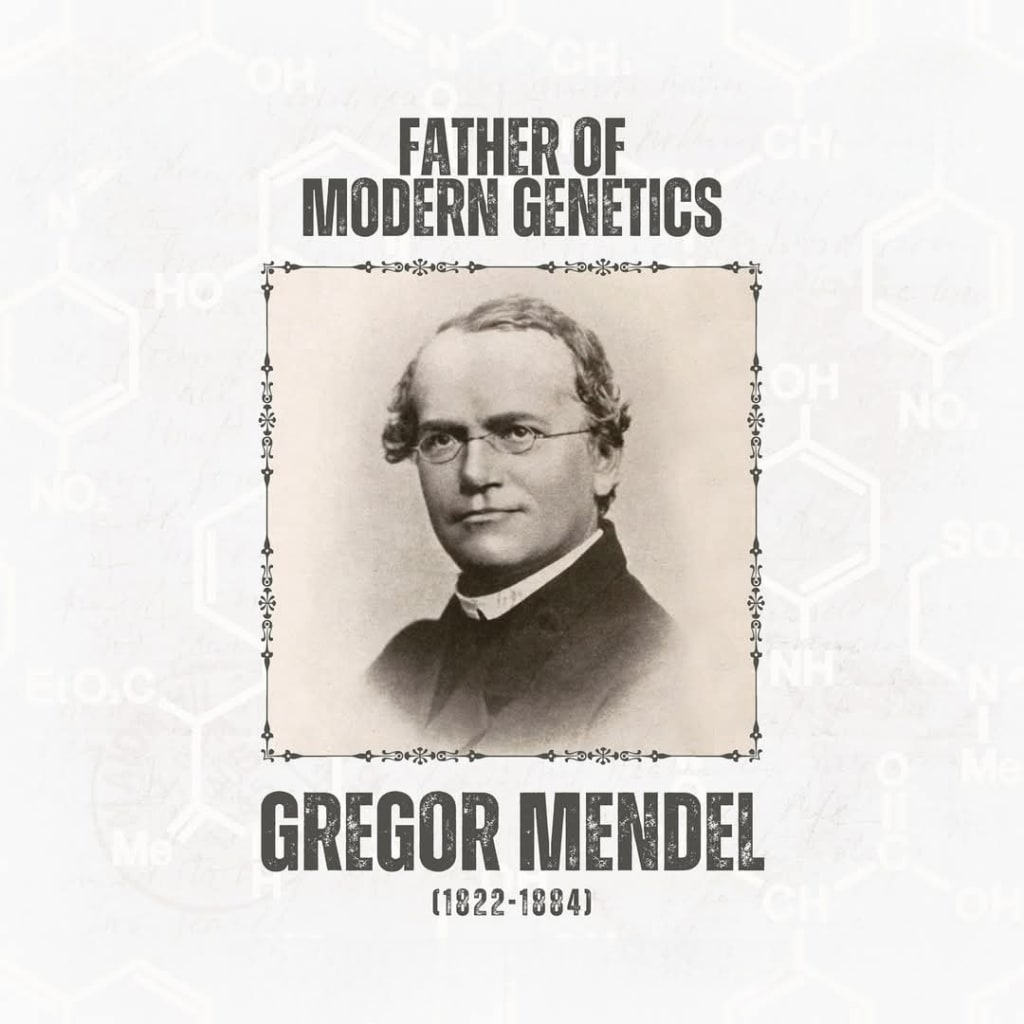
Gregor Johann Mendel was an Austrian scientist, an Augustinian friar, and a monk at the Abbey of St. Thomas in Brno, Moravia.
Mendel's research on pea plants led to the formulation of two fundamental laws of inheritance, now known as Mendel's Law of Segregation and Law of Independent Assortment. These laws help explain how traits are passed from parents to offspring. For this reason, he is also known as the Father of Genetics.
Early Life and Education:
Gregor Johann Mendel was born on July 20, 1822, in Heinzendorf bei Odrau, Silesia, in the Austrian Empire (now Hynčice, Czech Republic), into a poor German-speaking farming family. His father's name was Anton Mendel and his mother’s name was Rosine Mendel. Although born into a poor farming family, Mendel was not deprived of education due to financial constraints, as his father was very keen on his education. After completing his studies at a gymnasium school in 1840, he received a scholarship to study at the Philosophical Institute in Olomouc, where he studied physics, mathematics, and philosophy. Following the advice of his physics teacher, Friedrich Franz, he joined the Abbey of St. Thomas in Brno in 1843. At the start of his monastic life, he adopted the name "Gregor." In 1851, he went to study at the University of Vienna and returned to the monastery on September 7, 1853, primarily as a physics teacher. Encouraged by his teachers and colleagues, he began his research in the monastery garden.
Research on Pea Plants:
In 1856, Mendel began his research on pea plants in the monastery garden. He chose peas because they grew easily and had observable traits like flower color, seed shape, and plant height. Between 1856 and 1863, Mendel cultivated and tested around 29,000 pea plants (Pisum sativum). He crossed different varieties and carefully observed the traits of their offspring. From these observations, he noticed a consistent 3:1 ratio—one pure recessive, two hybrids, and one pure dominant.
Through this, Mendel formulated three key principles of inheritance, now known as Mendel’s Laws of Inheritance:
Law of Segregation: Each trait is determined by a pair of factors (now called alleles), one inherited from each parent. These factors separate during gamete formation, with each gamete carrying only one factor for each trait.
Law of Independent Assortment: Different traits are inherited independently of one another. The distribution of alleles for one trait does not affect the distribution of alleles for another.
Law of Dominance: When two alleles for a trait differ, one (the dominant allele) is expressed while the other (the recessive allele) is not.
On February 8, 1865, Mendel presented his findings to the Natural Science Society of Brno. His paper, "Experiments on Plant Hybrids", was published the following year in the Proceedings of the Natural History Society of Brno. Although appreciated, the significance of his work was not recognized at that time.
After his research on peas, he studied bees and even developed a hybrid breed. However, due to the difficulty in controlling bee reproduction, he couldn’t determine their exact patterns of inheritance. He also described several new plant species, whose scientific names include "Mendel" as a suffix.
In 1865, Mendel founded the Austrian Meteorological Society. Notably, he published more research papers in meteorology than in biology.
In 1868, he became the Abbot of the monastery. Although he performed his duties diligently, his administrative responsibilities eventually forced him to halt his research.
Recognition:
Mendel’s contributions were finally recognized in the early 20th century, when scientists rediscovered and validated his work. Researchers like Hugo de Vries, Carl Correns, and Erich von Tschermak independently confirmed Mendel’s laws, solidifying his legacy as the father of modern genetics.
His research laid the foundation for the field of genetics, providing a clear explanation for heredity and the variation of traits in living organisms. Mendel’s laws became the cornerstone of classical genetics and greatly contributed to advances in agriculture, medicine, and biotechnology.
Gregor Johann Mendel passed away on January 6, 1884, at the age of 61 due to nephritis, without receiving the recognition he deserved during his lifetime.
Mendel was a brilliant scientist whose revolutionary discoveries unraveled the nature of inheritance. His work fundamentally shaped the field of genetics and transformed our understanding of life. Truly, he was a personality worthy of the title “Father of Modern Genetics.”
About the Creator
Keep reading
More stories from writers in Fiction and other communities.
I Don't Need My Phone... Wait, Is That Actually True?
My parents gave me my first cell phone when I was twelve years old. It wasn't a fancy iPhone or anything, not even close. Just a simple black flip phone for when I needed to call or text them after school.
By Madison "Maddy" Newton3 days ago in Humans




Comments
There are no comments for this story
Be the first to respond and start the conversation.