


The old machine sat silent and motionless on the desk; dormant, yet still beckoning the author. It was dented and dinged in various places, the gold coating it once wore was tarnished and chipped. Though its insides were exposed, nobody knew how the machine worked.
Jiang, rested and ready, finally sat in his chair. He set three cups of tea and several biscuits on a corner of the desk. He uncorked his ink well and readied his quill, then took the machine's handle and began to wind. It took a long time to wind the machine's coils, several minutes at least. He felt the coil bind, and the handle stopped turning. He took a breath, then pressed a button, and the machine clicked and whirred to life. It lifted itself feebly off the desk, supported by seven tiny metal legs (the eighth was broken off a few decades ago). It swayed and swooped, making clickety-clackety noises. Golden eyelids lifted slowly to reveal faded blue mechanical eyes. The machine's mouth coughed a small cloud of dust, which the author waved away with his hand. Jiang picked up his quill and said to the machine, "I am ready."
With more clicking and whirring, the machine's eyes focused on the author, and its mouth began to move. "On a dreary night in the midst of spring," the machine began. Jiang quickly dipped his quill and scribbled the words on a blank page. "A young girl found herself in a terrible situation of her own creation." The machine's voice sounded old and weary.
For hours, the machine dictated, and Jiang faithfully recorded. The machine took no breaks; for once started, its tale could not be stopped. The author drank his tea and ate his biscuits with one hand, whilst continuing to write with the other. Though his hand ached, he pushed on. Not a single word the machine spoke could be lost.
The machine raised itself on its tiny legs, its voice quivered and quickened as it approached the denouement. Two of its legs slipped off the desk, and it wobbled precariously for a short moment, but quickly recovered with a frantic dance of the other five legs. "The young girl's salvation had all been for nought!" the machine belted, "For she discovered-" The machine was suddenly silent and still. Jiang's heart dropped. In the twelve years he had been fulfilling his duty as author, the machine had never once faltered. It sat posed, yet just as lifeless and stale as before it had been wound. The silence in the room made Jiang uncomfortable, and he became hyperaware of the arthritic ache in his hand that gripped the quill. He started to call out to the machine, but realized he didn't know its name. Did it even have a name? He had never referred to it as anything but "the machine."
Slowly, cautiously, he reached out his free hand. A trembling, slightly crooked index finger plunged the only button on the machine whose function he knew. The machine remained still. Unsure of what else to do, he slapped his hand against the side of the machine. The concussive maintenance appeared to have worked. The machine issued several loud clicks, a short but horrific grinding noise, then returned to life. It stuttered, repeating the same word five times, then picked up where it left off. The author quickly resumed his duties, his hand grateful for the momentary break.
The machine's tarnished gold eyelids began to droop, and its speech slowed as it neared the end of its winding. The eve was late, and most people had gone to bed long ago. The oil lamps in the author's humble hut were dim and flickered. He shivered slightly. He had earlier dropped his shal on the floor but dared not stop to pick it up. Not a single word the machine spoke could be lost.
Finally, the machine uttered its last phrase. The tarnished gold eyelids slowly closed, the mechanical mouth lost all tension, and the machine retracted its tiny legs, gently lowering itself to rest on the desk. The whirring and clicking continued for several seconds, then the room was left silent and still. Jiang placed his quill on the desk and corked his inkwell. He shook and stretched his hand, once again aware of the arthritis that afflicted it. He had lost exact count, but he was certain more than three hundred pages had been dictated that night. This was not unusual, but was on the heavier side.
After a sufficient break to rest his aching hand, Jiang took the stack of pages to another machine. This one was much less sophisticated; it simply bound the pages into a book. His final step was to glue a leather backing on the literary work, upon which he embossed the title in golden lettering: "The Misadventures of Sarai and The Price of Naivete". He took the new volume into the back room of his hut and slipped it into an empty place on the bookshelf.
He understood not the purpose of the machine nor the authors who so diligently inscribed its every word, but he did understand that these were no works of fiction. They were the words of fate. He felt for Sarai. He knew her journey would be painful, and the trauma of it would haunt her endlessly, but authors were not allowed to intercede. Observing the fate of others was safe, but change a single word, and suddenly the author's fate became intertwined with observed, often ending in disaster. That is how the machine had come to Jiang.
About the Creator
Eric Boring
I love to write and dream of publishing a novel someday. I'm here to hone my craft and am open to feedback.
Keep reading
More stories from Eric Boring and writers in Fiction and other communities.
Broken Safe Haven - Chapter 3
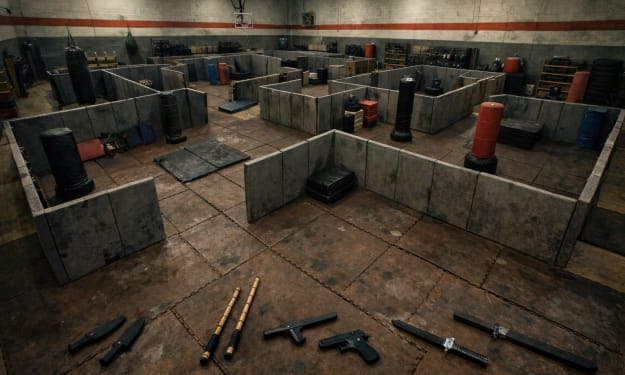
Previous Chapters Chapter 1 Chapter 2 Jordan rushed into the training room, an old basketball gym now a labyrinth of training mats, punching bags, and blunted weapons. The musk of sweaty bodies and athletic clothes their owners neglected to wash hung in the warm air. Jordan’s boots thumped against the wooden flooring as he stomped across the room.
By Eric Boring2 months ago in Fiction


Comments
There are no comments for this story
Be the first to respond and start the conversation.