
The Falcon and the Sky Stone
A boy’s destiny unfolds across empires and endless skies.
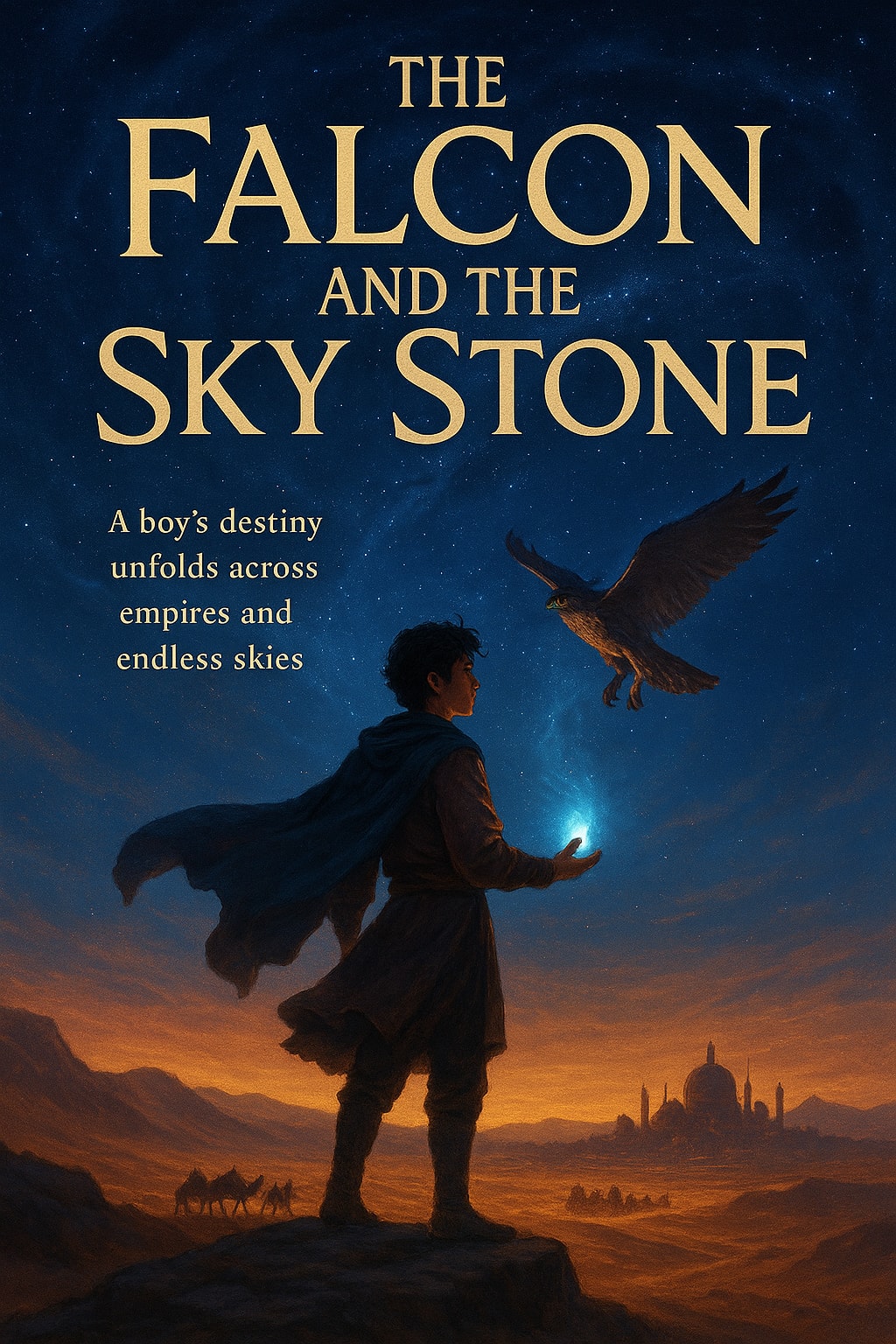
Start wThe Falcon of Samarkand
In the heart of the Silk Road, when the world was stitched together by caravans of spice, silk, and stories, there stood the magnificent city of Samarkand — a jewel of turquoise domes, golden minarets, and bustling bazaars that could make even a weary traveler feel alive again. It was the reign of the great conqueror Timur, known to the world as Tamerlane, whose empire stretched from Delhi to Damascus.
But this story is not about Timur.
It is about a boy — and a falcon.
The Boy Who Watched the Skies
His name was Arslan, the son of a humble mapmaker. His father spent long nights bent over parchment, tracing rivers and mountains from the stories of merchants. Arslan, however, spent his nights watching the stars.
“Maps show where we’ve been,” he would say, “but the stars show where we’re going.”
Every morning before sunrise, Arslan climbed to the top of the Registan’s tallest dome, where he watched his falcon, Zarif, soar over the city walls. The bird was his only friend since his mother’s death. Together, boy and bird shared a bond deeper than words.
But the peace of Samarkand never lasted long.
The Envoy from the West
One spring morning, an envoy arrived from the west — a Persian scholar named Hafiz al-Qazwini. He brought with him news of rebellion near the borders, and a strange, shimmering stone said to have fallen from the sky. Timur, fascinated by omens and relics, summoned the scholar to his palace.
Arslan’s father was called too, for his maps would guide the army if war came.
That night, while his father was gone, Arslan sneaked into the caravanserai where the Persian scholar stayed. Curiosity burned in him — what kind of stone could fall from the heavens?
Inside a small chest, wrapped in silk, he found it: a smooth, glowing stone, cold as ice and shining like the northern sky. But before he could touch it, a voice spoke behind him.
“You have the eyes of a thief — or a dreamer,” said Hafiz al-Qazwini.
Startled, Arslan bowed deeply. “I meant no harm, sir. I only wished to see the sky’s gift.”
The scholar smiled. “Then perhaps the heavens have sent you, not me. For there is more to this stone than beauty. It sings to those who listen.”
And he handed it to Arslan.
The moment the boy’s fingers touched it, a strange pulse ran through him — a heartbeat not his own. The world around him seemed to fade. In his mind, he saw visions: vast deserts, oceans of stars, and a city that shone brighter than Samarkand itself.
When he opened his eyes, the scholar was watching him carefully.
“The stone has chosen,” he whispered. “But beware — what comes from the heavens never returns without cost.”
---
The Falcon’s Flight
Days later, Timur’s court prepared for war. The mapmaker was sent to draw new routes; the scholar was kept close as an advisor. Arslan, left alone, often gazed at the sky-stone hidden in his pouch. It whispered faintly, almost like Zarif’s call.
One evening, as he released Zarif to hunt, a group of soldiers seized him.
“The boy stole something from the king’s guest!” one shouted.
The pouch was torn from his belt, and the glowing stone rolled onto the ground.
Timur himself appeared — tall, scarred, his eyes cold as steel.
“Do you know what you hold, boy?” he demanded.
Arslan trembled. “It is a gift from the sky.”
Timur raised the stone. “A gift, yes — or a curse. Men have killed for less.” He turned to his guards. “Take him to the watchtower. Let him learn patience in the wind.”
That night, Arslan sat imprisoned at the top of a lonely tower. His only companion was Zarif, who refused to leave. The falcon perched on the window, watching the moon rise.
Then, in the darkness, the stone began to hum again.
Arslan held it close, and suddenly, he understood: the visions it showed him were not dreams — they were maps. Maps of lands unseen, rivers unmapped, and stars unnamed. The stone was a compass of the cosmos.
The Escape
At dawn, the tower door creaked open — Hafiz stood there.
“I told the king the truth,” the scholar whispered. “That the stone chose you. I have seen your eyes — they see further than maps.”
He handed Arslan a rolled parchment. “Take this. It will lead you east, beyond the mountains. Guard the stone well. There are those who would burn empires to own it.”
Arslan bowed deeply. “And you?”
The scholar smiled sadly. “My path ends here. Yours begins.”
Before the guards could notice, Zarif took flight, soaring over the city as Arslan escaped into the desert beyond the walls of Samarkand.
The Map of the Heavens
Years passed.
Travelers spoke of a wandering cartographer who carried a falcon and a stone that glowed in moonlight. He mapped not only lands but the stars themselves, charting constellations no one had seen before.
Some said he reached Cathay and taught the astronomers there.
Others said he vanished into the mountains, following the trail of the heavens themselves.
But those who visited Samarkand centuries later swore that in one corner of the old observatory, there was a faint carving on the stone wall — a falcon, wings spread wide, above a map of the stars.
And beneath it, the words in old per Persian
About the Creator
Keep reading
More stories from Mukhtiar Ahmad and writers in Fiction and other communities.
Whispers of the Blue Rose Creek
Start writing...In the heart of the lush green valley known as Viridia, where the air was thick with the scent of wildflowers and the rustling of leaves whispered forgotten tales, there existed a legend that few dared to believe. It was said that deep within the forest, where the sunlight kissed the dew-draped grass and the wind sang lullabies to ancient trees, blue roses bloomed—guardians of a forgotten magic.
By Mukhtiar Ahmad9 months ago in Fiction
Flower Bloom 369
FLOWER Bloom 2/25/26 Wednesday By Mariann Carroll Karen had been with Tony for 7 years. Tony started acting strangely after her surgery. He would mow the lawn in the rain and be on his cellphone. He started pushing Karen away. Tony came clean about seeing someone. Karen moved out two months later. Karen moved in with a friend. She felt betrayed.
By Mariann Carroll5 days ago in Fiction
The Sweetness of Cinnamon
In the earliest days, before the rivers learned their names and before the moon chose her shape, the world was held together by flavors. Every emotion had a taste, every truth a scent, every secret a spice. Among them all, cinnamon was the most powerful. It carried warmth, memory, longing, and the ache of things both lost and found. It was said that cinnamon could soften the hardest heart, awaken the oldest grief, and call the wandering soul back to itself.
By Julie O'Hara - Author, Poet and Spiritual Warrior4 days ago in Fiction




Comments
There are no comments for this story
Be the first to respond and start the conversation.