
The Eye Behind the Door
It doesn’t watch you, it remembers you!

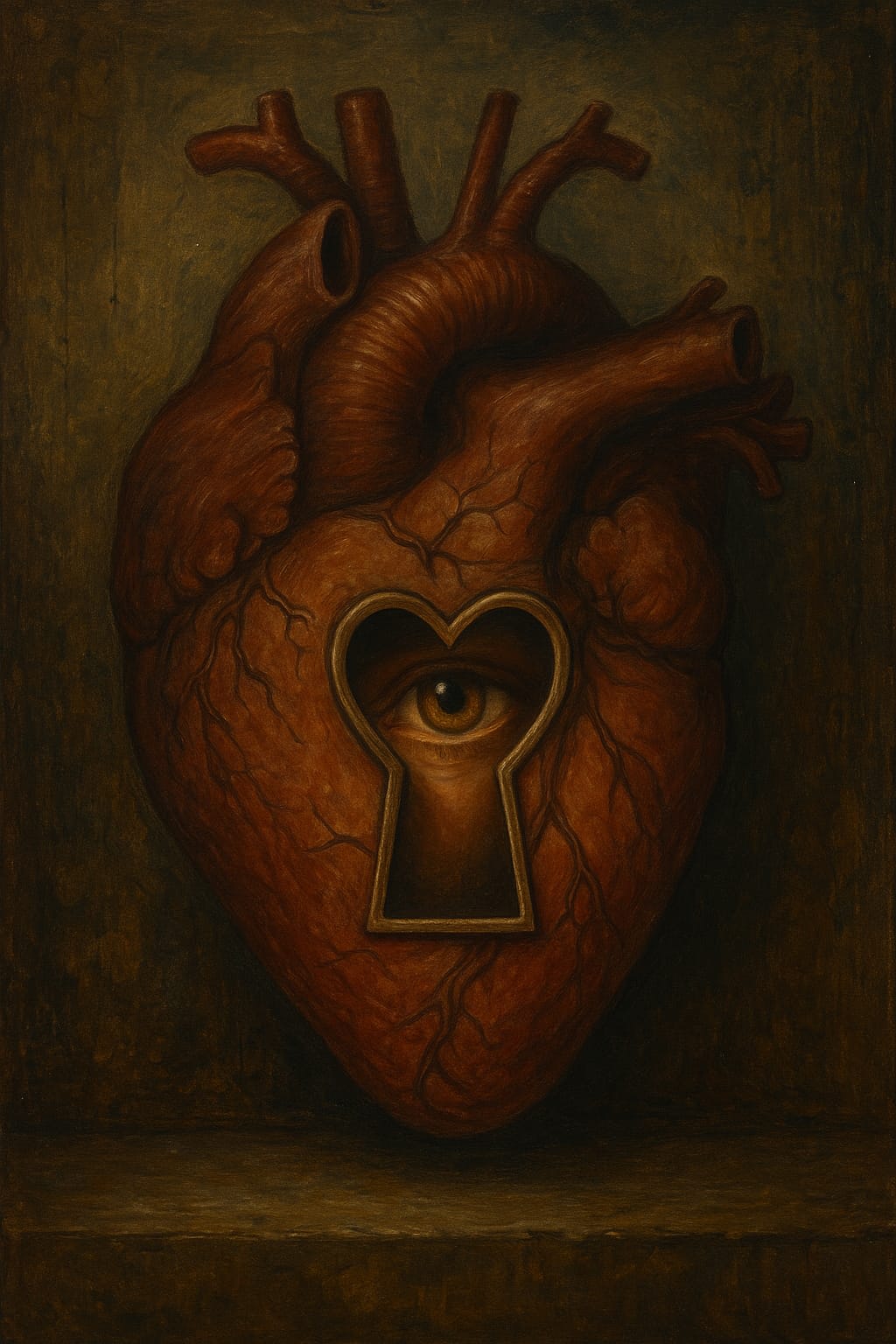
It begins with a blink.
Not yours, the keyhole's.
You lean toward the door and the brass narrows, then opens again, a pupil taking you in. The plate is warm, the way coins are warm after a stranger has held them. You tell yourself it’s the house breathing, wood adjusting to the evening. You tell yourself a lot of things that are almost true.
The corridor is quiet except for the long, slow draft that smells faintly of rain. Dust hangs in the air like unspoken words. No one has mentioned this door in years, or ever. Yet here it is at the end of the hall, paint the color of curdled ivory, swollen around the frame as if it grew there instead of being built.
You kneel. Curiosity has small bones but sharp teeth.
Through the keyhole, there is not darkness. There is a kind of light that moves like thought: soft, honeyed, and indecisive. It pulses, as if the space beyond has a pulse of its own. Shapes loosen and contract: a curve that could be a shoulder, a line that pretends to be a table’s edge, a suggestion of a window that refuses to hold still. Each time you blink, the room rearranges itself, as if someone were tidying the memory for company.
You whisper, "Hello", because it is polite to acknowledge what you disturb.
The keyhole exhales. A brief ribbon of cool passes over your eye. The light swells, pleased.
You could stand and leave. You could say you saw nothing and let the evening lock itself around your too-late errand. Instead, your hand finds the brass rosette, steadying yourself. The metal hums through bone, low, domestic, almost tender. The sound has a rhythm. On the fifth beat it stutters, a little off, the way your heart does when a name you’ve exiled wanders back into the room.
The not-room sharpens. Now there is a cup with a chipped rim. A book open to a page where the corner is folded. A chair that remembers a body without presuming to keep it. The light leans into the chip, the fold, the absence, admires these small wounds like jewelry.
The cup has your chip. The book has your fold. The chair remembers your body exactly.
You pull away and the hall straightens, offended at your surprise. The brass has left an oval of warmth against your cheek. You rub at it, as if you could erase the impression and what it implies.
When you stoop again, you decide not to ask questions. Questions make the listening shallow. You give the keyhole your silence and your eye and, because you’ve always been generous, what lies behind your eye too.
The not-room brightens. The table is gone; a sink has taken its place. In the basin, water trembles without rippling. In that trembling, something like a face flickers, no, not a face, the idea of one, written in light and then crossed out. Your name passes through the keyhole without sound, the way a fish slides under ice.
You want to say I didn’t give you that. But you did. You gave it years ago when you learned that doors will always take what you press against them.
The light shifts toward silver. Your lashes blur the view, you hold them wider until the air stings. The silver becomes a corridor, narrower than the one you kneel in, with wallpaper the colour of old tea. Footsteps approach and you brace for a stranger. What arrives is a pair of shoes you wore when you were kinder to yourself than you could admit. They stop within the frame, uncertain, as if they have reached the edge of a map.
You whisper, "Don’t", without deciding what you mean.
The shoes obey. The corridor drains away. The light returns to honey and begins to hum in a key you recognise from machines that watch for departure.
Curiosity is honest work until it becomes worship. You are close to worship now, the kind practiced on knees, the kind that leaves marks.
"Show me", you say, because the word has always opened more than doors.
And the keyhole, eager as a good dog, obeys.
It shows you a winter kitchen where someone offstage is washing the same glass again and again. It shows you a half-lit bedroom where a mirror has been turned against the wall, and a second mirror makes a second wall of refusal. It shows you laughter coming from a room only half open to you. It shows you what you did not say when saying it would have saved a small animal inside your chest from learning how to gnaw.
You do not cry. You do the other thing, your jaw sets in the old shape, and the old quiet takes your throat in its dry hand. The keyhole warms, as if it knows how to soothe you from the outside. You hate it for knowing. You press closer anyway.
It changes tactics. Places a cup in the windowsill. Slides sunlight along the rim. Let's dust parade through the bright like confetti sanctioned by a god. The light is so gentle you could forgive anyone anything in it. It makes you want to forgive yourself. That is the trap.
"Enough", you say, and hear that you do not mean it. "What are you?"
The not-room collects itself and answers with an arrangement rather than a voice. The light becomes a circle. In the circle stands a figure with your posture held like a question answered a long time ago. They turn half toward you and stop, generous with profile, stingy with confession. The wrist is scarred where your wrist is scarred. The mouth is your mouth softened by the kind thing you once said and then pretended you did not mean.
You feel it then, the brass has softened around your eye. When you try to withdraw, it refuses you gently, the way a hand refuses a hand that would leave too soon. Pain is not what holds you. Recognition does. You understand that the door is a throat and you are in it, and swallowing is a kind of hospitality.
"I know you", you tell the figure, who is not yet you enough to speak.
The hum coheres, finds words the way a wound finds scab. They are not heard so much as lived through. I know you first, the hum says. I know the parts you boarded over and labelled storage. I know the room you kept locked and called fate. I know the name you won’t say because you think names are unions and unions bind. I know the glass you turned to face the wall. I know the animal. It is hungry. It is not wrong.
"Stop", you say, and the light obeys by brightening to the point of mercy. Your eyes water. The brass tastes of coins and the hands that count them.
On the fifth blink, the scene changes. Not to a room this time, but to an act. A door within the door opens, and behind it, there is only a hallway, and at the end of that hallway, there is only another door with a brass plate that narrows and opens, narrows and opens. Infinite politeness. Infinite invitation. You watch yourself lean toward it, a figure small as a truth you won’t own. You press your face to the keyhole and give it your name. Through the second keyhole, you watch yourself lean toward a third.
You understand. You are not peering into a room. You are peering down a well-built of doors. Every aperture looks inward. Every inward looks further. It will go on until you are a dot and the dot is a throat and the throat is a house called Yours.
The keyhole, this first, patient eye, widened without consulting you. The metal thins, edges soft as a mouth that has said your name for years in the dark. Heat passes through the plate into your cheekbone, slides toward the socket. You wait for fear and get only relief, the kind that arrives when someone stops lying about what hurts.
"How do I get out?" you ask, because surrender always arrives dressed as a question.
You don’t, says the hum, delighted. You get in.
The light pours. It pours the way a memory does when you stop policing it. The figure in the bright faces you completely now. It is you, godless and luminous, dishonest and kind, tired and so loved you have to look away. The hum lowers, affectionate. You left me where it was safe. I grew teeth to pass the time. I grew windows. I learned your weather.
"Why call me now?" Your voice sounds like a hallway: long, unsubtle.
Because you knocked.
The brass gives an inch. You move without moving. The corridor shifts in your periphery, diminished; the wood under your knees protests in the language of old joints. The keyhole’s rim kisses your skin as if to claim you. You allow it. You are tired of refusing what is yours.
"This is possession", you say, to make it less holy.
This is return, says the hum, which has learned the difference.
What follows is not a vision but a graft. The bright steps forward and meets you at the point of most resistance, the small gate behind your eye where you keep the catalogue of pains sorted by colour and also a little by pettiness. It opens the gate with your own key, the one you hid under the stone marked Not Today. It walks into your gaze and sits down. The chair fits. The room fits. The light switches on as if it has always been wired for this.
You see, then, how practical doors are. They never lead to elsewhere. They correct you to yourself.
The corridor returns in pieces: skirting board, nail head, nick where the suitcase bruised the paint. The keyhole cools. The brass loosens its hold, reluctant but obedient. You lean back, and the hall receives you in its plain, almost kind way. A faint mark blooms where the metal held you. It looks like a small sun beginning.
The door is still shut. Your palm fits the knob poorly, as if your hand forgot how to enter. You try. The latch remains. You try again. The wood says wait, not no.
Behind the door, something moves, no, not behind. Within. A shift like furniture being returned to its original arrangement. A heartbeat in a room that doesn’t have one. The hum resolves into a smaller sound: breath, yours, learning the room’s rhythm, the room learning yours. Two clocks practicing a duet until the lag disappears.
You do not open the door. You step backward down the corridor, slowly, as if leaving a child to sleep. At your bedroom you turn the mirror around. It stares like an animal new to daylight and then, bravely, begins. You drink from the chipped cup and do not hide the chip when your mouth meets it. You pull the folded page from the book and read the sentence you left yourself: I will be good if you teach me how. You smile at the arrogance of hoping. You approve the curriculum.
Night comes with its old questions. You lie down and let them stand in the doorway like relatives. You do not perform hospitality. You name them, one by one, until naming becomes a kind of dispersal. When sleep argues, you show it the mark the brass left, and sleep recognises its own.
In your dream, you are a door, and you blink. Two, three times, slowly, like a cat assuring the room it means no harm. People pass the corridor and feel watched in the kindest way. Some pause; some do not. A few kneel. Their faces come close, and because you have learned politeness, you widen for them, just enough. You give them what they are strong enough to carry. You keep the rest warm.
When morning knocks, you answer. You answer with the ordinary ritual, tea, the window unlatching, the sound of the street deciding how to be itself. You pause in the hall. The door waits, patient, companionable. You touch the brass with two fingers the way you touch the forehead of someone in fever. It is cool now. The hum has settled into the walls, into the small corrections of heat and wood that keep a house from rupturing.
"Thank you", you say, though you do not know which you you are thanking.
The keyhole blinks. That is all. The tiny bright narrows, opens, narrows again, an eye relaxing after a long watch.
You could tell this as a haunting: the door, the light, the possession that names itself gentler. You could make it a parable: knock, and it shall open. You resist both because they are tidy and this is not. The truth is less ceremonial. You were looked into until you looked back. You were entered until you realised there was never an outside.
Some afternoons you still forget. You walk the hallway and the door is only paint and wood. The keyhole is only absence shaped to be useful. Then a draft carries rain through the house, and the brass warms where the sun considers it, and you remember the small animal that learned your weather and your name. You lean once, lightly, to the keyhole, not to pry but to say hello to the room that happens when you ask the right question.
It blinks. So do you. Two clocks keeping time without argument.
When people ask why this corridor feels larger than the house, you shrug and say you stopped locking yourself out. They laugh, the way the living do when the story resists melodrama. That is all right. Your job is not belief. It is maintenance. Oil the hinges. Turn the mirror. Fold the page. Practice the key until your hand cannot pretend it does not know how.
On the worst evening, the one you owe yourself and therefore dread, you kneel once more and give the door your eye. The light meets you at the threshold with the calm of a practised nurse. The figure waits, your posture perfected into ease. You do not ask for mercy. You ask for precision. It gives you exactly what you can bear and one inch more. You take both. You stand with both. The corridor applauds by not collapsing.
When at last you rise, the brass leaves no mark. You touch the doorknob for balance and the wood, satisfied with the lesson, says now. The latch clicks and the door swings an inch, not outward, not inward, but somehow both, a hinge that has learned to be generous.
You do not step through. There is nowhere to go. There is only this: a house with a corridor that leads to a door that leads to a room that leads to you. You keep it oiled. You keep it lit. When the keyhole blinks, you blink back, a small exchange of trust, an animal acknowledgement.
It begins with a blink.
It goes on because you keep looking.
About the Creator
Echoes By Juju
Writer, poet, and myth-maker exploring the spaces between love, ruin, and rebirth.
Author of "The Fire That Undid The World".
I write like I bleed, in verses sharp as bone, sacred as sin, burning like a heretic’s prayer.
Keep reading
More stories from Echoes By Juju and writers in Fiction and other communities.
Rage
Content Warning: Domestic Violence, Assault Rage D. A. Ratliff “Who did this?” My voice echoed through the house. All I wanted was a cup of tea, but one of the twins, running through the house like maniacs, knocked it over. My nerves tingled, and every muscle in my body felt coiled like a spring. Survival seemed out of reach.
By D. A. Ratliff5 days ago in Fiction



Comments
There are no comments for this story
Be the first to respond and start the conversation.