
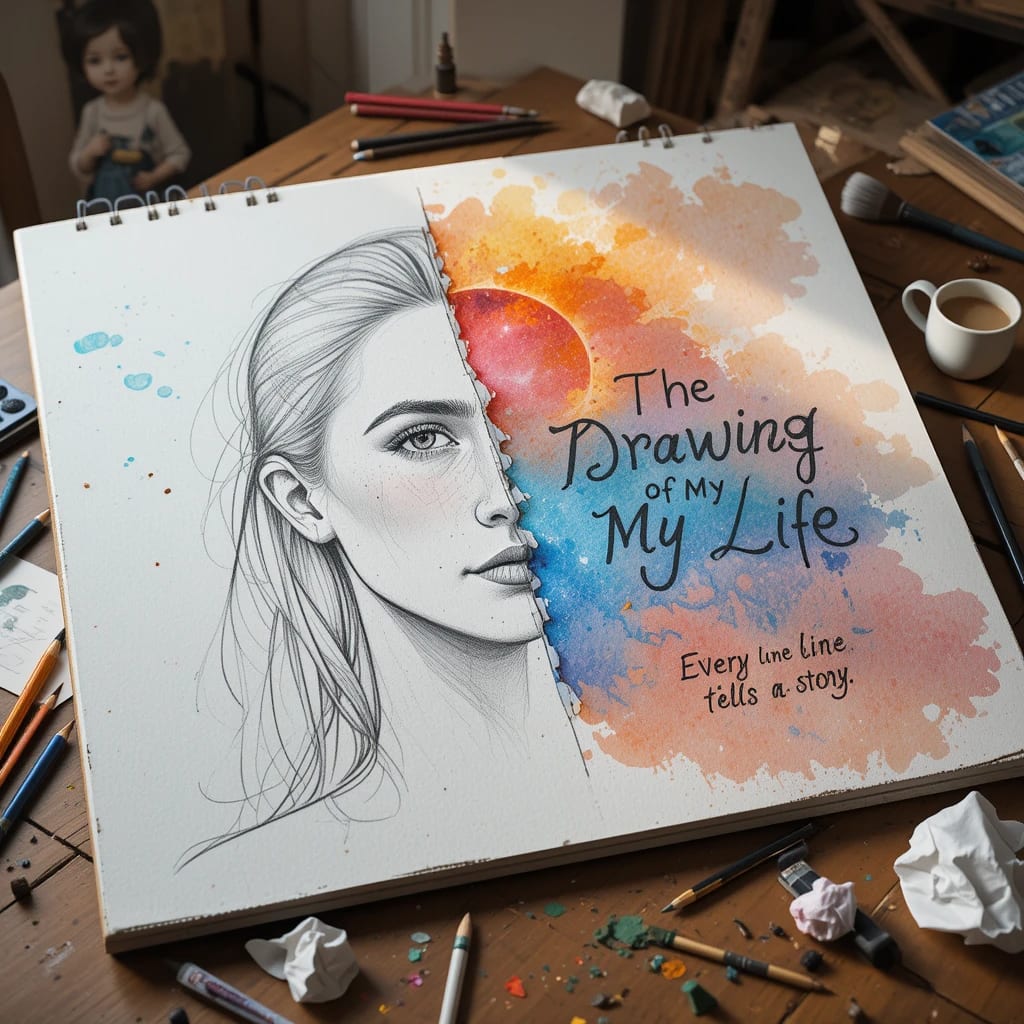
The Drawing of My Life
Every line I drew brought me closer to who I am

When I was a child, I believed that pencils held magic.
Not the kind of magic that turned frogs into princes or moved mountains—but the quiet kind. The kind that turned thoughts into pictures, emotions into shapes, and silence into color. I didn’t speak much as a kid. While other children chased each other on the playground or shouted answers in class, I sat in the corner of my own world, sketching stick figures and stars on the backs of my notebooks.
I still remember the first time someone noticed my drawings. It was Mrs. Rose, my third-grade teacher. She picked up a torn sheet I had thrown away—something I had drawn in frustration—and held it up like it was a masterpiece. “Did you draw this?” she asked, her eyes wide with wonder. I nodded, unsure whether I was in trouble or being praised.
She knelt beside me and whispered, “Never stop drawing. You have something special.”
That moment stayed with me. Because until then, I thought I was just someone who couldn’t speak well. But through her eyes, I began to see that maybe my silence wasn’t a weakness—it was just a different kind of voice.
As I grew older, drawing became more than a hobby. It became my diary, my therapist, and my best friend. When my parents fought behind closed doors, I drew gardens full of peace. When I failed a math test and felt like I’d never be good enough, I drew wings on myself and imagined flying away. And when my grandmother passed away, I filled my sketchbook with memories of her hands, her laughter, her teacup that always smelled of mint.
Each drawing was a story I couldn’t say out loud.
But not every part of my drawing journey was easy. There were years when I doubted myself. High school was brutal. People called me weird. “Why do you draw so much?” they’d ask. “It’s not like you’ll become famous or anything.” I tried to stop. I packed my sketchbooks in a box and told myself to grow up.
But I couldn’t stay away. One rainy afternoon, after a particularly rough week, I found myself sketching again—absentmindedly at first, then with urgency. My hands ached to draw. And for the first time in a while, I felt like myself again.
That’s when I realized something important: Drawing wasn’t a choice for me. It was who I was.
When I got to college, I took the risk of enrolling in a fine arts program. My parents were skeptical—“How will you make a living?”—but I knew I needed to follow my heart. I didn’t need fame. I didn’t need a million followers. I just needed to draw.
College was where I met people like me—quiet creatives who expressed themselves in color, motion, sound, and line. We’d sit for hours in shared silence, painting together in sunlit studios, each lost in our own world yet strangely connected.
In my second year, a professor assigned us a project: “Draw your life, not how it looks, but how it feels.”
At first, I stared at the blank canvas in panic. How could I possibly show all of that? My childhood fears, the sound of my mother crying in the kitchen, the joy of learning to ride a bike, the heartbreak of losing friends, the hope I felt when someone believed in me?
But then I picked up my pencil, and I started.
I drew crooked houses with warm windows. I drew a girl sitting alone with a sketchbook in her lap and stars above her head. I drew bridges built out of paper, walls that looked like mirrors, and hands reaching out from the darkness toward the light. I drew shadows and sunshine tangled together. I drew pain and healing in the same frame.
It wasn’t perfect. But it was honest.
When I presented it, the room went quiet. And then, slowly, someone clapped. Then another. And another. I didn’t need words. The drawing had spoken for me.
Since then, my life has continued to unfold like a canvas. Some days, the strokes are smooth and beautiful. Other days, I smudge the lines, start over, or rip the paper entirely. But I’ve learned that’s okay. Every masterpiece has messy beginnings.
Now, I teach art to children who are like I once was—quiet, unsure, and bursting with creativity that doesn’t know where to go. I tell them what Mrs. Rose told me: “Never stop drawing. You have something special.”
Some of them light up when they hear it. Others look down, not sure if they believe me yet. But I know they will. In time.
The drawing of my life isn’t finished. It probably never will be. It’s a work in progress, a canvas that keeps growing, changing, deepening. I’ve added colors I never expected, erased paths I thought were permanent, and painted in dreams I never dared say out loud.
But every line means something.
Every mark—good or bad—is part of who I am.
And if I’ve learned one thing through all these years, it’s this:
You don’t have to be perfect to be beautiful.
You don’t need to be loud to be heard.
And sometimes, the quietest lines tell the loudest stories.
Keep reading
More stories from Esther Sun and writers in Fiction and other communities.
In the Arms of the Night
The next morning, sunlight streamed through Mira’s window, casting warm patterns on the floor. Yet, despite the brightness of day, her mind kept drifting back to the night before — that profound quiet, the comforting darkness, the stars watching silently like ancient guardians.
By Esther Sun8 months ago in Fiction




Comments (1)
I can really relate to this. I had a similar experience with a teacher who saw something special in my work. It's amazing how one person's validation can change everything. You mentioned high school being tough. Did you ever find a way to show those doubters that your art was important? And how did you keep going when you wanted to quit?