
The Dragon, The Child, and The Styx
The tale of a Greek dragon and a young girl.

The air was thin, thin enough that the distant shouts from Delphi above could travel great distances; yes, thin enough that you could see the serpentine writhing of the clouds; and thin enough that the wind could eat you alive. Likewise, the sun was a hazy ball in a pale-blue sky that spread across the horizon. The air was so thin that even looking directly at the sun would cause pain in your eyes.
However, the heavy pong of rotting flesh lazily overpowered the thin atmosphere. The stench of rotting flesh permeated everything around you. It coated each blade of grass and clung to your nostrils and clothes when you tried to turn away. Every dead thing in the world seemed to have drifted to this desolate place.
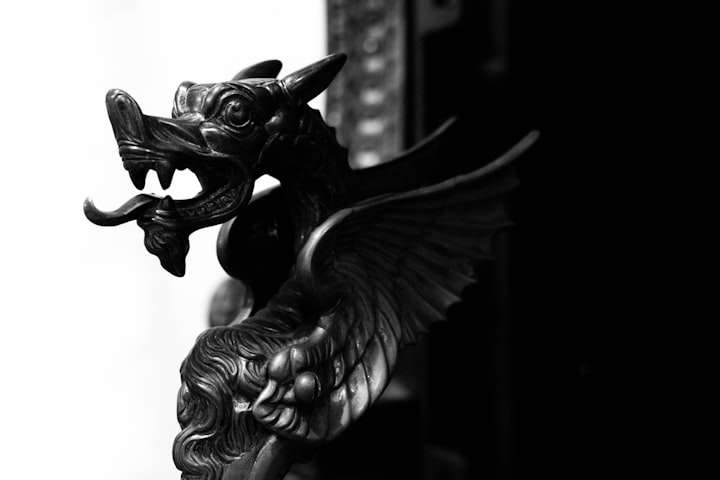
Delphyne, a Drakaina — a female creature half woman and half snake or a Greek dragon - was chained to the trunk of two fir trees, which were embedded at the base of Mount Parnassus. Her hair was long and black, spilling down over the great length of her scaled shoulders. Green scales covered the tops of her breasts, and the soft white skin of a woman’s belly peeked out from beneath them.
Her hands were shackled, and her ankles too. Her legs were thick and robust, with long muscles built for endurance and power. Her black tail was as long as she was tall and had a barbed tip that glistened with poison. While small chains were wrapped around it to keep it from moving too far, they were long enough to allow her to move around but not far.
The tree bark at her back was rough against her skin. It seemed to have grown around the tree for generations, wrapping it up in its gnarled arms until it was unrecognizable. The torturous bark cut into her when she moved; its edges were sharp enough to draw blood every time they touched.
Given her restraints, she spent most of her day eating - something she did freely because the food was abundant. Moreover, she had an endless supply of rejected sacrifices that were hurled over the city’s walls and down the chasm to where Delphyne was a prisoner. So, munching, chomping, and wolfing were how she spent her day. And when she wasn’t doing that, she was sleeping or wandering between the two trees.
And so, one day, it happened. At first, Delphyne didn’t realize that she was being watched. Instead, she paced in her small patch of forest, inhaling deeply as she went. The smell of the trees and flowers filled her senses, making her feel at peace for a moment.
As she continued pacing, however, something strange began to occur. It started with a faint buzzing in Delphyne’s ears that quickly grew into an overpowering roar. The noise made it impossible for her to think clearly or focus on anything else but finding its source.
As time passed and Delphyne got closer to whatever was causing all this commotion, things only grew stranger. Everything around her seemed to be glowing with an otherworldly light as plants and shrubs sprouted up out of nowhere before fading back into nothingness again almost instantly after appearing.
Finally, stepping out from behind some large trees, she saw something. Inside a huge leafy canopy were two magical creatures unlike any ever seen by her before. But, first, she noticed a big, winged lion-looking thing perched atop what appeared to be an armored human warrior who glowed like pure gold. His entire body was covered in it except for his gray eyes.
Then nearby the vision, there was a toddler… a young female child, no older than three years old. She was crying. As if the vision wasn’t weird enough, Delphyne felt her breath rush quickly out of her lungs. She hadn’t seen a human in millennia. Her isolated punishment banned her from interacting with any person. Yet, she was curious to see the child crying without consolation.
Delphyne inquisitively walked towards the child.
“What’s the matter?” She asked at length.
The young girl wiped her eyes and fearfully stared at Delphyne. She, too, was in amazement. She had never laid eyes on anything so hideous and horrendous. She couldn’t believe such a creature as a woman mixed with a serpent existed. The child screeched and hid her face in her tiny hands. Delphyne jumped back at the crack of the child’s voice.
“Don’t be afraid. I’ve been here too long by myself. And my curiosity brought me to you crying. I won’t hurt you.”
The sobbing child slowly rose her head and, with puppy eyes, stared at Delphyne.
“You promise?” She asked coyly.
Delphyne nodded in agreement.
“What are you?” asked the curious child.
“I’m an oddity. Or a creature from the past… one who no longer is relevant in this new world. Did you know that things are changing?” questioned Delphyne. Then, without waiting for an answer, she continued, “You wouldn’t know. You’re too young to know. You haven’t seen war. Or hunger. Or famine. Or the destructive powers of the god Apollo. The worst you’ve seen is a bad day where you’ve wandered off into the woods and encountered me… Do you understand what I am?”
The little girl shook her head but fixed her eyes on Delphyne. She studied her from head to toe as she let her olive-green pupils dance wildly in their sockets. They moved 300 times a second.
“Am I lost?” She inquired after conducting her survey. “I remember eating bread then waking up here. Where am I?”
Delphyne, with interest, listened to the girl. The words hung in the air and refused to lose their shape. Assuming the girl’s words were true, the story made no sense. She was carried or dropped off if she didn’t wander into the woods. The girl’s voice, with its soft accent, was as hard as her words.
“You don’t know where you are? You are at the base of Mount Parnassus. You’re in Delphi. Do you know Delphi? It’s the city where the god Apollo lives. And where Pythia lives.”
“Who?”
“Pythia - the revered Oracle. Her job is to be the mouthpiece of the god Apollo. Through her, he speaks and communicates messages to common folk and the kings. Through her, he answers a plethora of questions that are brought to him daily. Should we go to war? Is one. Does my wife love me? Is another. And so, daily, the god Apollo speaks through the Pythia. And day-to-day, he satisfies the curiosity of all who come from afar. Surely, that’s why you’re here. Your parents brought you, I’m sure. Do you know where you’re from?”
She nodded yes and said Athens.
“Athens? Child, you are far from home. Who brought you here? Your father? Your mother? Someone else?”
“I’m not sure. I was eating bread, and then I woke. And then there was a river. And a bad man. He had a boat. He wouldn’t let me get on his boat. He said I needed to pay him. I don’t have money. I don’t work.”
A bad man… the cogwheels started turning within Delphyne’s head. In her mind, only one man owned a boat and required payment to get on his boat. He was an evil man, according to some. And it wasn’t necessarily his character that made him bad. It was his looks.
He had an ancient body. And he wore a cloak and hood to cover his face. The old man hunched over, his back curving like a question mark. His eyes were a murky red, and his skin sallow and dried like a prune. His hairs were long, grey, and white.
His smell reminded you of old age. It smells like an old library and mothballs. He had a deep voice, and he was singing a song. The song was about the Trojan War and a hero called Agamemnon. He had very short breath, and it came out in quick puffs. His voice was a whisper, his words sharp and straightforward. No one knew what he said. When he did speak, it was to himself.
“Did he have a very long beard, and was his skin wrinkly like a dried prune?” Delphyne paused.
“Yes. His hand was very rough and wrinkly. He was dry like a corpse, his skin withered and eyes sunken. His lips cracked, and his hand was a claw. He moved slowly; his joints creaked when he moved. And he had a white beard, gnarled fingers, spotted hands, and a reflection of age in his eyes. He was haggard, hunched, spotted, and snowy-haired.” The little girl replied.
Delphyne stepped back as she realized what was before her. She then extended her scaly hand to the girl sitting on the ground. The girl hesitated but complied and stretched her tiny hands, which disappeared in Delphyne’s.
The little girl stared blankly as she stood up from the ground. Her gaze was lost in the hideousness of the Drakaina. Delphyne pulled her in. And turned her around. She pointed to a set of caves nearby. She said there was a way to get back to the river’s shore in those caves.
“Why?” asked the child as she started to cry. “I don’t want to go there. The mean man will try to hurt me or tell me that I can’t go to the other side of the river.”
“He won’t hurt you. That’s where you have to go.”
“I want to go back home, back to mommy and daddy. I won’t misbehave anymore. I’m scared.”
“You can’t go back to them. You are no longer part of this world. You belong to the next world… do you have any brothers or sisters or friends who aren’t around anymore? Maybe something bad happened to them?” Probed Delphyne.
The little girl nodded through her tears.
“Ok, then you will see them again. They will be there to play with you. To be with you. And one day, your mommy and daddy will come to see you.”
“What about you? Will you be there too?”
Delphyne hesitated to answer. She then looked around. Above her head, the humdrum of the city could be heard. The bustling and the raucous could be heard everywhere.
“That place is for people like you – mortals. I won’t be there. I die if a god kills me, but I don’t get to live on. It’s part of the reason that I’m here shackled. I’m hidden from those gods that want to kill me. I’m protected. But if my enemies find me, I will die.”
“Enemies?”
“We all have enemies. Maybe not you. You’re young. But the older you get, the more likely it is to have enemies… bad people… those who don’t like us.”
“Why would someone not like you? I mean, you’re ugly, but you aren’t mean.”
Delphyne laughed a huge, snorting chuckle, an old dragon’s laugh, the laugh of a mother not just to her own but her whole community. This laugh was like cannon fire, a laugh that was lava flooding a city, a laugh that was a million talons scrabbling on an enormous cage.
“People hate me because I’m different and because I represent a world that’s different from theirs. Their world runs on supplications for more. Not only for more of their own but also more of what rightfully belongs to someone else’s. Their pleonexia drives them. But, on the other hand, it doesn’t drive me. I’m an archaic propelled by my sense of duty and commitment to my purpose.” She said at last.
“What is purpose? Do I have a purpose?” The girl asked.
“I think you do. I’m not sure. I’m not entirely human. Do you know what pleonexia means?”
“Greed.”
“You’re a smart girl. I’m sorry you couldn’t make more with your life.”
“Can you make more with yours?”
Delphyne wiped the little girl’s face. Tears stained her pale cheeks, and her round eyes looked like she would scream at any moment if the Drakaina didn’t hold her tight. Her nose was crusted with snot, and she couldn’t breathe through her stuffed nose. Then she hugged her.
“We have to go. Kharon won’t hurt you.”
“Is that the old man?” The girl asked coyly.
“Yes. I have the fare for you to pay. I’ll walk you to the edge of the river. What’s your name?”
Suddenly, the little girl shook violently and transformed before Delphyne. She was riven and detritus, stinging insects with stings as sharp as scorpion tails. She was carrion and the dew-mad cobwebs that fill the corners of old barns; she was a foul sore of a canker growing in the mouth of a diseased demon that fed on excreta, rotting carcass, and vipers. All beauty was cast aside. The world was askew. Her breath was contaminated. Delphyne was thrown back by the metamorphosis of the child.
The child convulsed and caved in. She fell to the ground and balled up. She shrieked. Her voice juddered the base of Mount Parnassus. Delphyne felt the scales on her back spike like sharp barbwires.
At last, the girl stopped. Then in radiant splendor, she stood to her feet. She was no longer young. Instead, She was a large and majestic, massive marble woman with a gown that shone like water, a gown that changed and shifted color so that it always seemed to be reflecting light, a gown that made her grow ever more into something enormous. This gown would swallow up children and whole civilizations as it swirled around her hips, a gown woven by the talented hands of Arachnid.
“Hera.”
“Your enemy, as you say. Were you really going to take me to the Styx, or were you trying to lure me inside the cave to eat me? You, creatures, are all the same: base. You lack the common sense of us, the gods. Mortals supplicate for more. We take it. It’s ours, rightfully. Don’t you agree, you abomination?”
“Abomination? Me? You’re the doppelganger of injustice, the counterfeit that promises more than what you can deliver. You’re why this world is nigh to burning at the gates of Tartarus.
‘You’re arrogant. You and all the gods. Delphi is not Delphi simply because of the Temple of Apollo. This place was first Pytho, where we worship Gaea. And the same place where Gaea had instructed Pythonos to guard it.
‘Zeus, Apollo, you, and the gods, all jealous wanting to have this place for yourselves. This tiny backwater village, where Zeus called it the navel of the world.”
“Silence, you abomination. I’ve looked for you forever. You escaped the fate of Pythonos because Athena helped you. But, unfortunately, she won’t aid you anymore. Therefore, I now assume the role of judge. I am the Queen of Mount Olympus and Queen of all the gods and goddesses. And I alone sentence you to death.”
With those words, the pain had thunder-pressured itself into Delphyne’s skull, and her front teeth were chipped. She knew she was going to do battle. She knew she would have to fight Hera. Kill or be killed. But that knowledge quickly faded when she saw her reflection in the sweat drops floating in front of her face. Hera’s anger made everything around them shake and defy the laws of nature.
Delphyne’s palms were sweaty, her fingers tingled, a thousand ants crawled over her skin, and the gooseflesh rising rose from paranoia and fear, not cold.
Without warning, she was flung into a Greek fir. Her knees buckled and compressed so tightly that they felt like springs, ready to release the tension. And her head whacked against the bark. Delphyne tasted the iron in her mouth, an unpleasant metallic aftertaste. Her tongue tried to move out of the way, but she couldn’t swallow or breathe.
Delphyne panted, and her breath was like a fire on the wind, hot and constant, a wildfire that couldn’t be put out. The scent of sulfur, smoke, and burning wood flooded her nostrils and scalded her lungs. Her mouth watered with the taste of scorched earth, wild grass, and animal hides.
Delphyne shook. The tiny muscles throughout her body flexed and trembled, every inch of her skin reacting to the threat. Finally, she could do no more than curl up near the tree. She shivered and shuddered; her pale scaly skin was wet with sweat, and her beastly hair matted to her head.
“You think yourself better than the gods; better than the mortals. Then I will make you feel what it is to be a god and a mortal at once. See if you can handle the true beast that lives in us.”
With those words, Hera released Delphyne from her shackles and lifted her high above the city. Suddenly, Delphyne was struck by the beauty of the great city above, its skyline familiar yet foreign. She breathed in deeply to taste the city and all its wonders.
But then, she was suddenly overwhelmed by fear. Thousands of people walked around her, breathing the same air and drinking the same water. She was just a single human, weak, frail. She was easily replaced, easily forgotten. She was afraid that someone would find out what she was. She was human now, but some part of her was still a dragon. Then Hera motioned her hand into a fist, and Delphyne exploded into a million pieces.
About the Creator
Edy Zoo
Edy Zoo is an author who writes about social subjects. He contributes to the ever-growing library of social critics.
Becca
"Everything is so... flat." Denille said stupidly as she looked around her new neighborhood. She looked around at the muted desert where even the smallest sign of life seemed to have given up. The plant life was shrubs that were half cooked by the heat and where there should have been a lawn, a mess of white rocks laid glistening in the sun. Even the sky looked stretched thin, like the sun had ironed it smooth. She’d moved from Riverside, where at least there were hills, but here in Barstow, everything felt baked and brittle.
By Sara Wilson7 days ago in Fiction


Comments (2)
I like the characterization of a very not typical dragon, specifically in the physical form you describe. Your descriptive language is amazing, I feel like I can picture the characters and setting in my mind! Nice work.
Very interesting tale...