
The Dogs of Willow Lane
Sometimes, it’s the smallest paws that leave the biggest prints on our hearts.

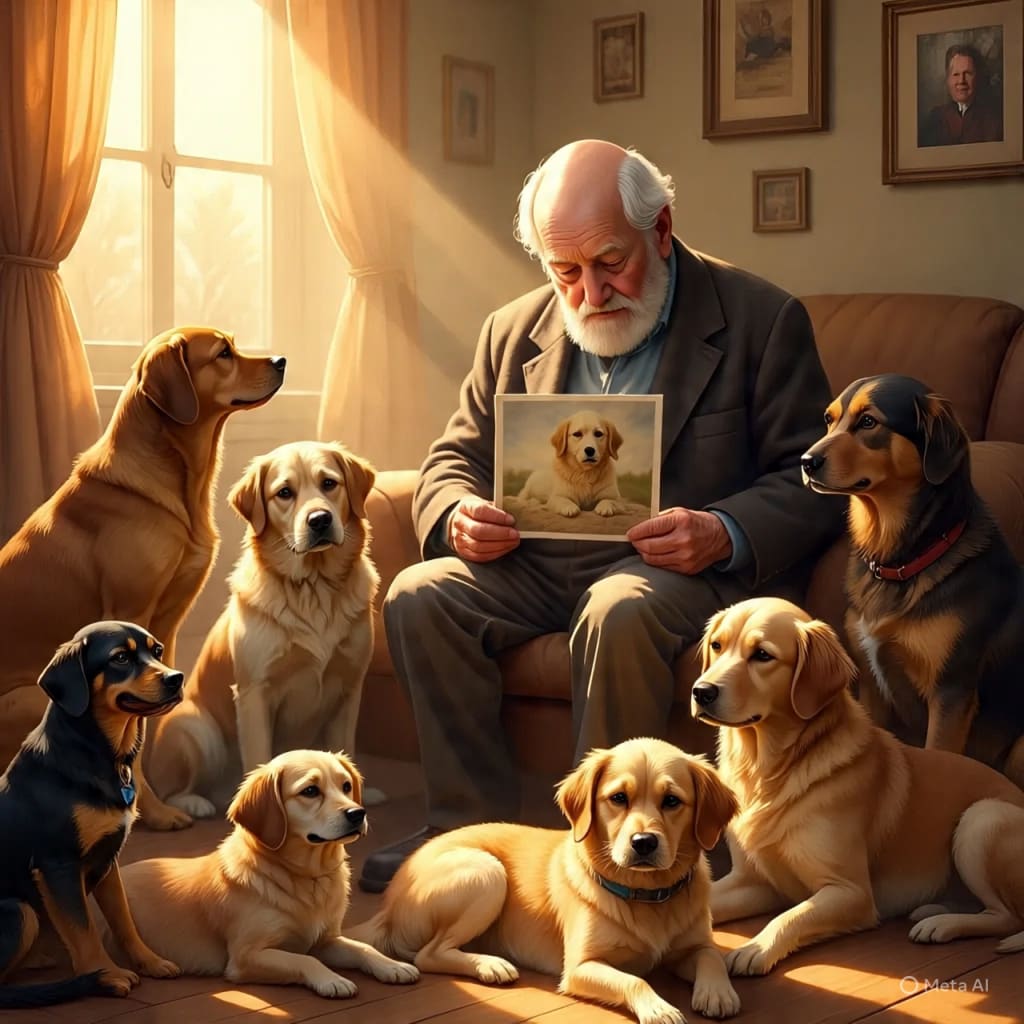
At the very end of Willow Lane stood a modest little house surrounded by trees, flowers, and laughter. It wasn’t fancy. The paint was chipped, the fence leaned to one side, and the roof sometimes leaked in heavy rain. But every person in town knew that house. Not because of the house itself—but because of the dogs.
Twelve of them, to be exact.
Big ones. Small ones. Fluffy, shaggy, short-haired, and long-eared. They came in all colors—golden, black, spotted, brindle, and snow white. But what they had in common was one thing: they all belonged to an old man named Leo.
Leo had lived on Willow Lane for over 40 years. A retired mailman, he had walked nearly every street in town and knew every doorstep, every barking voice, and every tail wag. He’d started with just one dog—a golden retriever named Daisy. She used to wait for him at the end of the lane every day after work, tail wagging like a flag in the wind.
But as the years passed, things changed. One rainy evening, Leo found a trembling pup in a box behind the grocery store. He brought it home. A few months later, someone abandoned a limping stray near his fence. He brought that one in too. Soon, it became a habit.
“Just one more,” he’d say.
But dogs don’t understand numbers. They only understand kindness.
By the time Leo was 75, his house was a sanctuary—filled with barks and snores, dog bowls and tennis balls. Every morning, he took them all on a slow walk through the town. The dogs were so well-behaved, so gentle, that children would run from their front doors just to walk alongside them.
Old ladies sitting on benches would save scraps from breakfast to offer a sniffing nose. Workers would stop their lawnmowers just to wave. The entire town looked forward to Leo’s daily walk.
And then, one day, he didn’t come.
The next morning, there was no parade of paws down Maple Street. No barking. No wagging tails. The town noticed.
By afternoon, three kids from the neighborhood rode their bikes to Leo’s house. They knocked. No answer. The dogs barked inside—but there was no Leo.
Mrs. Henderson from next door had a spare key. She opened the door and gasped.
Leo was in his chair, smiling faintly, holding an old photo of Daisy. His eyes were closed. Peaceful.
The dogs were all gathered around him—quiet, still, as if they understood.
The news spread fast. The man who’d never asked for anything, who’d only given love, was gone.
People wept. Some brought flowers. Others brought food—for the dogs. And the question rose: what now?
Twelve dogs. No family. No will. Just a small house full of big hearts.
The town didn’t argue. They acted.
The kids made posters. "Leo's Dogs Need Homes."
The bakery put photos on their counter.
The mayor posted on social media: “Leo gave our town love. Let’s return it.”
By the end of the week, every dog had found a new home.
Buddy, the clumsy St. Bernard, went to the fire station.
Lucy, the small terrier with the loud bark, was adopted by the local librarian.
Even Max—the nervous one who only trusted Leo—was taken in by the vet’s family and slowly learned to wag again.
But the story doesn’t end there.
The townspeople missed the daily walks. They missed the laughter, the joy. They missed Leo.
So one spring morning, a little girl named Emma showed up with her puppy and walked alone down Willow Lane.
The next day, two more kids joined her.
Then a woman with her dachshund.
A teenager with a rescue greyhound.
A man who had never owned a dog but borrowed his neighbor’s Labrador “just to be part of it.”
By summer, dozens of dogs and owners walked together through the town every morning. They called it “The Leo Walk.”
They even painted a mural on the side of the old bakery—Leo sitting on a bench, surrounded by dogs of every size, his eyes crinkled in a smile.
Years passed. The dogs changed. People moved in and out. But the Leo Walk remained.
Because some love is too big to disappear. It stays in the air, in the footsteps of dogs, in the happy yips of puppies and the warmth of a wagging tail.
It stays in the heart of a town that learned:
One man and a dozen dogs can make the world feel like home.
About the Creator
Keep reading
More stories from Muhammad Bilal and writers in Fiction and other communities.
The Whispering Tree
In the quiet village of Noorabad, nestled between golden fields and deep forests, there stood an ancient tree—its branches twisted like the fingers of an old storyteller. No one knew exactly how long it had been there, but everyone called it The Whispering Tree. It was said to speak when the wind was just right—softly, like a lullaby, and only to those who dared to truly listen.
By Muhammad Bilal7 months ago in Fiction
Bomb Scare
It was 2027, and the world never thought it would happen. A missle hit the United States, but it wasn't where they had anticipated. A little town in the northeast was hit by a missile strike, they didn't know why, and they didn't know exactly where it hit, but they did know it was a coastal community, somewhere between Maine and Delaware.
By Gregory Payton7 days ago in Fiction
A Dystopian Escape into Hope
In the not-too-distant future, the world as we know it collapses. A once-thriving civilization, perched at the peak of technological advancements and power, crumbles under the weight of its own excesses. Greed, war, and environmental destruction ravage the Earth. What remains is a haunting, desolate world where only one city stands as the last bastion of human survival. But even this sanctuary, surrounded by decaying ruins and the remains of former glories, is on the brink of falling apart. The story of The Last Human City is a haunting narrative of survival, hope, and the resilience of the human spirit in the face of overwhelming odds.
By Jhon smith5 days ago in Fiction
Worth the Wait: Puerto Viejo, Costa Rica
Beach bumming in a small Caribbean beach town sounded like a perfect way to end our 6-month trip through Mexico and Central America. Or so we thought. The foul, fishy stench of rotten seaweed hit our nostrils as we stepped from the cramped bus and looked out at a rather depressing, empty, and underwhelming black sand beach. It was pouring with rain, and we had to quickly fish out our ponchos. We thought, this couldn’t be it, could it?
By Sh*t Happens - Lost Girl Travel6 days ago in Wander



Comments
There are no comments for this story
Be the first to respond and start the conversation.