
The Day We All Started Hearing Our Future Regrets
One morning, the world woke up to whispers from the future—regrets of choices not yet made, echoing in everyone’s ears.

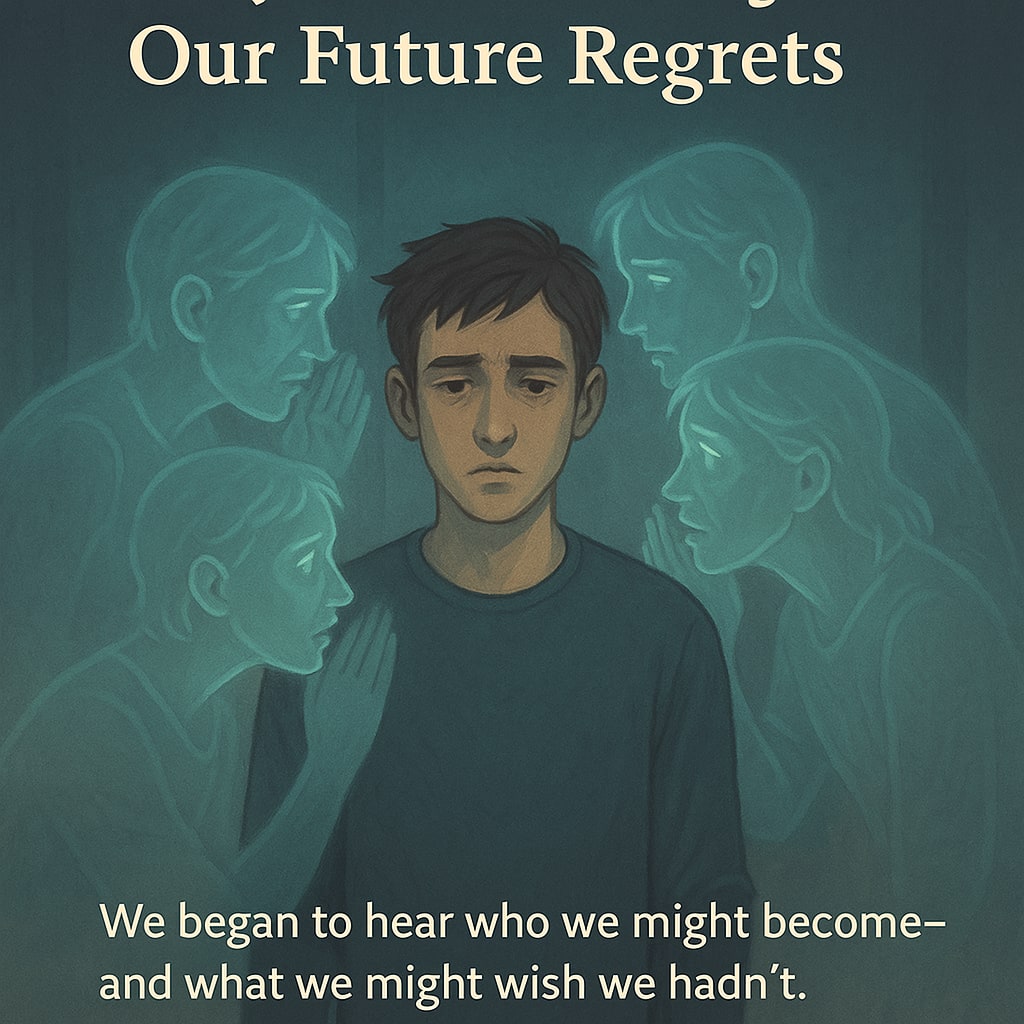
It began with a sound that didn’t belong.
At 4:13 a.m. in Reykjavik, a woman sat up in bed and heard a voice say, “You should have told her you loved her when you had the chance.” The voice was her own—but older, sadder. She was alone in the apartment.
By sunrise, millions had heard similar phrases. Whispers in their ears. Clear as conversation, yet sourced from nowhere. All in their own voice. All speaking of future regrets.
Not memories.
Not dreams.
But echoes of what would one day hurt to remember.
The First Day of Regret
People poured into streets, phones in hand, recording what they heard:
“You stayed at the job too long.”
“You never visited your father before he passed.”
“You let fear decide everything.”
The phenomenon spared no one. Children heard simpler phrases—“You stopped drawing when they laughed”—while elders were overwhelmed by a torrent of voices: paths not taken, people not forgiven, words not said.
Governments declared national emergencies. Not due to violence, but due to the collective psychological unraveling. Airports were flooded with people chasing family, lovers, dreams. Office towers stood half-empty by noon.
Therapists reported 600% increases in emergency calls.
The Science of Echoes
Scientists struggled to define it.
No devices were implanted. No signals detected. No proof of external tech, religion, or psychosis. But the pattern was universal, and always intimate.
A neurologist from Chile coined the term “Cognitive Time Feedback”—the brain, somehow, skipping forward to the echoes of emotional regret and bouncing those signals back.
“It’s not prophecy,” she clarified. “It’s potential pain. You’re hearing your own future disappointment.”
Societal Breakdown—or Breakthrough?
At first, chaos. Then… recalibration.
People left abusive relationships overnight. Others returned to long-abandoned passions. Marriage proposals surged. So did divorces. Quiet revolutions bloomed in living rooms, dorms, park benches.
One man quit his job as an oil executive, stating his regret whisper told him: “You made money but died ashamed.”
Children began to ignore rules designed to keep them quiet, especially when their whispers said, “You stopped being curious.”
And there were those who resisted. Who called the phenomenon a hoax, a test. But even they heard the voices in the quiet moments.
One protester’s sign read:
“IF THIS IS FAKE, WHY DID IT TELL ME HER NAME?”
Monetizing the Echo
Of course, capitalism tried to capitalize.
Tech startups sold “Regret Trackers” to log and analyze your whispers. Life coaches tripled their rates. Apps offered AI-simulated “counter-whispers” to drown out the real ones.
But nothing worked like simply… listening.
Some whispers vanished the moment the listener changed their mind—called their mother, enrolled in that course, apologized sincerely.
Others lingered. Repeating, fading, returning—until something internal clicked.
One woman documented her whisper: “You never wrote the book.”
She started that night. She never heard it again.
The Echo Doesn’t Lie
What frightened people most wasn’t the regret.
It was the truth behind it.
These weren’t grand, melodramatic visions of death or failure. They were quiet, aching losses of authenticity. The subtle erosion of self.
“You never forgave yourself.”
“You stayed quiet to keep the peace.”
“You became someone else’s version of you.”
The whispers didn't predict apocalypse. They warned of wasted time.
And that made them harder to ignore.
A New Kind of Time
Months passed. The whispers remained—but people changed.
The world grew softer. Slower. Stranger.
We began to live with one foot in the future—not chasing fear, but listening for the weight of it. Choices became sacred. Not perfect. Just deliberate.
And while some regrets could not be undone, new ones could be prevented.
Even now, I hear mine. Faintly. At night.
“You let it all fade. You stopped writing.”
So I’m writing this.
Because maybe if I do, that whisper will fade.
And I’ll become someone I don’t have to apologize to later.
About the Creator
Ahmet Kıvanç Demirkıran
As a technology and innovation enthusiast, I aim to bring fresh perspectives to my readers, drawing from my experience.
Keep reading
More stories from Ahmet Kıvanç Demirkıran and writers in Fiction and other communities.
The Day It Started Raining Personal Clouds
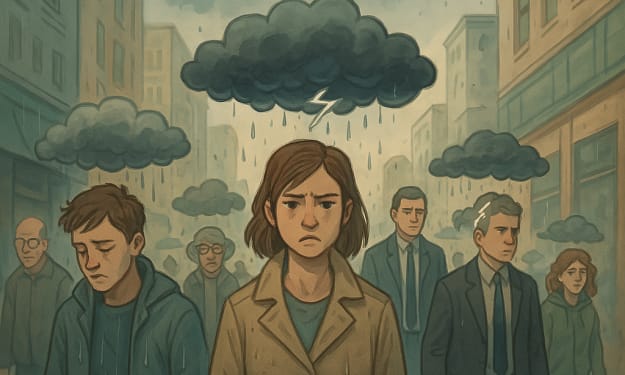
It was a Tuesday when the clouds got personal. At first, no one noticed. A gray sky, a drizzle here and there—nothing unusual. But by 10:47 AM, every person on Earth had a small cloud hovering precisely two feet above their head. Not a shared storm. Not a city-wide weather pattern. Each individual, from toddlers in strollers to CEOs in boardrooms, suddenly had their own little weather system.
By Ahmet Kıvanç Demirkıran10 months ago in Fiction
The Devil's Cut
“Comrade, finally you’re awake.” The voice was smooth, sensual. A flickering incandescent bar was all that lit the white, sterile room. All Vladimir remembered was everything going black. He tried to move his arms and found them strapped to the gurney.
By Matthew J. Fromm5 days ago in Fiction
The Ancient Egyptian Goddess Ammit
In Egyptian mythology the ‘Hall of Ma'at’ is a forsaken place, dark and unforgiving. The rite of passage to immortality of one’s soul hangs in the balance. A ceremony named quite appropriately as the “Weighing of the Heart” has two potential outcomes, a pathway to eternity for the pure of heart, the other a dark voyage into everlasting agony and condemnation.
By Michael Langilleabout 15 hours ago in Fiction


Comments (1)
Fabulous I don’t want to hear mine ♦️💙♦️