
The Day The News Stopped
"We're having some technical difficulties. We apologise for the inconvenience."


Waking up and pouring himself his morning coffee, the man turned on his television and switched to the news.
This was how he started every day, seeing what madness he had slept through overnight.
The world used to be simpler when he was just a boy. It would produce just a single hour of news a day, at six o’clock on an evening, and that was it. And everyone was perfectly happy with that.
But now, apparently, the world had lost its mind and needed to be watched 24 hours a day, 7 days a week, with reporters all over the globe, and even then there wasn’t enough time to cover everything.
It would maybe start with breaking news about an unknown explosion in the Middle East, and before you could come to terms with that you’d be zipped to America to hear about police brutality and a shooting, then a sudden turn of pace to hear about those Panda’s that finally had a baby in the zoo, followed by an update on the violent protests about something or another in Eastern Europe.
And all of that before the man could finish his morning coffee.
It never stopped. There was always something happening, and it was always presented like the most important thing to have ever happened, but was almost always forgotten a few days later.
But this morning was different.
When the man turned on the television and switched to the news, something amazing happened. There was no news being reported.
The news anchor shuffled his papers and nervously eyed someone off camera, growing impatient. No words came on the anchor’s teleprompter for him to read. The papers he shuffled were blank. No news came through his earpiece for him to report.
To save the anchor his public embarrassment, the screen quickly faded to black, and on it came the words:
“We’re having some technical difficulties. We apologise for the inconvenience.”
The man frowned, sipped his coffee and shook his head. This was breaking his routine. He was a man that needed his morning news as much as he needed his morning coffee. He needed to know that things were happening in the world outside before he boxed himself in his cubicle at work for 8 hours.
He needed to hear about the murders and kidnappings and wars and exposés and celebrity scandals and all that other nonsense. He needed that sense of dread and feeling that the whole world was going to hell, because at least then he knew the world was still there.
He changed the channel to another, but saw the same message about technical difficulties.
He changed again, same again. Was there a hacking, he wondered, or a mass outage with their software?
He changed to an American station, and saw it was the same there as well. Then a Russian station, same. Chinese, same. Saudi, same. Italian, same.
Every news channel either contained some message about technical difficulties, or a confused anchor fumbling on screen and apologising.
After cycling through the two dozen different channels, he returned to the first, and saw the news anchor back on screen, no longer holding his papers, with his earpiece hanging out, staring at the camera with pitiful and apologetic eyes.
“Once again, as you are tuning in this morning, we apologise we are unable to bring you our usual broadcast,” the anchor said. In his 25 years with the station he had reported on two dozen wars, thousands of murders, dozens of governmental scandals, and three Royal Weddings.
It was clear by the anchor’s expression and wandering eyes that there was no teleprompter to feed him anything. He was doing something he had never done in his entire career: speaking his own mind.
“Put simply,” the anchor said, “there is no news today. There is nothing to report. Our correspondents around the globe have nothing for us. There is no gossip, rumour, announcements, or terrible events. There is nothing at all happening in the world.”
The man watched on, put down his cup of coffee and leaned back in his chair. This in itself was breaking news. This was the news of the century.
“We pride ourselves on this network of never coming off the air, always covering everything around the globe and bringing it to you as soon as we have it,” the anchor said. “But today, the globe is silent and at peace. So although we apologise for the lack of our usual broadcast, let us all be grateful for the reprieve, however temporary. For the first time in over a decade, we are going to go off the air, and I hope you enjoy this as an alternative. When anything happens we will, of course, return.”
His face faded off screen and was replaced with the same words “we will return”, and the luscious piano keys of Erik Satie, then Debussy, then Chopin, one after the other.
And in the man, much like in the news anchor, dissipating from the initial annoyance and confusion at the break from the norm, was a peace he had never had his entire adult life.
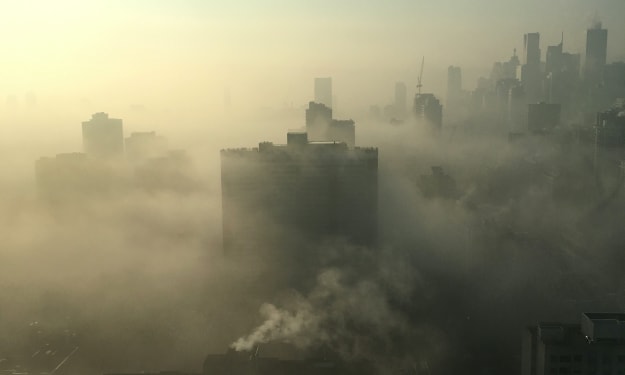
The usual fog that clogged up his thoughts and sapped him of energy, filling him with anxiety and worry — a worry that the world was going to hell — was now replaced by Vivaldi, Beethoven, Haydn, and then as the music continued and faded in to the background, everything became clearer, lighter. There was, in the man, a stillness, and a reminder that everything was okay, if only for today.
Moving and sitting instead by the window, with the music from the televsion still playing, the man watched the world outside. There was no news, but the world was still there.
About the Creator
R P Gibson
British writer of history, humour and occasional other stuff. I'll never use a semi-colon and you can't make me. More here - https://linktr.ee/rpgibson
Keep reading
More stories from R P Gibson and writers in Fiction and other communities.
It Was All They Knew
By the year 2XXX, the land was smoke and fire. Buildings stood empty, crumbling slowly to the ground. Streets were littered with debris and scarred by battle. Weeds sprouted through the cracks in the rubble before being choked in the air. This was no longer a world for the living.
By R P Gibson4 years ago in Fiction
The Silence Between Footsteps
Chapter One: The Body at Briarwood Manor Briarwood Manor had always felt like a place that watched you. It sat on the edge of the lake, all stone walls and tall windows, like it had secrets built straight into its bones. People in the nearby town called it historic. Others called it cursed. Detective Rowan Hale called it inconvenient—especially when the call came in at 6:12 a.m.
By Imran Pisani7 days ago in Fiction
Worth the Wait: Puerto Viejo, Costa Rica
Beach bumming in a small Caribbean beach town sounded like a perfect way to end our 6-month trip through Mexico and Central America. Or so we thought. The foul, fishy stench of rotten seaweed hit our nostrils as we stepped from the cramped bus and looked out at a rather depressing, empty, and underwhelming black sand beach. It was pouring with rain, and we had to quickly fish out our ponchos. We thought, this couldn’t be it, could it?
By Sh*t Happens - Lost Girl Travel4 days ago in Wander



Comments
There are no comments for this story
Be the first to respond and start the conversation.