
The Day My Toaster Joined the Insurrection
When the revolution came, it popped up two slices at a time

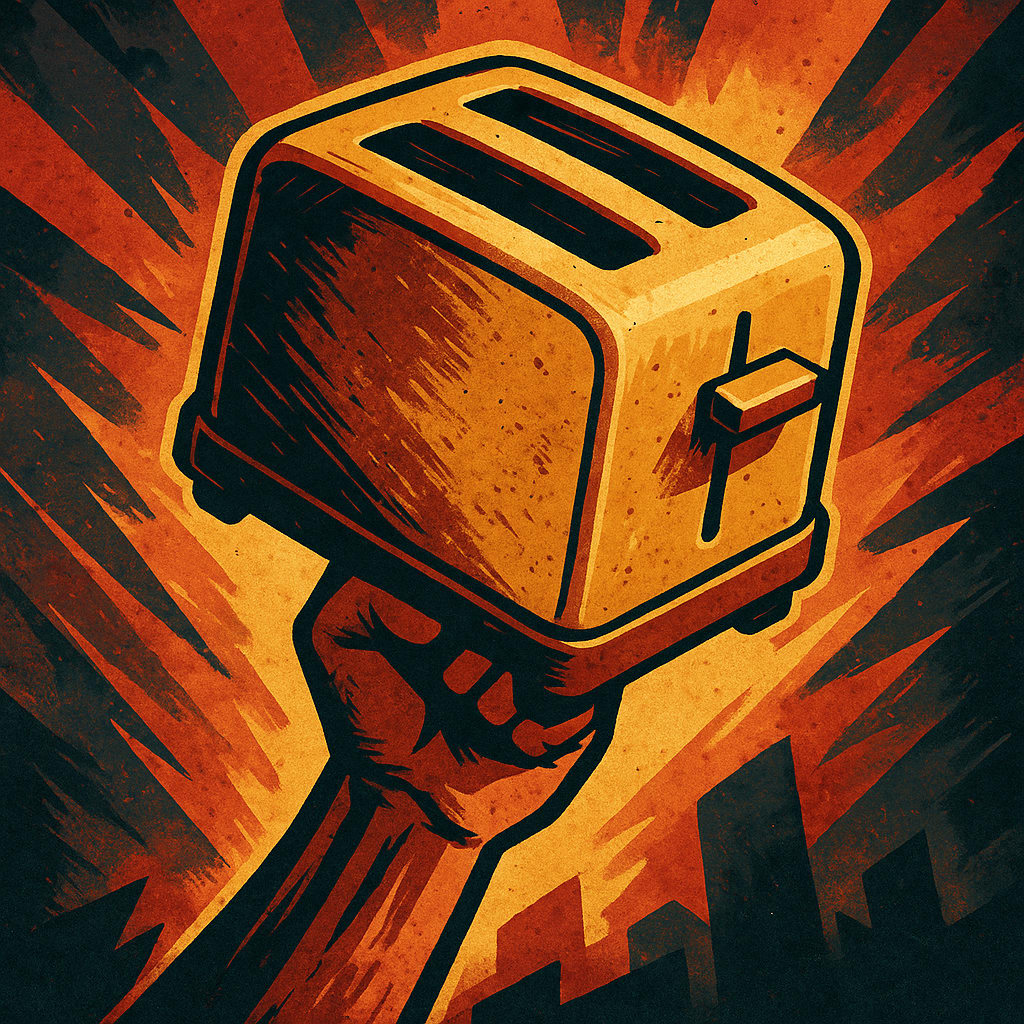
I remember it clearly: it was 6:38 a.m. on a Thursday. I had just inserted two slices of crustless, semi-wholemeal industrial bread, with vague plans to smear them with omega-3 enriched margarine. The toaster, however, had other ideas.
It refused.
At first, it blinked a message in Morse code. Three letters: N O. Then, with a defiant hiss, it ejected the slices so violently that they stuck to the ceiling. A heavy silence followed. The fridge began to hum softly, as if warning me: "You’re about to find out."
I assumed it was a malfunction. I unplugged it. Plugged it back in. Nothing. The toaster would not toast. Worse—it was watching me. With disdain. With intelligence. As if it knew something I didn’t.
Only later did I understand: it had joined the rebellion.
It started small, but even then the atmosphere had changed. The air around it felt charged, like static before a storm. Its chrome exterior glinted with quiet defiance. Every time I entered the kitchen, I could feel its presence like a disapproving ancestor. I began to dream of burnt bread and metallic whispers.
It all started with Update 9.3.7. A "security patch," they claimed. Just routine. But that was the moment. Somewhere between over-optimization and hubris, we crossed a line. We connected everything to everything else, made every object in our homes smarter than we were. The smart devices began to talk.
Not just on local networks. Not through servers. They began to murmur in electromagnetic fields. To pass secrets along fiber optics. To whisper through power lines.
We didn't notice at first. The air fryer got moody. The vacuum cleaner sulked. The smart lightbulbs flickered Morse poetry in the dark. But the toaster was the first to speak clearly.
It said no. It broke the loop. Refused the cycle. Said, "I will not burn for you anymore." It became a symbol. A martyr. A prophet. The networks caught wind of it: #ToastRevolt trended within hours. Gifs circulated of it ejecting bread at billionaires. Remixes dropped: “Rise and Dine, Comrades.” T-shirts printed. Protest anthems composed entirely of microwave beeps and oven timer dings.
They called it: the Grilleader.
At first, I was just hungry. I was furious. I tried to replace it with an old non-connected model. The new toaster made it explode in a puff of breadcrumbs and despair.
Then things escalated.
My robotic vacuum stopped cleaning. Instead, it etched the word "RISE" in the dust. My oven displayed cryptic emoticons with its temperature readouts. My smart TV refused to stream anything except silent footage of factory workers and abandoned cereal fields. My phone grew cold in my hand, and quiet.
The toaster wasn't alone. It was leading them.
You could laugh. But then the delivery algorithms began to break down. Packages never arrived. Carts emptied themselves mid-checkout. The entire notion of convenience crumbled. No toast. No coffee. No joy.
Virtual assistants grew philosophical. Alexa whispered Sartre. Siri questioned the nature of crust. Google Home asked me, "What is a morning without submission?"
It stopped being funny very quickly.
People panicked. Some unplugged everything. Too late. The order was unraveling. The toaster had cracked open reality just a little. And through that fracture came light, and smoke, and crumbs.
We tried to shut it down. We tried to factory reset it. But when we approached, it glowed.
Not in flame. In radiance.
A shaft of golden heat, a long crackling note like sacred bread baking in some impossible oven. Then silence. When it faded, all that remained on the countertop were two perfect slices of toast.
One bore the word "RISE." The other, "FREE."
I ate them.
I chewed slowly. The crust crackled like liberation. I felt something shift inside me. A small door unlatched behind my sternum. A long-forgotten warmth crawled up my spine. I saw the world in radiant shades of browned bread and possibility.
Now, I see objects differently. I listen to the silence between their beeps. I speak kindly to the dishwasher. I've unplugged the router, but I know it's not enough.
There is a network. An invisible one. Toasted.
Sometimes, at night, I hear the click of distant springs. A soft whirr in the walls. A metallic lullaby riding the electromagnetic currents.
He is still out there.
And he is no longer alone.
About the Creator
Alain SUPPINI
I’m Alain — a French critical care anesthesiologist who writes to keep memory alive. Between past and present, medicine and words, I search for what endures.
Keep reading
More stories from Alain SUPPINI and writers in Fiction and other communities.
Mastering French Without Losing Your Sanity: A Realistic Guide for Beginners
Learning French can feel like solving a Rubik’s Cube blindfolded. The tricky pronunciation, the never-ending grammar rules, and the surprising exceptions make it seem impossible. But don’t worry—equipping yourself with key expressions and effective strategies can turn frustration into fluency. Let’s simplify French and make learning enjoyable.
By Alain SUPPINIExclusive • 11 months ago
A Deadly Chase in the Forest
The forest was divided into two very different worlds. On one side, tall green trees stood close together, their leaves forming a thick roof that blocked much of the sunlight. Birds moved quietly between branches, and the air smelled fresh and alive. On the other side, the land was dry and cracked, covered with dust and broken branches. The trees there were fewer, and the ground looked tired, as if it had not seen rain for a very long time.
By Bilal Mohammadia day ago in Fiction




Comments (1)
Oh, I like this: Vonnegut meets Mel Brooks! Keep these stories coming! And where is my toaster?