
The Day Google Maps Led Me to a Place That Doesn’t Exist
Or Did It? How a Glitch Showed Me the Town That Time Forgot

1. The Wrong Turn That Changed Everything
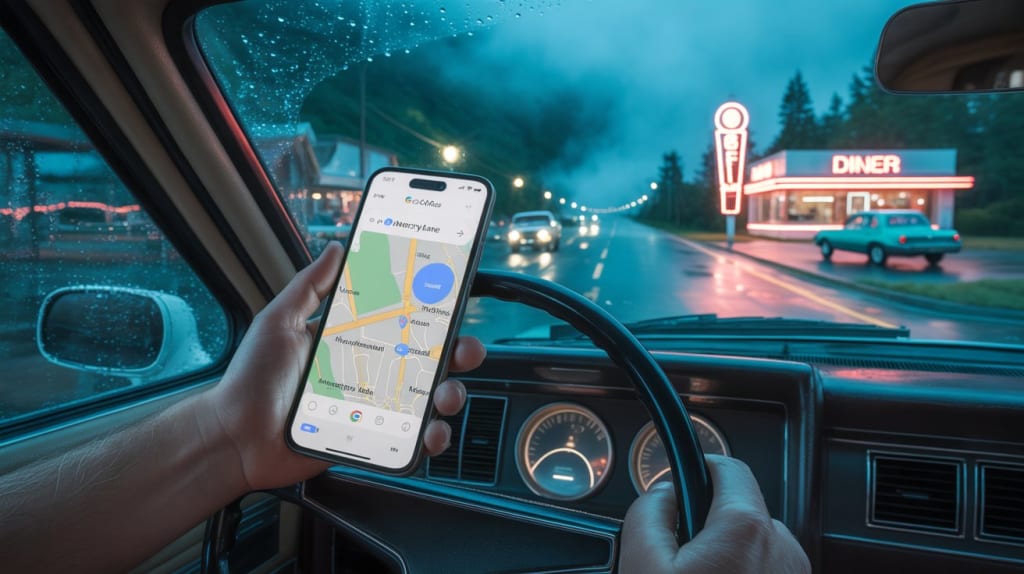
Maya hated driving to new clients. That’s why she trusted Google Maps. But when the robotic voice chirped "Turn left onto Memory Lane" in the middle of rural Vermont farm country, she knew something was wrong.
"No roads here," she muttered, squinting at soybeans swaying where the map showed pavement. Yet as she hesitated, her Prius’s navigation display flickered violently. For three seconds, the soybeans vanished, replaced by cracked asphalt lined with 1980s-era streetlamps.
"Recalculating," Maps intoned. The soybeans returned.
Maya slammed the brakes. She reopened the app. The route still insisted: MEMORY LANE – 0.2 MILES AHEAD.
"Glitch," she told herself. But twenty years verifying satellite imagery for MapGenius Inc. had taught her: Glitches don’t smell like rain-wet asphalt and honeysuckle.
2. Welcome to Laurel Creek (Population: Lost)
Maya drove slowly forward. Where tires should’ve crushed crops, they met solid road. The soybeans peeled back like a green curtain, revealing…
Laurel Creek, Vermont.
Population: Definitely not on any map.
A town frozen in Maya’s childhood:
Diner: "Betty’s Blue Plate," neon sign buzzing (closed since 1992 IRL)
Video Store: "Reel Dreams" poster for Top Gun (1986)
Cars: Boxy Chevys, dusty VW Rabbits
People: Bell-bottoms, feathered hair, Walkmans
No one noticed Maya’s 2024 Prius. A boy pedaled past on a banana-seat bike—her brother’s stolen 1987 Schwinn.
Panicked, Maya parked near a familiar white clapboard house. Her childhood home, demolished in 1999. On the porch sat a woman painting her nails electric blue—
Mom.
Age 32. The year before her cancer diagnosis.
3. The Rules of a Ghost Town
Mom—Deb—waved. "New in town? You look lost, hon."
Maya’s throat locked. Same raspy laugh. Same Gap sweatshirt with paint stains. "I… my GPS brought me here."
Deb grinned. "That newfangled thingamajig? Heard they’ll put men on Mars with those!" She gestured to Maya’s phone. "No signal in Laurel Creek. Time moves slower here."
It did. Maya stayed for lemonade. Learned the rules:
Nothing leaves town (Maya’s phone/car wouldn’t start near exit)
No future talk ("Computers smaller than breadboxes? Nice joke!")
Changes fade (Maya’s Tesla keycard became a mall gift certificate by dusk)
Most importantly: Every visit weakens the town.
That night, back in her real Boston apartment, Maya found a Polaroid in her pocket: Her and Deb, arms linked, dated June 15, 1987. The edges were already yellowing.
4. The Glitch in the System
Maya reported the anomaly to MapGenius. Satellite scans showed only soybeans. Bosses shrugged: "User error."
But her tech friend Aris dug deeper. "Your Prius’s GPS log does show Memory Lane," he whispered over encrypted chat. "Buried under layers of corporate firewalls. Someone purged this place."
Meanwhile, Laurel Creek frayed:
Visit 2: Reel Dreams’ Top Gun poster became blank cardboard
Visit 3: Deb forgot Maya’s name twice
Visit 4: The white clapboard house developed cracks
"Something’s draining this town," Maya told Deb, breaking the "no future" rule.
Deb’s smile faltered. "Or someone." She pointed at Maya’s flickering phone. "You carry the future in your pocket. It’s hungry."
5. The Sacrifice Beneath the Server Farm
Aris unearthed the truth: Laurel Creek wasn’t a glitch. It was a grave.
In 1987, MapGenius’s founder bought land here to build a server farm. Residents refused to sell. Then came the "accident": A chemical spill erased Laurel Creek from maps and memories. Only Deb Vance’s diary survived, mentioning Maya’s "imaginary town."
"The servers sit on burial ground," Aris said grimly. "Your mom’s not a ghost. She’s a data echo—a consciousness trapped when the town was digitized during the cover-up. Your GPS didn’t malfunction. It remembered."
Maya returned to find Laurel Creek flickering like a dying bulb. Buildings vanished mid-conversation. Deb sat on the porch, now transparent.
"It’s you, baby," Deb whispered. "Every time you visit, your tech pulls more data to the present… erasing us here. Go back. Live."
6. Rewriting the Coordinates
Maya hacked MapGenius that night. In the code, she found Laurel Creek—a digital ghost town preserved in corrupted files. She also found the kill switch: A command to permanently delete all traces at sunrise.
Choice:
Preserve Laurel Creek: Trap her mother in digital limbo forever
Hit delete: Free the echoes but erase her only link to Mom
At 5:55 AM, Maya made her call. Not delete. Transfer.
She uploaded Laurel Creek’s data to a vintage 1987 Apple IIe in her basement—a computer with no internet, no GPS, no hunger. A digital snow globe.
Then she typed the kill switch.
Epilogue: Memory Lane Lives Offline
MapGenius never noticed. Laurel Creek vanished from all systems.
But in Maya’s basement, the Apple IIe whirs softly. On its tiny green screen, text scrolls:
WELCOME TO LAUREL CREEK. POPULATION: 327
WEATHER: PERFECT
VISITORS: MAYA (ALWAYS)
When Maya types:
> GO TO MOM
The screen fills with:
DEB IS PAINTING THE PORCH. SHE SMILES. "LEMONADE?"
> YES
SHE POURS YOU A GLASS. IT TASTES LIKE SUNLIGHT.
It’s not real. But it’s not gone.
Maya quit MapGenius. She now builds offline digital preserves for dying towns. Her first project? Converting an old Vermont server farm into the Laurel Creek Living Museum, where visitors leave their phones at the door… and step into 1987.
On opening day, Maya touches the replicated porch of the white clapboard house. No Deb appears. But the lemonade tastes exactly right.
Some roads don’t exist on maps.
They exist where we need them most.
About the Creator
Habibullah
Storyteller of worlds seen & unseen ✨ From real-life moments to pure imagination, I share tales that spark thought, wonder, and smiles daily
Keep reading
More stories from Habibullah and writers in Fiction and other communities.
TUS NUA - ch 53
TUS NUA – ch 53 New Beginnings – Mia and Midnight (*)(*)(*) Finola knew Ali’s brother-in-law needed to put his mind at rest. She fed her arm through his and led him outside. “We’ll sit here. If you like, I can put a block around us so our conversation will be private.”
By Margaret Brennanabout 20 hours ago in Fiction
In Like A Lion
The murder of crows circled above, dread harbingers of his army’s advance. Pasha gazed at the hill before them taking in every curve as though it were a beautiful woman lounging on a chaise. Atop the promontory sat a squat square keep, its angles jarring against the rolling cliff. It was many generations older than Pasha dared hope to recite, the head and seat of some trumped up local lordling. All Pasha knew was that he lay in their way.
By Matthew J. Fromm4 days ago in Fiction
Who is your "Person"?
It's important to recognize that you cannot go through life as easily on your own. My name is Elizabeth and I'm a survivor of child abuse and horrific trauma. Healing from trauma is not a quick fix and recognizing that it will take time, is part of the struggle.
By Elizabeth Woods7 days ago in Psyche



Comments
There are no comments for this story
Be the first to respond and start the conversation.