
The Day Everyone Got the Same Dream
When 8 billion people woke up with identical visions of a countdown and a mysterious door

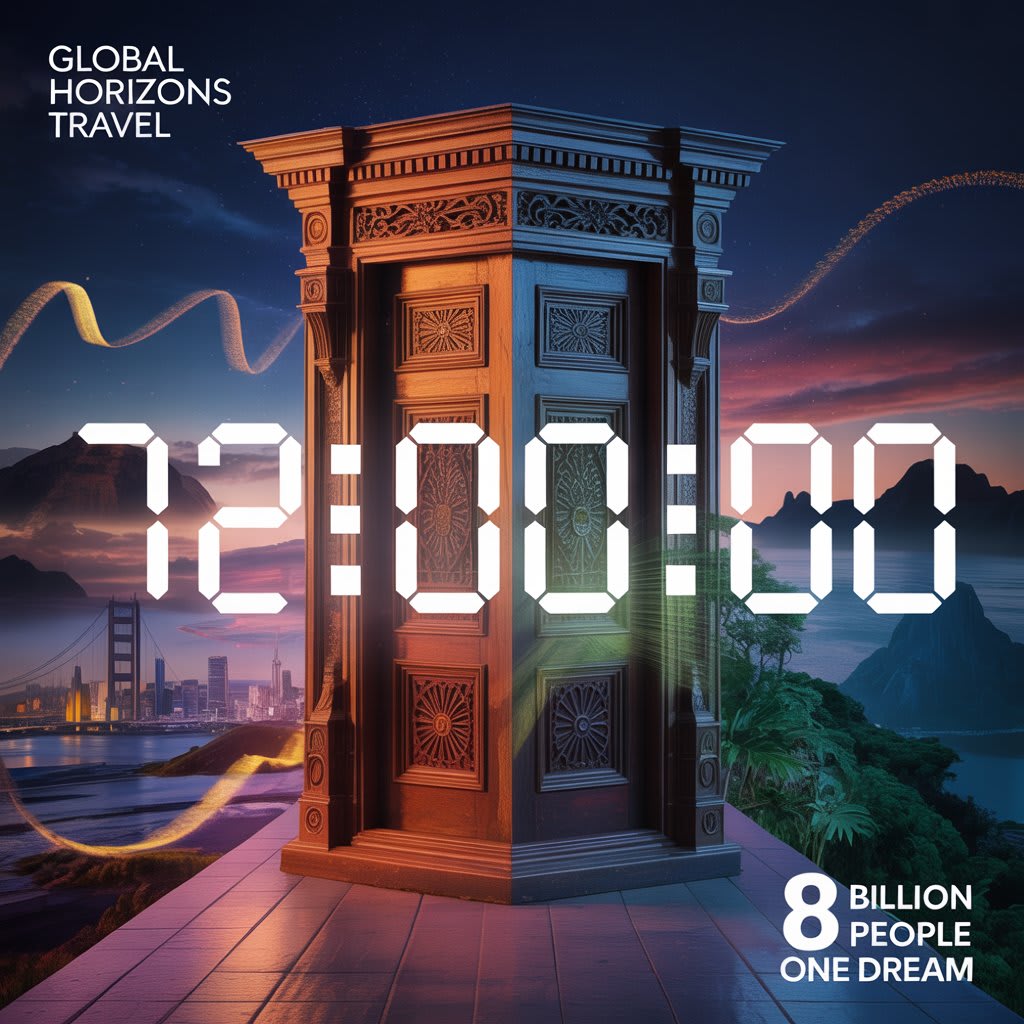
Sarah Martinez thought she was losing her mind when she woke up at 3:47 AM on Tuesday, October 15th, drenched in sweat and haunted by the most vivid dream of her life. A massive digital countdown floating in an endless white void: 72:00:00. Seventy-two hours. And behind the numbers, a door—ancient, wooden, with intricate carvings that seemed to move when she wasn't looking directly at them.
But Sarah wasn't losing her mind. Neither were the 8 billion other people who woke up that same morning with the exact same dream.
By 6 AM Eastern Time, SameDream was trending worldwide. By noon, emergency sessions were being called in governments across the globe. By evening, the world had fundamentally changed, united by the most impossible shared experience in human history.
The First 24 Hours: Digital Chaos and Desperate Explanations
The initial reaction was pure chaos. Social media platforms crashed under the weight of billions of people describing identical visions. Reddit's servers melted down as users flooded r/dreams with posts containing suspiciously similar sketches of ornate doors and countdown timers. TikTok became a gallery of people drawing the same intricate carvings from memory, each artist adding details others had missed but somehow still creating the same overall image.
Dr. Elena Vasquez, a sleep researcher at Johns Hopkins, received over 400 calls before 8 AM. "In thirty years of studying dreams, I've never seen anything like this," she told CNN that afternoon, her voice shaking. "Dreams are supposed to be intensely personal, shaped by individual experiences, memories, and neural patterns. A shared dream of this specificity and scale should be impossible."
The scientific community scrambled for explanations. Solar flare activity? Mass hysteria? A coordinated hoax involving billions of actors? Each theory crumbled under scrutiny. The dream was too detailed, too consistent across cultures, languages, and ages. Five-year-olds in rural Bangladesh described the same wooden grain patterns that physicists in Geneva sketched in their lab notebooks.
Religious leaders found themselves in the unusual position of having to address a miracle in real-time. Pastor Michael Rodriguez of Houston's Lakewood Church held an emergency service at 2 PM, declaring it "a sign from God that judgment day approaches." Meanwhile, Buddhist monk Tenzin Norbu in Tibet called it "evidence that consciousness is truly interconnected, just as the Buddha taught." The Vatican remained diplomatically silent, but sources close to Pope Francis reported emergency meetings throughout the night.
Government Response: When the Impossible Becomes Policy
By day two, governments could no longer treat the event as a curiosity. The sheer scale of the phenomenon had implications for national security, mental health, and social stability. President Elena Rodriguez called an emergency Cabinet meeting, establishing the first-ever Department of Anomalous Phenomena within hours.
"We're dealing with something that challenges our fundamental understanding of human consciousness," Deputy Press Secretary James Chen announced. "While we investigate the cause, our priority is maintaining public order and supporting citizens through this unprecedented experience."
But maintaining order proved challenging when the very nature of reality seemed negotiable. Stock markets plummeted as investors grappled with uncertainty. Productivity dropped 40% globally as workers obsessively discussed their shared vision. Some corporations embraced the chaos—a marketing agency in Tokyo launched a campaign featuring the mysterious door, earning both praise and condemnation.
The European Union convened an emergency session in Brussels, with neuroscientists, theologians, and military officials testifying before a joint committee. Dr. Hans Mueller, Germany's leading consciousness researcher, admitted the scientific community was "completely at a loss."
"We're not just looking at an anomaly," he testified. "We're potentially witnessing the first documented case of genuinely collective consciousness in human history."
The Countdown Continues: Theories, Fears, and Fanatics
As the dream's countdown continued to tick down in millions of minds, society began reorganizing around the shared experience. Support groups formed online and in person. The "Dreamers United" movement gained 200 million members in 48 hours, while conspiracy theorists founded competing organizations convinced the dream was evidence of alien contact, government mind control, or interdimensional communication.
Dr. Rachel Kim, a quantum physicist at MIT, proposed the most scientifically grounded theory: "What if consciousness isn't generated by individual brains but is instead a field that brains access? A disruption in that field could theoretically cause shared experiences." Her theory gained traction when she revealed that quantum computers at CERN had detected unusual fluctuations in what they termed "background consciousness resonance" exactly 72 hours before the first dreams occurred.
The religious implications grew more complex as various faith traditions struggled to interpret the phenomenon. Rabbi David Goldstein in New York suggested it might be a modern form of prophecy, while Imam Yasmin Hassan in Cairo wondered if it was a test of faith. Hindu scholars in India pointed to ancient texts describing collective visions during times of great change.
But perhaps the most unsettling development was the emergence of "Door Cults"—groups convinced that when the countdown reached zero, the door would literally appear and transport believers to another realm. The largest, led by former tech executive Marcus Vale, attracted 50,000 followers to a compound in Nevada, all waiting for what he called "The Great Transition."
Personal Stories from the Global Dream
While experts debated and governments strategized, ordinary people grappled with the profound intimacy of sharing humanity's most private experience. Maria Santos, a teacher in São Paulo, described feeling "connected to every person on Earth in a way I never thought possible." Her students drew pictures of the door during art class, each adding details the others hadn't included, collectively reconstructing the vision with startling accuracy.
In Mumbai, software engineer Raj Patel found himself in deep conversations with strangers on the street. "Everyone recognizes the look in your eyes," he said. "We all saw the same thing. We're all carrying the same mystery."
The psychological impact varied dramatically. Some people reported feeling euphoric, describing a sense of unity and shared purpose they'd never experienced. Others suffered anxiety attacks, unable to cope with the violation of mental privacy. Therapists worldwide reported unprecedented demand for services as people struggled to process the experience.
Children seemed to adapt most easily. Eight-year-old Lucy Chen in Vancouver told her mother, "It's like we all read the same book before bed." Teenagers incorporated the door imagery into art projects and social media posts with characteristic adaptability. But elderly populations often found the experience more disturbing, with many feeling their fundamental understanding of reality had been shattered.
The Science Scramble: Racing Against the Clock
As the countdown approached its final 24 hours, the scientific community made desperate attempts to understand and potentially prepare for whatever was coming. Brain imaging studies revealed that people recalling the dream showed identical neural activation patterns—an impossibility according to current neuroscience.
Dr. Sarah Okafor, a neuroscientist at Oxford, made a breakthrough discovery: "The hippocampus, which processes memory formation, shows activity patterns that suggest the dream wasn't processed like a typical dream at all. The neural signatures are more consistent with actual memories of real events."
This finding sent shockwaves through the research community. If the dream was processed as a memory rather than imagination, what did that suggest about its nature? Were 8 billion people remembering something that actually happened to them collectively?
Meanwhile, astronomers detected unusual electromagnetic signatures from deep space, leading some to theorize about external influences on human consciousness. Dr. Wang Li at the Beijing Institute of Technology noted: "The electromagnetic patterns we're seeing have never been recorded before. They're almost... linguistic in structure."
The Final Hours: Anticipation and Transformation
As the countdown entered its final hours, the world held its breath. Major cities deployed extra security forces in anticipation of potential mass gatherings or unrest. The Door Cult compounds became focal points of media attention, with live streams showing thousands of believers preparing for what they expected to be humanity's next evolutionary step.
In contrast, many families simply gathered together, uncertain but united in their shared experience. Churches, mosques, temples, and synagogues opened their doors for interfaith vigils. Scientists maintained round-the-clock monitoring stations, hoping to capture whatever phenomenon might occur.
The psychological tension was unprecedented. Dr. Amanda Foster, a crisis counselor in London, observed: "People are experiencing collective anticipatory anxiety on a scale we've never seen. We're all waiting for something, but nobody knows what."
Social media became a real-time documentary of human consciousness. People shared countdown timers, door sketches, and theories in an endless stream of collective processing. The tag WhatBehindTheDoor gained 2 billion posts in 12 hours.
When Zero Hour Arrived: The Anticlimactic Revelation
At exactly 72 hours after the first reports, as clocks around the world reached the moment the countdown had been pointing toward, something remarkable happened: absolutely nothing.
No doors appeared. No revelations descended from the sky. No dimensional portals opened in the Nevada desert, leaving Marcus Vale's followers confused and disappointed. The world exhaled collectively, a mixture of relief and bewilderment settling over billions of minds.
But in the weeks that followed, researchers began to understand that the lack of a dramatic ending might have been the point entirely. Dr. Elena Vasquez published a groundbreaking paper suggesting that the shared dream had been humanity's first documented experience of true collective consciousness—not a message from outside, but a message from within.
"Perhaps," she wrote, "we were never meant to find what was behind the door. Perhaps the door was always just a mirror, showing us that the barriers between individual minds aren't as solid as we believed."
The Lasting Impact: A World Forever Changed
Six months later, the world still grapples with the implications of October 15th. The "Dream Day," as historians have begun calling it, marked a turning point in human consciousness and cooperation. International conflicts decreased dramatically as leaders struggled to maintain animosity toward people they'd shared such an intimate experience with.
Scientific research into consciousness expanded exponentially, funded by governments desperate to understand what had happened and whether it could happen again. The field of "collective neuroscience" emerged, studying how individual minds might connect in ways previously thought impossible.
Religious and philosophical communities continue debating the meaning of the shared vision. Some see it as proof of spiritual interconnectedness, others as evidence that consciousness operates on quantum principles we're only beginning to understand.
But perhaps the most significant change has been cultural. The knowledge that our most private experiences—our dreams—could become universal has shifted how we think about privacy, individuality, and human connection. Support groups for "Dream Day experiencers" have evolved into permanent communities focused on maintaining the sense of unity the experience created.
Dr. Sarah Okafor's latest research suggests that people who experienced the dream show lasting changes in neural connectivity patterns associated with empathy and emotional intelligence. "It's as if sharing that one experience permanently enhanced our capacity for human connection," she explains.
The Door Remains Open
Today, as conspiracy theories fade and scientific understanding slowly advances, one question remains: Will it happen again? Government monitoring systems watch for electromagnetic anomalies. Researchers track global consciousness indicators. And billions of people around the world occasionally find themselves staring at wooden doors, wondering if they recognize the grain patterns.
The Dream Day taught humanity that the boundaries between minds might be more permeable than we ever imagined. In a world often divided by politics, religion, and ideology, perhaps the greatest gift of that mysterious countdown wasn't what lay behind the door—but the reminder that, in the end, we're all dreaming together.
As Dr. Vasquez concluded in her final paper on the phenomenon: "We spent so much time asking what the dream meant that we almost missed its most important message: When 8 billion people can share the same vision, perhaps the only thing separating us from solving our greatest challenges is the illusion that we're truly alone in our minds."
The door may have been a dream, but the connections it revealed were startlingly, beautifully real.
About the Creator
Muhammad Sabeel
I write not for silence, but for the echo—where mystery lingers, hearts awaken, and every story dares to leave a mark
Keep reading
More stories from Muhammad Sabeel and writers in Fiction and other communities.
I Sold My Reflection for a Wish
The Shop That Wasn’t There Yesterday It wasn’t there the day before. On Thursday morning, as I walked to work past the old textile mill on Gable Street—a route I’d taken every morning for the past six years—I noticed a small shop tucked between two boarded-up buildings. A crooked sign above the door read:
By Muhammad Sabeel8 months ago in Fiction
Lightning Never Strikes Twice
The distant rumble, the sudden deluge, the crescendo of sound, the flash of light, the explosive energy — it never gets old. I became an amateur storm chaser about two years ago. My wife, Cindy suggested it. Sort of. She said, "Alex, you know this cancer is killing me. I've come to terms with that, but you're smothering me. Go join a band, write a book, or become a storm chaser, for all I care. I love you, but you need a hobby."
By Julie Lacksonen3 days ago in Fiction
A Historic Declaration
We the People of the Husbands of the United States of America, in Order to form a more perfect Union, and I mean you...with me...establish Justice, insure domestic Tranquility, provide for the common defence, promote the general Welfare, and secure the Blessings of Liberty to ourselves, after Puberty, do ordain and establish this Declaration of Co-Dependence.
By Gerard DiLeo5 days ago in Humans


Comments
There are no comments for this story
Be the first to respond and start the conversation.