


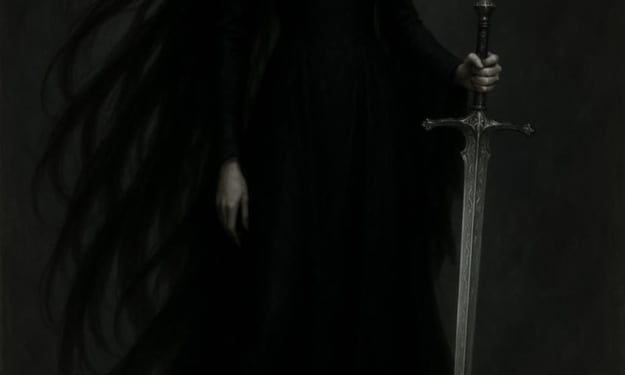
They said Lady Isolde was born beneath an eclipse — a black sun hung over her cradle like a crown. Her skin was white as wax, her lips bruised red. The midwife whispered a blessing. The priest bit his tongue. Her father smiled too long.
She grew in the halls of Castle Virelais, wrapped in velvet and watched by shadows. Tutors came and vanished, one by one. The chapel doors warped and never reopened. Her mother was buried without a face.
And yet, Isolde was exquisite.
When she walked, men forgot their names. When she smiled, flowers turned to face her. But no one who loved her ever lived long.
In the spring of 1572, a guest arrived.
Lord Thorne of Larkridge — the third son of a bitter duke, sent south to escape scandal and whispered madness. He rode a midnight mare and wore mourning black, though no one had died. He had a voice like oiled steel and eyes that did not blink often enough.
The moment he saw Isolde on the rosewalk — pale dress, blood-dark hair — he removed his gloves. “I have dreamt of you,” he said.
She studied him for a moment, as though reading a line written in smoke. Then: “We are not dreams, my lord. We are echoes.”
They were wed in a fortnight.
Their courtship was brief and glimmering. Candlelight spilled like honey across stone floors. The great hall sang with viols and silver laughter. Isolde smiled more. Her father drank less. Even the mirrors stopped warping.
But on the eve of their wedding, the castle dogs howled until dawn.
Thorne stood alone in the crypt, touching the old stones. Whispering names.
Their wedding was a pageant of myth.
Isolde wore crimson silk stitched with black garnets — no white, no veil. Thorne’s blade hung at his hip even as he pledged his troth. The wine at the feast was so dark it left stains that never quite washed out. Every guest felt it — the thrill beneath the joy, the quiet ache behind the harp strings.
At midnight, it began to rain petals. Not roses. Something darker.
By morning, three guests were missing.
Their marriage was a dance of heat and silence.
Thorne brought her books bound in old skin, and Isolde read them aloud by firelight, her voice like velvet on glass. She wore pearls in her hair and wounds on her wrists. He touched her throat like a prayer. They did not sleep much.
He found her once, barefoot in the crypt, speaking softly to the bones of a child in a velvet shroud. She found him another night writing with ink that glistened red, pages vanishing as he finished them.
They never asked questions. They already knew the answers.
Isolde’s father died on the first frost.
They buried him in a sealed coffin.
The next day, the vines outside the window began to bleed.
With her father gone, Isolde ruled Virelais. Nobles came to pay homage and left pale and blinking, as if waking from fever. Crops withered beyond the castle walls. The bells stopped ringing. Time moved oddly.
Still, Thorne loved her.
And she him.
The kind of love that sings in locked rooms and shivers in empty halls. The kind that drinks from the throat when the mouth is too far.
But love does not go unnoticed.
A priest arrived — Father Briant — sent by the Bishop of Rouen, bearing a crucifix carved from ashwood and eyes like fireflies. He did not flinch when Thorne passed him. He did not bow when Isolde offered her hand.
He walked the halls for days, silent and watchful, and said at last, “There is no God in this place. Only hunger wearing a wedding band.”
That night, he was found flayed in the nave. His cross driven through his own mouth.
No one spoke of it again.
Thorne began to change.
He grew colder. Moved slower. His breath no longer fogged the windows. He bled darker when he nicked himself shaving. And his reflection became hesitant, like it was trying to look away.
Isolde watched, and did nothing. Only held his hand when he trembled, and sang to him in a language that had no consonants.
She had always known.
The final winter came like a black tide.
Snow fell for thirteen weeks without pause. The lake froze solid, and voices echoed beneath it. Servants wept blood. Guests came and never left. At night, wolves sat outside the castle gates and stared without blinking.
Thorne began sleepwalking. Isolde stopped sleeping at all.
Their love, once luminous, now pulsed like a wound. Tender. Raw. Drenched in warmth that smelled faintly of rot.
One evening, Thorne placed his blade in her lap.
“I dreamt I tore your heart out,” he said.
“Did you eat it?” she asked, without looking up.
He nodded.
“Then you’ll never lose me,” she whispered, and kissed him, tasting iron.
On the last night of that cursed year, Isolde stood on the parapets in her wedding gown, which had darkened with time to a shade beyond crimson.
Thorne stood beside her, barefoot, his eyes moon-pale.
Below, the snow had melted. The ground was black and steaming.
“You could leave,” he said, voice ragged. “Take the title. The estate. Forget this hunger. Forget me.”
“I would rather die,” she said.
He looked at her then, and for the first time, she saw fear.
“My love,” he whispered, “I do not think we are capable of that anymore.”
She turned and placed his hand over her heart.
“Then we remain,” she said.
They say the castle still stands, far in the north, where maps forgot to name things.
No one who enters returns.
The snow never falls there.
And on nights when the sky turns black and the wind forgets its path, some say you can see them on the parapet — a lady in red and a man with no shadow, locked in an embrace so tender it could kill you.
And they are smiling.
Always smiling.
Because they are in love.
And love, after all, is eternal.
About the Creator
E. hasan
An aspiring engineer who once wanted to be a writer .
Flower Bloom 369
FLOWER Bloom 2/25/26 Wednesday By Mariann Carroll Karen had been with Tony for 7 years. Tony started acting strangely after her surgery. He would mow the lawn in the rain and be on his cellphone. He started pushing Karen away. Tony came clean about seeing someone. Karen moved out two months later. Karen moved in with a friend. She felt betrayed.
By Mariann Carroll5 days ago in Fiction



Comments
There are no comments for this story
Be the first to respond and start the conversation.