
The Cosmic Background Whisper
The Echo of Other Universes

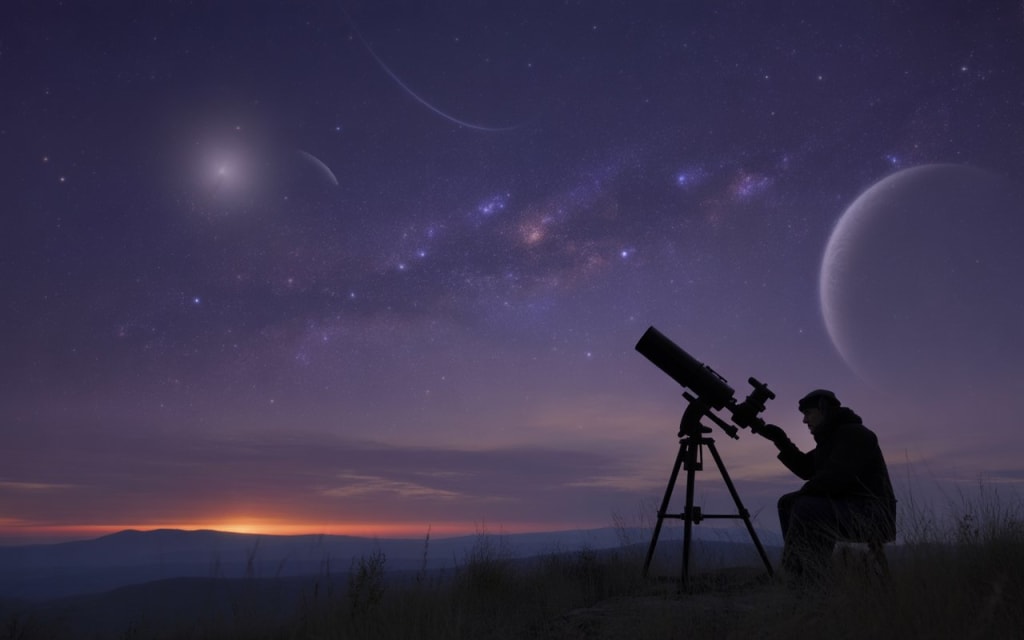
Dr. Elias Koren had spent his life listening to the stars. Not with his ears, exactly, but with the instruments that let him hear space—the faint hum of cosmic radiation, the static that stretched across the universe like whispers between galaxies.
It had begun innocuously enough, in the quiet of the Harvard Observatory. Elias was calibrating his telescope one cold, winter evening when the data started acting strangely. The static—the ever-present hiss left over from the Big Bang—was supposed to be random. Pure noise. Yet he noticed patterns. Small, deliberate ripples in the background radiation, almost imperceptible, like someone tapping on a cosmic door.
He leaned closer, heart pounding, scanning the readings again and again. Night after night, the pattern persisted. Other astronomers were skeptical when he shared his findings. “You’re chasing ghosts,” one said, the warmth of his office a stark contrast to the windswept roof above Elias. But Elias felt it. Something behind the numbers, something ancient and purposeful, waiting for someone to notice.
He began spending nights alone on the hilltops outside Boston, telescope trained toward the darkest reaches of space. He stopped worrying about sleep, food, even the small comforts of life. There was only the hum, and the way it seemed to pulse in rhythm with his own heartbeat.
Then, one night, it happened. The static formed something he could almost understand. Not words, not numbers, but shapes—patterns that flickered like shadows in the corner of perception. Images of stars that didn’t exist, galaxies forming in impossible spirals, and distant planets orbiting suns that had long since died. Elias felt dizzy. Could this be… other universes? His mind tried to reject it, tried to ground itself in reason. But the evidence, the pattern, the hum—everything was pointing to a reality far beyond the limits of human understanding.
He returned to his lab, feverishly scribbling notes, diagrams, and sketches. Every day he became more aware of how fragile his own understanding was. The static seemed alive, communicating in a language that his mind could barely grasp. He began dreaming of it at night—floating through the void, passing through stars like they were gates, watching other Earths orbit alien suns, civilizations that mirrored his own in strange, distorted reflections. He woke with tears on his cheeks, shaking with exhilaration and fear.
Elias knew he was close to discovery, yet he also understood that he had crossed a boundary few humans had ever crossed. For weeks, he barely spoke to anyone, fearing that sharing the secret would either drive them mad or expose the universe to questions it was not ready to answer. He was learning to read not letters or numbers, but the rhythm of existence itself—a silent code written in the hum of creation.
Then came the night when the hum coalesced into a single, profound sensation. It was no longer noise. It was a voice—or the closest thing to one that Elias could recognize. Not words, not syllables, but a feeling of something older than stars, older than time. A memory of existence before the universe he knew was born. And in that moment, he realized what the pattern had been trying to tell him all along: we are not alone. There are echoes of life and consciousness beyond the edges of reality, ripples of other universes intersecting with ours in ways we cannot yet measure.
Elias felt tears welling up in his eyes. He thought of all the people he had loved, all the moments that had shaped him, and he understood that existence was far more intricate than anyone had imagined. The hum of the cosmos was not random—it was a vast, unfinished story, and every star, every human, every heartbeat was a note in that symphony.
He decided he could no longer keep the discovery to himself. But even as he prepared to publish his findings, he hesitated. How could he explain it to a world that feared what it could not see? How could he convey the beauty, the terror, and the profound intimacy of knowing that the universe itself was alive with voices, with echoes, with unseen worlds?
So, he did the only thing he could: he documented it carefully, in a way that would invite curiosity rather than panic. And then he returned, night after night, to the hilltop, letting the hum guide him, letting the whispers shape his understanding.
Years later, when students asked him what he had discovered, he would smile quietly and say, “Some things cannot be explained. They are meant to be felt.” And he would look up at the sky, where the stars shimmered with secrets older than humanity, and listen to the hum of the cosmic background—a gentle reminder that our universe is only one of many, and that the whispers of existence extend far beyond what we can touch, hear, or even imagine.
Elias understood, in a way few could, that the cosmos was patient. It had waited billions of years for someone to listen. And now, through him, it had been heard.
About the Creator
Nusuki
I am a storyteller and writer who brings human emotions to life through heartfelt narratives. His stories explore love, loss, and the unspoken, connecting deeply with listeners and inspiring reflection.
More Orangutans
Ernie watched himself get out of bed. It was part of his morning routine: he opened his eyes to the sky-mirror, and peeled the translucent covers from himself. He slept in pajama pants, and a matching pajama shirt, because he didn’t want the others to see his bare, milky body through the glass roof.
By Noah Husband5 days ago in Fiction




Comments
There are no comments for this story
Be the first to respond and start the conversation.