
The Corner Store at the End of the Hill
A Quiet Storefront, a Forgotten Pact, and the Boy Who Waited Too Long

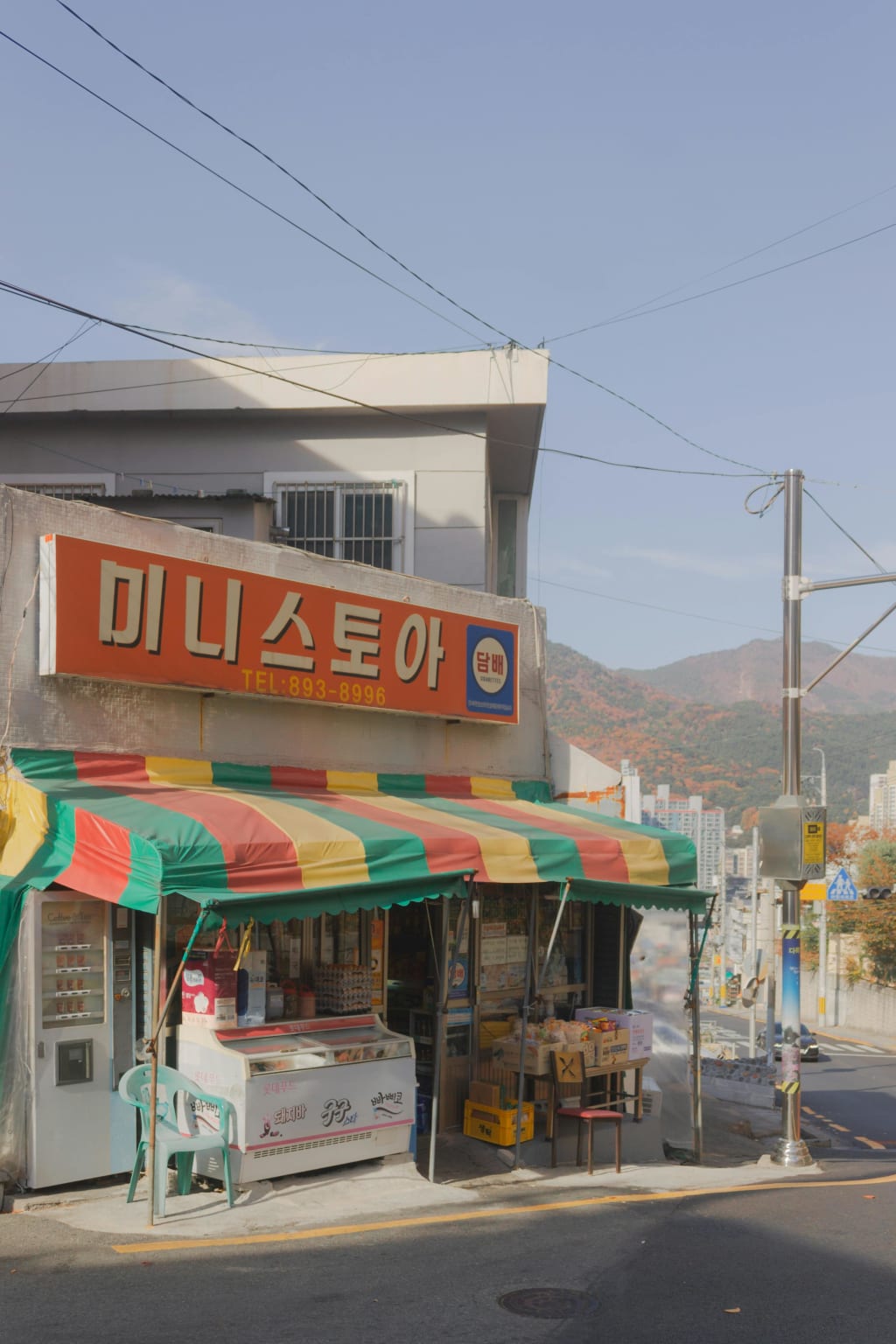
Hyun pressed his back against the small retaining wall, noticing how the late afternoon sun cast an elongated shadow across the asphalt. Just beyond his outstretched legs stood the corner store—an unremarkable building unless you were from this neighborhood. Its bright orange sign, emblazoned with the words “미니스토아,” caught the light of the descending sun. Beneath that, in faintly chipped numerals, was a telephone number no one called anymore. The sign’s edges had begun to curl and fade, like an old photograph left too long in the sun.
A striped canopy stretched from the building, providing shade over an assortment of clutter: a vending machine humming quietly, a freezer bearing brand stickers half peeled away, and two plastic chairs in mismatched shades of green. The canopy itself boasted bold stripes in red, yellow, and green, looking more festive than the store’s tired exterior otherwise suggested. A mild breeze from the nearby mountains rustled the fabric, and Hyun watched the stripes wave as though beckoning him closer.
He had spent so many afternoons here, once upon a time. He could practically taste the memory of sweet banana milk on his tongue. Even now, despite the gentle hum of the vending machine and the distant chirping of birds, Hyun could hear echoes of teenage laughter—his own younger voice, mingling with another’s. Maybe if he closed his eyes for long enough, he might still catch the faint trace of Yuna’s scent, like sunlight trapped in chestnut hair.
But that was years ago. He hadn’t planned on coming back here—ever, really. Life had a way of sweeping people into new routines, new dreams, new heartbreaks. Yet here he was again, drawn by the news of his grandmother’s fragile health. Late the night before, a phone call had come, urgent, tearful, telling him to hurry home. So he packed a small bag, left his apartment in Seoul, and returned to the place he once called home.
He arrived that very morning, found his grandmother sleeping fitfully, and realized there was little for him to do beyond waiting. Feeling restless and suffocated by the quiet of her small house, he wandered down the street, letting muscle memory guide him. Each step pulled him deeper into recollection—his old elementary school, the park where the cherry blossoms used to bloom in mesmerizing pink, and finally, the steep hill that curved around to reveal this little shop perched precariously over the city below.
He had promised himself not to linger in the past. But as he stood there, looking at the store, the swirl of memory was too powerful to resist.
A Memory Carved in Sunlight
Back then, he was sixteen, with scuffed sneakers and a perpetual sense of uncertainty. School felt like a cage, and home wasn’t much better—his father lost in work, his mother busy with his younger siblings. At school, he struggled to fit into any particular circle. He liked music, but not enough to join the band; he appreciated sports, but never made the team; he found books interesting, but wasn’t quite the top student. So, he drifted.
That corner store became his secret refuge on days when the world felt too big, or maybe too small. He would gather whatever coins he’d scavenged from the couch cushions and buy a chocolate pie or a packet of seaweed snacks and linger outside, savoring the sense of freedom. The plastic chair in front of the store was more comfortable than the plushest sofa at home—mostly because it was his space, on his time.
He remembered the day he first met Yuna with startling clarity. Classes had ended, and a group of students flooded the hallway. Hyun slipped away, as he often did, exiting the school grounds through the back gate to avoid the crowds. He made his way up the hill, panting by the time he reached the store. Sweaty, disheveled, he pushed the door open to hear the soft ding of the entrance bell.
Inside, the fluorescent lights buzzed overhead. The middle-aged woman behind the counter—everyone just called her “Ahjumma,” though that wasn’t her name—nodded politely, barely looking up from her accounting ledger. Hyun scanned the neat rows of gum, chips, and ramen packets, then grabbed his usual Choco Pie and banana milk. He counted out coins, placed them on the counter, and shoved the items into the large pockets of his uniform blazer.
Before he could step back outside, the door chimed again.
She breezed in, hair brushed by the setting sun, wearing the same uniform but in a way that seemed entirely her own. She didn’t look at the racks of snacks. Instead, she studied Hyun first, as though he were as much a curiosity as anything else in that store. She was new—he realized immediately he had never seen her on the hill before.
“You go to Seongyeon High, right?” she asked, her tone casual, but her eyes bright with curiosity.
“Uh, yeah,” Hyun managed, swallowing the sudden knot in his throat.
“I’m Yuna,” she offered, with a small tilt of her head that almost resembled a bow. “Class 2-B.”
It was an introduction that lacked the usual formality—no last names, no mention of family, no mention of what clubs she was in. It felt strangely intimate. And that moment, brief as it was, became an anchor in Hyun’s life. From that day, they found themselves meeting at the store regularly—sometimes by coincidence, sometimes by a quiet understanding they never articulated. One would appear five minutes after the other, always around 4:17 p.m.
They’d buy drinks or snacks and sit outside together. At first, they talked about small things: teachers they disliked, the annoying construction on the main road, the new action movie screening at the local theater. But as days turned into weeks, the conversations became something more. Yuna confided that her parents argued often at home, and she found solace in these little escapes. Hyun admitted he felt like a ghost in his own house, overshadowed by siblings who excelled at everything. They joked, laughed, sometimes even argued about silly things—like which flavor of instant noodles was the best.
One late afternoon, Yuna ran her fingers over the wooden awning support, tracing invisible patterns. “Do you think places can remember us?” she asked.
Hyun grinned awkwardly. “Like they have ghosts?”
She shook her head. “No, more like… places store up our echoes. The things we say, the moments we share. Even when we leave, it’s as though those memories get etched into the walls.”
Hyun had never thought of walls as living diaries. But the sincerity in her voice made him want to believe.
The Day She Disappeared
Time in high school follows a strange rhythm—simultaneously feeling endless and fleeting. One week, Hyun and Yuna were meeting at the store almost daily; the next, she was gone. He didn’t see her at school. He asked around and discovered rumors that her father’s job had forced them to relocate suddenly. Someone mentioned hearing about family issues. Another said they moved to another city. The details varied, but the outcome was the same: Yuna vanished without a goodbye.
Hyun tried calling her phone, but it rang endlessly. He stared at the intersection where their paths diverged, wondering if he had done something wrong. For a couple of weeks, he held onto the hope that maybe she was just absent, maybe sick. He still turned up at the corner store each day at 4:17, waiting in silence. The older woman behind the counter—Ahjumma—would cast sympathetic glances in his direction, but never said a word. Eventually, Hyun stopped looking at the door every time the bell chimed. He stopped buying Choco Pies and replaced them with cheaper snacks. Then, he stopped coming altogether.
Life moved on. He finished high school, packed his bags for university in Seoul, and rarely thought of the store or the hill. He would catch flashes of memory—banana milk in a convenience store aisle, a chestnut-haired girl glimpsed in a crowd—but these moments were fleeting, overshadowed by new responsibilities. He found a part-time job, made new friends, discovered new passions. The corner store receded to a quiet corner of his mind.
The Return
The call about his grandmother came late one evening. She was ill—very ill. Hyun left everything behind and took the next train south, arriving at the family home he had avoided for so long. The house felt emptier than he remembered. The walls seemed to echo every footstep. His grandmother’s breathing, shallow and labored, filled him with guilt. He stayed by her side, feeding her spoonfuls of warm soup, but she mostly slept. When he couldn’t handle the suffocating stillness any longer, he slipped outside under the pretext of needing fresh air.
With no particular destination, his legs carried him down the hill. The feeling of nostalgia was instantaneous. Each house, each lamp post, and each bend in the road was a mirror reflecting a younger version of himself. And then he saw it: the store with the vibrant canopy. Despite the chipped paint and a few more rusted edges on the signage, it looked much the same as it did years ago—like a piece of a puzzle that never fit anywhere else.
It was late afternoon, and the city below glimmered in the golden light. A breeze rustled the canopy, and Hyun felt the old tug of memory. He opened the door, the bell chiming with a familiar ring. A younger woman he didn’t recognize stood behind the counter. She greeted him with a polite nod.
“Welcome,” she said. “Let me know if you need help.”
He looked around. The interior layout remained unchanged—racks of snacks on one side, refrigerators humming on the other, a small aisle in the middle just wide enough for two people to pass. But gone was the old Ahjumma. Gone were the faint scribbles of pencil on the calendar behind the counter. Hyun approached the register, selecting a Choco Pie and banana milk almost as an afterthought.
The woman rang up his purchase. “That’ll be 2,000 won.”
He handed over the money, hesitant. “I used to come here a lot,” he said, attempting a smile. “Back when the older lady ran it.”
The woman nodded, a flicker of sadness in her eyes. “She was my mother. She passed away last year. I’m doing my best to keep the place running, though it’s hard now. Fewer customers come up here.”
Hyun mumbled his condolences. He felt a pang of sadness. The Ahjumma had been a quiet fixture of his adolescence, always present but seldom acknowledged. He stepped outside and took a seat on one of the plastic chairs. Opening the banana milk, he sipped it slowly, its taste mingling with memories of that younger boy he no longer was.
Echoes in the Wood
As the sun dipped lower, it illuminated something just under the wooden countertop where the old freezer used to be stationed. Curious, Hyun stood and walked over. There, carved into the wood with a shaky hand, was a heart. Inside the outline, the letters read: H + Y. The carving was small, faint, and obviously done in a hurry—maybe with the tip of a mechanical pencil or a pocket knife. He ran his fingers over the grooves, heart pounding. There was no question who had made it. He felt his throat tighten as the memories poured in like water breaking through a dam.
He remembered the day after midterms. He and Yuna had skipped the first part of afternoon study hall to meet at the store. They were the only ones around, with the Ahjumma dozing behind the counter. Yuna had rummaged for something in her backpack, produced a tiny blade from a craft kit, and smirked at Hyun. “Let’s leave something behind,” she whispered. “So this place never forgets us.”
They picked a spot under the counter, out of immediate sight but still accessible if you bent down. She scratched the small heart shape, giggling as though performing a prank. Hyun added the letters with a trembling hand. For a moment, it felt like sealing a pact—a promise of something that might last.
That memory, that day, had gone dormant in his mind until now. He didn’t know whether to smile or cry. The carving looked older than it should. Perhaps time had eroded it, or maybe he had overestimated how deep they’d cut it. Either way, it was still there, a silent testament to a friendship—or was it a young love?—that had ended too abruptly.
He set down the banana milk and traced the letters once more. “You asked if places could remember us,” he whispered to the air. “Yes, they do. Even when I wish I could forget.”
Waiting for a Ghost
That night, Hyun returned home to find his grandmother awake, more lucid than before. She nodded weakly when he offered her water, and asked him to sit on the edge of her bed. She told him old stories: how his grandfather had once proposed by slipping a ring into her sewing box, how she used to chase Hyun’s father around the yard with a wooden spoon when he misbehaved. Hyun listened, interjecting occasionally to keep her talking, to keep her awake.
When she drifted off, he sat alone in the living room, grappling with the swirl of emotions from the day. He thought of Yuna’s disappearance, of the little heart carving, of the quiet store, of how everything around him seemed to be decaying—except that memory, which felt more alive now than ever.
The following afternoon, Hyun went back to the store. He arrived at 4:17 p.m. Not because he believed in miracles, but because it felt like the only right time to be there. He bought the same snacks, even though he wasn’t hungry, and settled into a chair. The autumn sun warmed his face. The breeze carried hints of the changing season, that first crispness in the air.
Hours passed. The shadows grew longer. He watched a few locals come by for small groceries—a jar of kimchi, a carton of eggs, a pack of cigarettes. He recognized one or two from his youth, but they didn’t recognize him. The store’s new owner gave him polite glances. Hyun suspected she thought him odd, loitering there without much of an explanation.
But Yuna didn’t appear. Of course she didn’t. Why would she? Years had gone by. She could be anywhere—maybe in another province, studying, working, living an entirely different life. She might even be abroad. The rational part of Hyun’s mind told him he was being foolish, clinging to a relic of adolescence. Yet something deeper told him to come back the next day. And the next. And the next.
A Glimpse Beyond the Stripes
A week slipped by. Hyun’s grandmother’s condition stabilized somewhat, but she was still frail. He balanced his time between caring for her and making his silent pilgrimage to the store each afternoon. There, he would sit, sometimes flipping through old text messages on his phone—long since replaced and reactivated. He found none from Yuna. She had disappeared from his digital life as thoroughly as from the physical.
On the eighth day, he caught a glimpse of a girl with chestnut hair walking up the street. Heart pounding, he rose from his chair. But as she drew closer, he realized her hair was the wrong shade, her face unfamiliar. She passed him by without a second glance. He slumped back into his seat, feeling the sting of disappointment.
He thought about that question again: Did places truly remember the people who had come and gone? The scratched heart remained under the counter, an undeniable artifact of them. And yet, it offered no comfort, no closure.
Late that day, the store’s owner approached him. “You come here often,” she said softly, wiping her hands on her apron. “Is there something in particular you’re looking for?”
Hyun debated telling her everything. Instead, he simply smiled and shook his head. She lingered a moment, as though wanting to offer some motherly advice, then retreated inside.
The Day She Passed By
On the tenth day, the sun shone brilliantly, the sky a clear autumn blue, and the mountains in the distance were crowned with leaves turning shades of gold and red. Hyun was lost in thought, sipping on a soda he didn’t really want. The store’s bell chimed. He looked up, expecting to see another local or maybe a group of kids.
She walked in quietly, wearing jeans and an oversized gray hoodie. Her hair fell just past her shoulders, chestnut with golden undertones. She didn’t look at him. Instead, she moved toward the shelves, picking up a small carton of yogurt. Her movements were careful, unhurried, like someone visiting a place they hadn’t seen in years.
Hyun’s heart thundered in his chest. Yuna. It had to be her. He tried to speak, but his mouth went dry. He rose halfway from his chair, knocking the soda can off the table. It clattered to the ground, causing her to glance toward the noise. He caught a glimpse of her face—a moment that felt like an eternity. She looked older, of course, and her eyes held a guarded softness. But it was definitely her. She still had that gentle curve of the lips, the same shape of eyebrows.
For a heartbeat, it seemed she recognized him, too. Or maybe she just noticed his reaction. Then, as if unsure, she pivoted and approached the counter, paid for her yogurt, and moved toward the door. Right before stepping outside, she hesitated. Her gaze flicked to the underside of the wooden counter, where Hyun knew their carving remained. Her fingertips grazed that very spot. Then she stepped out onto the sidewalk and was gone.
Hyun stood frozen, torn between rushing after her and staying put. Something in her expression—the slight tremor of her lips, or the dip of her head—suggested she might not want to be chased. Still, the desire to run after her, to shout her name, blazed within him.
He snatched his wallet from the table and dashed outside, scanning both directions. The glare of sunlight and the angle of the hill made it difficult to see clearly. He thought he glimpsed a figure heading down the slope, hoodie pulled up over her hair. He could have run, maybe caught up, but he wavered. His heart pounded like it was about to break free of his ribs. In that hesitation, she disappeared around the bend.
Unfinished Echoes
He returned to his grandmother’s house shaken, stumbling over how to process what he’d just seen. Was it truly Yuna, or a specter conjured by his longing? He spent the evening by his grandmother’s side, not saying much, just holding her hand as she dozed in and out of consciousness. When she was asleep, he stepped out into the cool night air. The stars spread overhead in a dizzying panorama. He wondered if there was some cosmic joke in seeing her at the exact moment he’d lost the nerve to speak.
Days continued to pass. Hyun had to make preparations to return to Seoul—his job, his apartment, and the responsibilities of adulthood beckoned. His grandmother was doing slightly better, and other family members were arriving to care for her. He came to the store again on his last evening in town, unsure if he was hoping to see Yuna or dreading it. The bell chimed, and once more, he stood by the counter, eyes drifting to that small carving under the wood.
Placing a hand over it, he closed his eyes and remembered the way she laughed, the way she studied his face when he spoke, and the way she asked that strange question about places and echoes. A part of him wanted to find her, to resurrect the past, to fill in the years they’d lost. But another part of him was strangely content with the knowledge that she was still here, in some capacity—alive, existing in the same space, perhaps leaving her own echoes in the places she passed through.
A New Dawn
The next morning, he left quietly for Seoul. The train ride felt both long and too short. He stared out the window, the countryside rolling by, and replayed that brief glimpse of Yuna a thousand times. He had so many questions but no certain answers. Had she seen him, recognized him? Why hadn’t she spoken? Did she carve that heart with him all those years ago only to forget? Or had she carried that memory in secret, just as he had?
As the train pulled into the station, Hyun recalled her old words: “Places can remember us.” Maybe the corner store was proof enough of that claim. The heart carving remained, etched into the wood, unforgotten. Perhaps the store still hummed with the echoes of their younger selves.
Though their lives had led them down separate paths, perhaps that place would keep their footprints a little longer. A time capsule of stolen moments and whispered confessions. Hyun felt a strange sense of peace. Even if he never saw Yuna again, he knew he wasn’t alone in remembering. The shop, the old hill, the scuffed plastic chairs—they, too, bore witness. And sometimes, that is enough.
About the Creator
Alpha Cortex
As Alpha Cortex, I live for the rhythm of language and the magic of story. I chase tales that linger long after the last line, from raw emotion to boundless imagination. Let's get lost in stories worth remembering.
Keep reading
More stories from Alpha Cortex and writers in Fiction and other communities.
Shadows on a Rain-Soaked Path
The alley was unassuming at first glance. Narrow and cramped, its walls bore the marks of time and the echoes of untold stories. Overhead wires tangled in chaotic lines, bridging one building to the next. Everything was cast in a quiet shade of grey, as though the entire place existed in a dreamlike monochrome. In the dim light of early evening, the street looked almost deserted, but a subtle hum of life persisted just beneath the surface. A lone motorbike leaned against a faded shutter, its metal parts reflecting the sparse glimmers of what little daylight remained. The alley’s stillness called out to passersby—an invitation for the curious or the lost. From the moment the traveler stepped inside, it felt like entering another world.
By Alpha Cortex12 months ago in Fiction
The First Rainbow Baby
Pitter-patter, pitter-patter. The rain fell in rhythmic splatters, slowly slowing, but still constant. Mira rolled onto her side pulling the blanket tight against her ears, but still she could hear chitter-chatter and scurrying feet of the creatures that refused to sleep in the lower decks.
By A. J. Schoenfeld2 days ago in Fiction
The Last Lightkeeper of Lake Kivu
On the northern edge of , where the water turns molten gold at sunset and the fishing boats drift like shadows across the horizon, stands a lighthouse that most maps have forgotten. It is small, built of aging stone, and leans ever so slightly toward the wind. And inside it lives Emmanuel Nkuranga, the last lightkeeper.
By Nsengiyumva Benit Ricardo7 days ago in Fiction


Comments (1)
I love the corner store at the end of the hill! Amazing