
The compass that points to the bottom of forever
The most profound discoveries are found where logic breaks down.

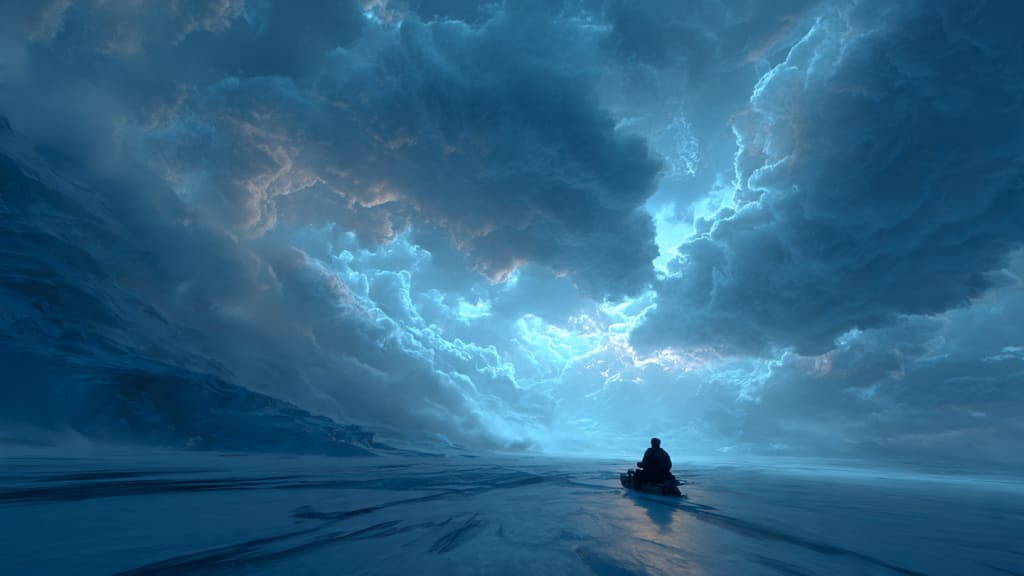
The air felt sharp, like tiny shards of broken glass. It was so quiet, almost silent, with a hum.
Dr. Alistair Finch grew accustomed to Antarctica’s quiet, not because it was empty, but because it felt genuine. His small station, a worn green prefab hut nicknamed 'The Logic Box,' stood alone on the ice, where facts were straightforward: air temperature, pressure changes, and how magnets pointed off true north.
Over the course of a decade, the shifting magnetic pole became his primary focus. There, he observed it move tiny amounts on Earth's surface. This job required careful work, often done alone, collecting data day after day.
Next up was the compass.
He didn’t own it. Just dug up near ice fields, far from where he stayed, a chunk of old brass locked in foggy, salt-crusted glass. Came with a message, tucked in a rusted tube, stamped 1957. Handwriting faded, yet the last shaky line stood clear: Keeps shifting. Always aim below.
Alistair snorted. No surprise there. An old thing, most likely busted; the needle is either rust-jammed or has lost its magnetism. Back at The Logic Box, he hauled it, aiming to scrub off gunk and slap it down as a grim little desk knick-knack.
Yet right in the middle of his desk, while the new electronic sensor showed what he expected, just a steady signal, the old compass didn't match up.
The compass wasn't showing the usual north, nor the regular magnetic shift. Instead, it shook briefly before locking into place, aiming straight downward with eerie precision. As Alistair lifted it and turned it bit by bit, the needle fought against what should’ve been normal magnetism, holding firm toward some hidden direction under his wooden planks.
This moment stuck with Alistair more than any note. He realized some things don’t fit on paper; old items carry whispers modern gadgets miss.
The Rhythm of the Unknowable
Alistair wasted three whole weeks attempting to kill the compass with science. Instead of just tossing it, he wrapped it in metal shielding. Then came the heat, cranking up the temperature to an extremely high level. After that, cold hit it hard. Additionally, weak magnetic pulses were introduced intentionally. Not done yet, he dragged it outdoors during a mid-solar storm, when space lit up like a noisy light show, which really ought to have made the little brass pointer freak out entirely.
The needle just stayed locked on that underground spot.
Yet the true horror of the moment his logical mind cracked open hit once the needle shifted.
It was faint, one tiny flicker, nearly invisible on the fast-motion cam he'd rigged up. Then a second blink. Followed by a third. Not just static or glitchy footage. There was a pattern in the flashes.
Alistair stayed put, bent low over the old device, the hiss of wind from outside keeping him company. He counted each time, after 4.7 minutes, the pointer twitched before snapping back down again, as if something huge beneath was stirring just a little.
Beneath the frost. Underneath the stone layer. Deeper than the hot middle part.
At first, he didn't believe it. Perhaps it was a buried rock, or thick layers of old iron, down there. Yet iron can’t pulse like that; nothing made of metal beats in steady, unnatural rhythms.
He activated his most delicate low-frequency magnetometer equipment, typically used in earthquake research. Then he began the advanced calculations, adjusting for each recognized factor: shifts in tectonic plates, the pull from ocean tides, and the weak, distant magnetic traces of the southern lights.
The results made no sense. Not tied to any rock formation. Spitting out a weird doughnut-shaped magnet field, way too powerful, buried way too far down, yet somehow still moving when it shouldn't. What really stood out was that last part.
It shifted. Just a bit. Huge like.
This moment led him to another insight, harsh and cold: what stops exploration most is not knowing it’s thinking you already know enough because you’ve learned a bit.
The Isolation of Truth
The moment hit hard, like a punch to the gut. Alone, completely with no one within a hundred miles, and the closest person lived five times farther from any real settlement. His eyes flicked between the satellite phone and the old-school compass on his palm, realizing one call would set off two unavoidable outcomes.
People would think being alone wore him down.
They’d dispatch a crew, gather the information, then hide everything behind endless red tape and claims of protecting the country.
The pressure of picking between mental peace and honest science hit hard. A sharp rush of fear made it clear that he saw now that back in '57, others had probably stood at that same crossroads; the compass was all they risked leaving as proof.
He chose with grit, not reason. Yet he’d chase the signal anyway.
Over the course of two months, he built a portable sensor setup, arduous and shielded, to follow the oddity creeping under the ice. Parts came from his heater; warmth was ditched, so circuits had juice. Fingers cracked, thoughts fogged, he pushed nonstop. A thin coffee drip kept him going, plus that quiet, unnerving twitch of the gauge.
The sensory bits from that time felt harsh. There was the constant radio static. He left it playing only so some voice could break the silence, even if canned and dull. Ice made noise: now a soft scrape, then a boom like reality splitting apart. I wonder what stuck? That sharp scent of ozone, plus a faint zap in the air right before the compass jumped again, like something massive moving on weird, unknown energy.
The magnetic origin, he discovered, was drifting eastward toward the hidden ridge under Antarctica’s ice, where the ground below was cracked and worn thin. Not fast, just inches each day, yet pushing forward without pause, almost like a giant landmass repositioning in slow motion.
The third quiet truth settled deep inside him. Bravery doesn't mean no fear. Instead, it's picking a strange, unclear fact instead of a cozy story you've told yourself again and again.
The Descent
At last, the signal quit drifting. It came to rest under a vast, untouched shell of icy blue.
Alistair figured there was no turning back now. With a heavy-duty heat-powered drill designed for slicing through frozen layers, he began carving downward, maintaining a tight grip on the compass’s exact angle.
The drill moved at a crawl, like torture. Ice here felt heavier than anything before, old stuff crushed under the weight of ages. For three whole days, he kept going, took breaks to swap out batteries or glance at the compass; it worked again, needle twitching, aimed dead into the dark pit below.
At 800 feet, the noise shifted. Instead of the jagged scrape of metal cutting through ice, there came a low, steady hum. The air rising from the hole was no longer cold. It felt damp, warm, carrying a hint of sulfur along with another scent, one like wet earth or thick forest moss.
Alistair couldn’t take it anymore. His limit was hit hard. Actually, he’d run out of rope. It measured exactly 810 feet. Not a yard more.
He set up a tiny pressurized camera along with a powerful light, then lowered it the last ten feet. Holding his breath, he stared at the little monitor inside the Logic Box.
The lens twisted as it dropped into a slick, dark film of liquid.
Right after, a glow lit up what was there.
It wasn't a machine, nor some beast, yet it sure looked like no shooting star. This thing had shape, though nothing made by people or born from Earth.
A huge thing hung there, turning slowly, maybe three hundred feet wide, a giant ring covered in sharp edges. Still, it wasn't the size that hit him first. It was what it was built from. No ordinary material, this: pure black glass, totally transparent, sliced exactly by some unseen hand. Each piece fit tight against the next, forming countless slanted faces that caught faint glimmers. Light didn’t just bounce off. It seemed trapped, flickering between the corners.
When the camera stopped shaking, Alistair spotted what made the compass twitch something off in the distance, pulled it sideways.
The thing wasn’t made of metal; it was a vast, precisely built magnetic lens. Instead of reflecting, it pulled in Earth’s magnetic energy, squeezed it tight, then shot it back out as an ultra-focused stream. What looked like a pulse on the compass? Not a beat, just the lens turning slowly, tweaking its aim, maybe trying to signal across vast distances.
In the middle of the spinning black glass disk, Alistair spotted one giant pale crystal. Not shifting at all. Making a low sound instead and just sitting there.
The center created the strange pull, yet stayed still while everything else shifted around it.
The Inner Compass
Alistair stared at the picture for just a couple of minutes longer until the camera died. The display flickered out; still, that quiet, spinning, unreal wonder stayed stuck in his head.
He grabbed the camera, stuffed the drill gear into his bag, then closed off the hole using spray foam, which’d freeze solid before sixty minutes passed. Wiped every trace of magnetic signals from his machine, knowing automated scans would catch even a hint. All he saved was the old compass; once set on his table, it leaned forward as if it meant something now.
He didn't save everyone. Yet he saw it wasn't about answers. Instead, he realized quietly that some truths come too early. Or they don't matter.
After wrapping up his shift, he turned in the usual paperwork about the steady movement of the magnetic pole, nothing surprising. He walked away from Antarctica different than when he arrived.
He figured out the real point wasn’t the thing under the ice. Instead, it was all about the compass.
The old gadget, a basic compass, was designed to track true north, a fixed point on Earth's surface. Yet this one twitched toward something odd, some shifting power no science could explain. Instead of facts, it chased feelings, revealing truths beyond any official chart.
He saw that idea show up in his own world. Years went by where he followed outside rules, what science said, chasing job security, needing others to approve, sticking close to known truths. Yet underneath, something kept tugging at him, an odd hunch, a quiet glitch inside that hinted reality was weirder, messier, deeper than any machine could measure.
This fourth lesson’s the last one, the kind that shifts everything, the rule he follows today because that gut feeling, the quiet tug toward some calling or odd passion or weird certainty inside you, isn’t random; it’s what actually shows where you belong.
Going north is simple; everyone heads that way anyway. Sticking to what others expect feels secure, like ground you can stand on. Yet real answers, the ones that actually fit who we are, show up only once we quit dodging our own weirdness. That shaky feeling? You can lean into it. Please pay attention to its beat. Move with whatever pulls from inside, even if it doesn’t make sense.
Alistair never tracked down the strange pull under Antarctic ice. Instead, he stumbled on something buried deeper: a forgotten urge to escape numbers, rules, fixed paths. His hunger for mystery flared up again after years of quiet.
The world’s packed with old spinning objects, hidden not beneath frost but under piles of what people expect and rigid thinking. The key? Locate your vintage guide, your gut feeling tool, and admit it doesn’t aim north; it pulls downward, into the warm, pulsing, shifting heart of who you really are.
Don't just measure the surface; dare to drill.
About the Creator
Nipun M. Wijerathne
Hello! I’m a creative writer, and I love it. I write creative fiction & mysteries of my own making. When I’m not writing, you’ll find me reading and watching.
Keep reading
More stories from Nipun M. Wijerathne and writers in Fiction and other communities.
Imagine dinosaurs roaming the earth again. What is it like?
The world is full of dinosaurs. They're everywhere, in all sorts of weird places. You've probably seen them in the movies or on TV, but have you ever wondered what they actually look like? Or how they act? Or even where they live? Well, here's your chance! This article will tell you everything you need to know about dinosaurs: where they roam free and why we're still fascinated by them today.
By Nipun M. Wijerathne2 years ago in Fiction


Comments
There are no comments for this story
Be the first to respond and start the conversation.