
The Color of Sound
When silence takes everything, he learns to hear with his heart instead of his ears

I never thought I’d hear music again.
They told me the silence would be permanent. The explosion at the plant left me half-conscious in the hospital for days, and when I woke up, the world had folded into a thick, suffocating quiet.
My wife, Mari, mouthed words I couldn’t understand. The nurses used bright yellow notepads and markers to explain simple things: breathe, swallow, blink.
I tried to scream, but even my own voice was gone.
I was 38. I had been a sound engineer, someone who spent entire days living inside waves, echoes, and vibrations. In one second, my universe collapsed into a graveyard of noise I could no longer touch.
The first year was a sequence of sharp grief.
I missed the squeak of the old floorboards, the way Mari’s laughter trickled out from the kitchen, the rhythmic click of my dog’s paws on the tile. Even the distant, annoying leaf blower from next door, all of it gone.
I learned to read lips, sort of. My mother dropped off books in large print, as if I had lost my sight too. Friends disappeared in slow waves, unsure of what to say to a man living in a cocoon.
I felt like I was haunting my own life.
A year after the accident, Mari surprised me.
She came home from the grocery store with a small box, her eyes wild with excitement.
“Open it,” she mouthed, her hands trembling.
Inside was a headset and a small black device the size of a matchbox. I squinted at the instructions: “Cochlear auditory prototype. Experimental.”
She typed on her phone:
It’s a new trial. It doesn’t give you back full sound, but it converts vibrations into electrical signals you can “feel.” They think your brain might learn to interpret it as sound over time.
I felt my heart pound against my ribs.
It was too risky. Too unknown.
But Mari’s eyes gleamed with a desperate hope I hadn’t seen since before the accident.
I nodded.
The first time they turned it on was like being inside a thunderstorm underwater.
I didn’t hear music or voices — I felt something. A low, pulsing hum in my skull, an electric dance across my skin. The doctors clapped. I cried.
Mari hugged me so tightly that the device almost popped off. She kept mouthing, We’ll figure it out. Together.
For months, we trained. I sat in sterile rooms, learning to identify a doorbell versus a dog bark. The engineers played scales on a piano, and I pressed buttons whenever I thought I felt a shift.
It was exhausting, humiliating, and exhilarating all at once.
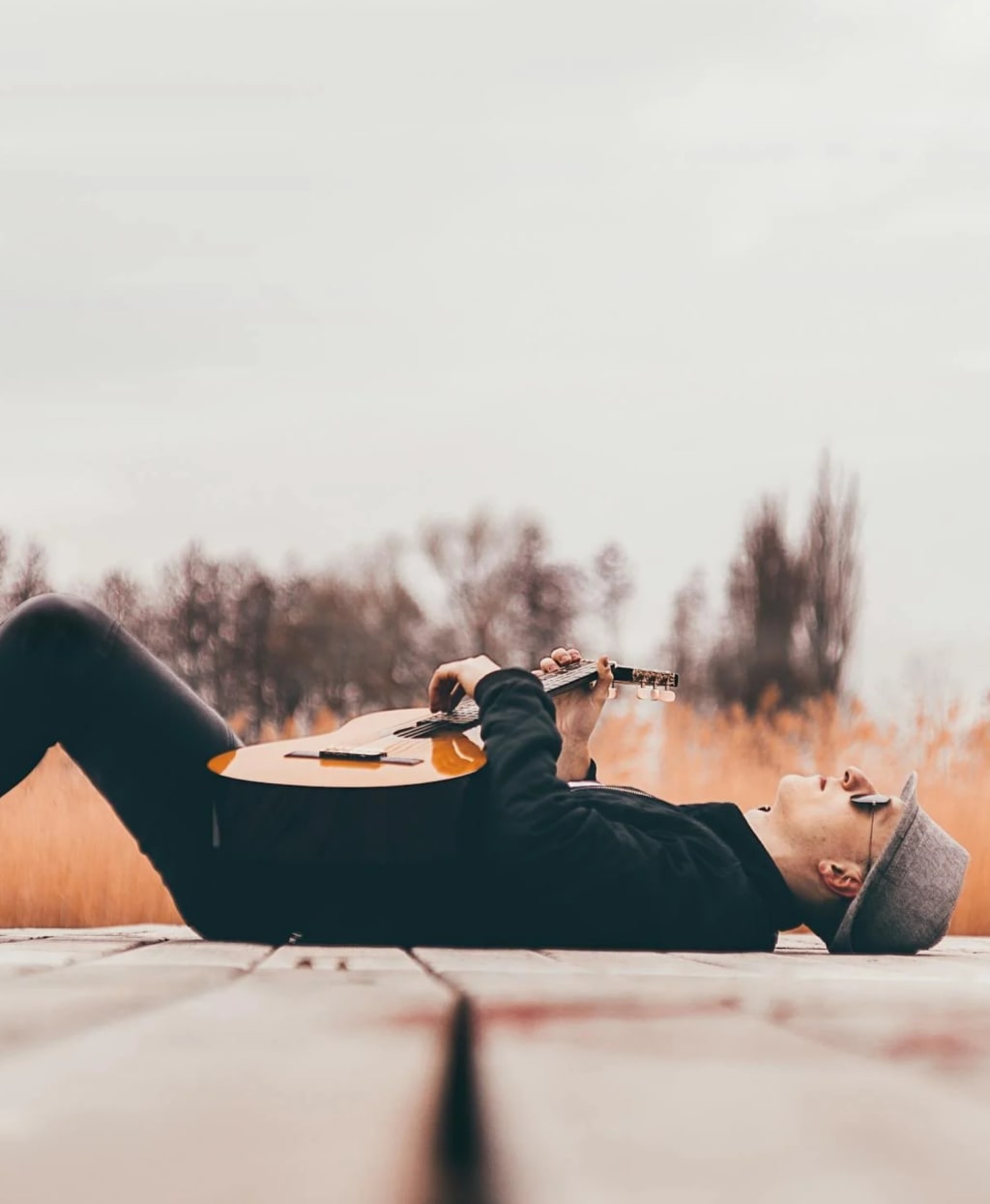
Then one morning, Mari brought out my old guitar.
She had kept it in its case, thinking it might hurt too much to see. But today, she placed it in my lap gently, as if offering me a fragile bird.
I ran my fingers over the strings. The vibration shivered up my fingertips and into my elbow.
She wrote on her pad:
Try playing your favorite song.
I hesitated. My favorite song used to be “Harvest Moon” by Neil Young. I had played it for her on our second date under a canopy of fairy lights, when I still believed love could fix everything.
I positioned my fingers. The first strum felt alien, like holding someone else’s hand.
Then I strummed again.
A ripple crawled up my bones and into my chest. The shapes of the notes felt like sparks behind my eyes.
Mari started crying, her shoulders shaking. She pressed her forehead to mine, and for the first time in years, I felt her laughter reverberating against my skin.
It wasn’t sound as I knew it. It wasn’t what I had lost. But it was something.
It felt like the first time I ever touched a guitar at thirteen. That wild, breathless feeling of discovering a secret language only I understood.
We began a nightly ritual. After dinner, Mari would sit on the porch swing, and I’d play whatever came into my head. I learned to “hear” her reactions by the vibrations in her body, the way she shivered when she was moved, the way she stomped her foot when something felt joyful.
I started writing new songs. Not for the charts or for applause. Just for us.
Sometimes neighbors would lean over the fence and wave. Sometimes kids would sit on the curb, wide-eyed.
To them, I was a man with a guitar. To me, I was rebuilding a universe.
Months passed, and the engineers asked me to come back for an evaluation.
They plugged in graphs and electrodes, tapping keys while I strummed chords they assigned me.
One young tech, nervous and eager, leaned in and asked, “Does it feel like music again?”
I paused.
It wasn’t music in the traditional sense. I couldn’t pick out harmonies or subtle shifts. I couldn’t tell if a song was in D minor or G major.
But I had learned something no studio could teach me: music isn’t just sound. It’s presence. It’s the way Mari’s shoulders shake with laughter, the way my dog’s tail thumps against the porch, the way the oak trees sway under moonlight.
I looked at the tech and simply nodded.
Last week, Mari surprised me again.
She planned a small gathering — just a few close friends, the ones who stayed, the ones who learned to speak with their eyes and their hands.
I sat in a circle of folding chairs in our backyard. String lights glowed above us, and Mari passed out warm peach cobbler.
When I picked up my guitar, my fingers trembled.
It felt like the first time all over again.
Not just because I was playing for an audience, but because I was showing them a new part of me, a man who had to relearn his language, a man who almost gave up, a man who found a different kind of melody in the silence.
As I strummed the final chord, I felt the energy move through my arms, my ribs, my heart.
Mari stood up and clapped, tears sliding down her cheeks. One by one, everyone joined her, their cheers rising into the night.
I didn’t hear it, not in the way I used to.
But I felt it.
Like a warm tidal wave crashing through my bones. Like the first breath after being underwater. Like waking up in a world I thought I’d lost.
The engineers call it “partial auditory re-entry.”
I call it a miracle.
Every time I play now, it feels like the first time.
Because it is.
A new first time.
Again and again.
About the Creator
The Arlee
Sweet tea addict, professional people-watcher, and recovering overthinker. Writing about whatever makes me laugh, cry, or holler “bless your heart.”
Tiktok: @thearlee
Beneath the Liquid Sky
Silence. A silence so deep it pressed against the shore like the world itself forgot to breathe. The water remained still, its glazed edges shone with an iridescent glow that pulsed with life beneath the burning sun. Dark trunks rose skyward to the heavens, their branches tracing the outline of the world suspended in silence.
By Caylin Watkinsabout 16 hours ago in Fiction
Why Didn't Anyone Tell Us
Men, move along. This is not for you. This is for the women. I was forty-five when I began menopause. It is pretty young for that to be going on in a woman’s life, but I had undiagnosed PCOS, my entire life. Thank you to all the gynecologists I had seen my entire life. That in itself should encourage women to keep seeking second opinions, especially when you are not getting correct answers or any at all.
By Alexandra Grant5 days ago in Humans



Comments
There are no comments for this story
Be the first to respond and start the conversation.