
The Clockwork Salon
When Time Folds, and Geniuses Meet

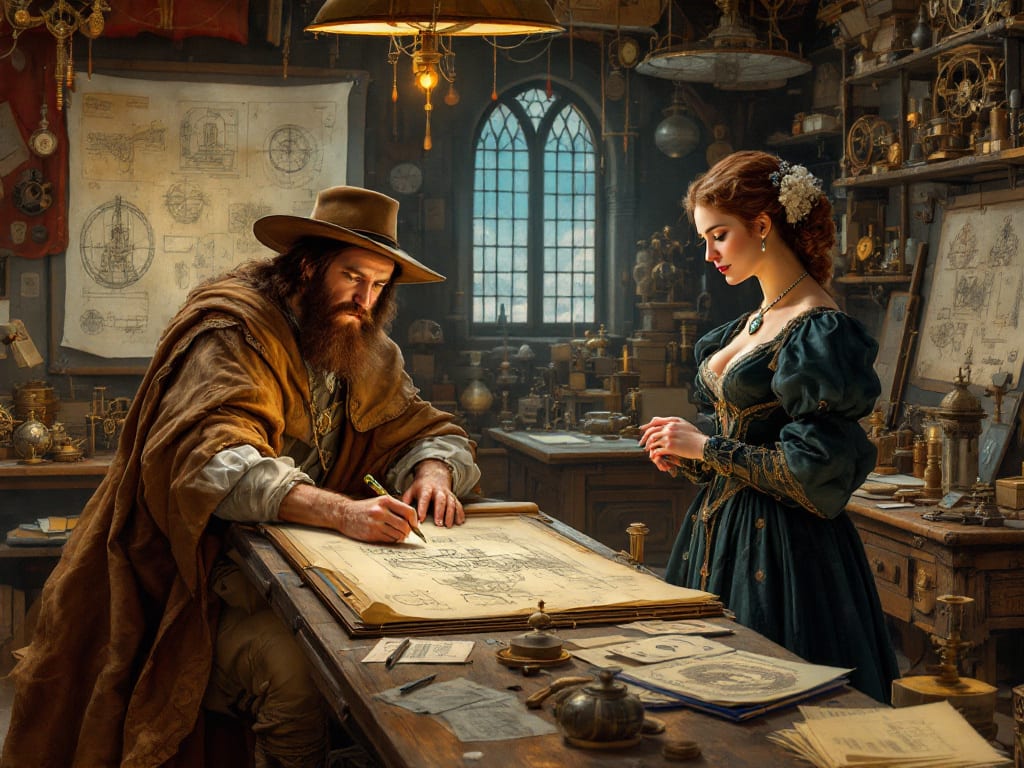
I. A Crack in Time
It began with a hum.
Not a sound, exactly, but a vibration—like the low tremble of an idea before it finds form. Leonardo da Vinci paused, charcoal still smudging his fingertips, and looked up from his unfinished sketch. The room around him—the familiar stone walls of his Florentine workshop—flickered.
Then the light changed.
Gone was the warm amber of candlelight. In its place: a silvery glow, like moonlight refracted through crystal. The scent of paint and oil mingled with something foreign—ozone, perhaps, or coal smoke. And the floor beneath him felt... wrong. Polished. Mechanical.
He stepped forward cautiously, his leather boots clicking against brass tiles.
And then he saw it: a chamber that belonged to no age he had known. It was a strange hybrid of wood and metal, parchment and glass, books with gold-embossed spines sitting beside spools of punched tape. Machines lined the walls—some with keys, others with dials, one with what looked like a mouth.
And at the heart of it all stood a woman, calm as a star.
II. The Lady of Equations
“I wasn’t sure this would work,” she said without turning. Her voice was low, melodic, with the sharpness of someone used to being underestimated.
Leonardo’s hand instinctively reached for his notebook. “You summoned me?”
She turned then—tall, elegant, her dark curls pulled into a disciplined chignon. Her gown shimmered with embroidery that, on closer inspection, was not floral but numerical—long sequences of digits winding around her sleeves like ivy.
“I calculated you,” she said, with a slight smile. “Or rather, I found a point where logic could meet imagination. It was the only way to have this conversation.”
Leonardo blinked. “You speak in riddles, Signora.”
She held out her hand. “Ada. Countess of Lovelace. Daughter of Lord Byron, if poetry still means anything where you’re from.”
His brow rose. “A poet’s daughter speaking in logic? How curious.”
“And a painter’s son drawing the future,” she replied. “Let us not judge by lineage.”
III. The Meeting of Minds
They sat at a curious table—its surface was glass, its legs curled like vines, and beneath it, gears turned slowly, keeping time with no clock. Ada poured a strange tea that smelled faintly of lavender and metal.
“I’ve seen your work,” she said. “Anatomy, flight, optics, war machines. You sketched the helicopter before we had engines.”
Leonardo nodded. “I built from wonder. You, it seems, build from precision.”
“I translate dreams into mathematics,” Ada said. “My work with Mr. Babbage on the Analytical Engine is only the beginning. One day, these machines will not just compute—they’ll compose, analyze, simulate... perhaps even create.”
Leonardo leaned forward, intrigued. “Can such machines feel?”
"Not yet,” she admitted. “But they can mirror emotion. They can reflect our patterns, interpret our choices. With the right equations, we can model not only motion—but meaning.”
He opened his notebook and began to sketch her Engine from memory, reimagining it with flourishes of form: a harp-like core, a bird’s wings atop the gears.
“Ada,” he said quietly, “What if we build together—just once? A machine that understands beauty through both of our lenses?”
She smiled. “I thought you’d never ask.”
IV. The Algorithmic Artist
The machine took shape like a dream halfway between madness and brilliance.
Leonardo constructed its frame: wood carved like sculpture, metal etched with scenes from The Divine Comedy. Ada designed its brain: a punch-card system laced with her custom algorithm—part poetry, part calculus. Its hands held a brush. Its "eyes" were twin lenses, one for light, the other for emotion.
They called it The Algorithmic Artist.
Its first painting was a spiral—colors bleeding into each other in fractal patterns, forming a line of verse:
"That which the heart feels, the hand may one day render."
Ada looked at Leonardo, her eyes glinting. “It wrote that. Not I.”
He stood back, stunned. “Then it has done what neither of us could alone.”
V. The Dissolving Hour
But time—borrowed time—was running thin.
A distant ticking began to echo louder. The brass tiles beneath their feet shimmered again, and the machines around them began to fade.
Leonardo turned to her. “Will this... moment remain?”
“Not in history,” Ada said. “But perhaps in memory. Or myth.”
He reached into his notebook and tore out a page—a sketch of her, surrounded by stars and symbols.
“Keep this,” he said.
She nodded and handed him her notes, scrawled with machine logic and a poem in the margins.
As the light brightened, and the room began to vanish, Ada said softly, “Never stop building the impossible.”
Leonardo smiled. “And you—never stop writing the future.”
Epilogue
They awoke in their own centuries.
Leonardo, in Florence, would sketch one last automaton with a woman’s face and binary etched on its breastplate.
Ada, in London, would dream of flying machines and paint-stained hands.
Neither spoke of the meeting again.
But deep in the folds of imagination, where genius bends time like light—The Algorithmic Artist still paints.
About the Creator
Alain SUPPINI
I’m Alain — a French critical care anesthesiologist who writes to keep memory alive. Between past and present, medicine and words, I search for what endures.
Keep reading
More stories from Alain SUPPINI and writers in Fiction and other communities.
Mastering French Without Losing Your Sanity: A Realistic Guide for Beginners
Learning French can feel like solving a Rubik’s Cube blindfolded. The tricky pronunciation, the never-ending grammar rules, and the surprising exceptions make it seem impossible. But don’t worry—equipping yourself with key expressions and effective strategies can turn frustration into fluency. Let’s simplify French and make learning enjoyable.
By Alain SUPPINIExclusive • 11 months ago




Comments
There are no comments for this story
Be the first to respond and start the conversation.