
The Clockmaker's Secret
Time doesn’t just tick forward — sometimes, it remembers.

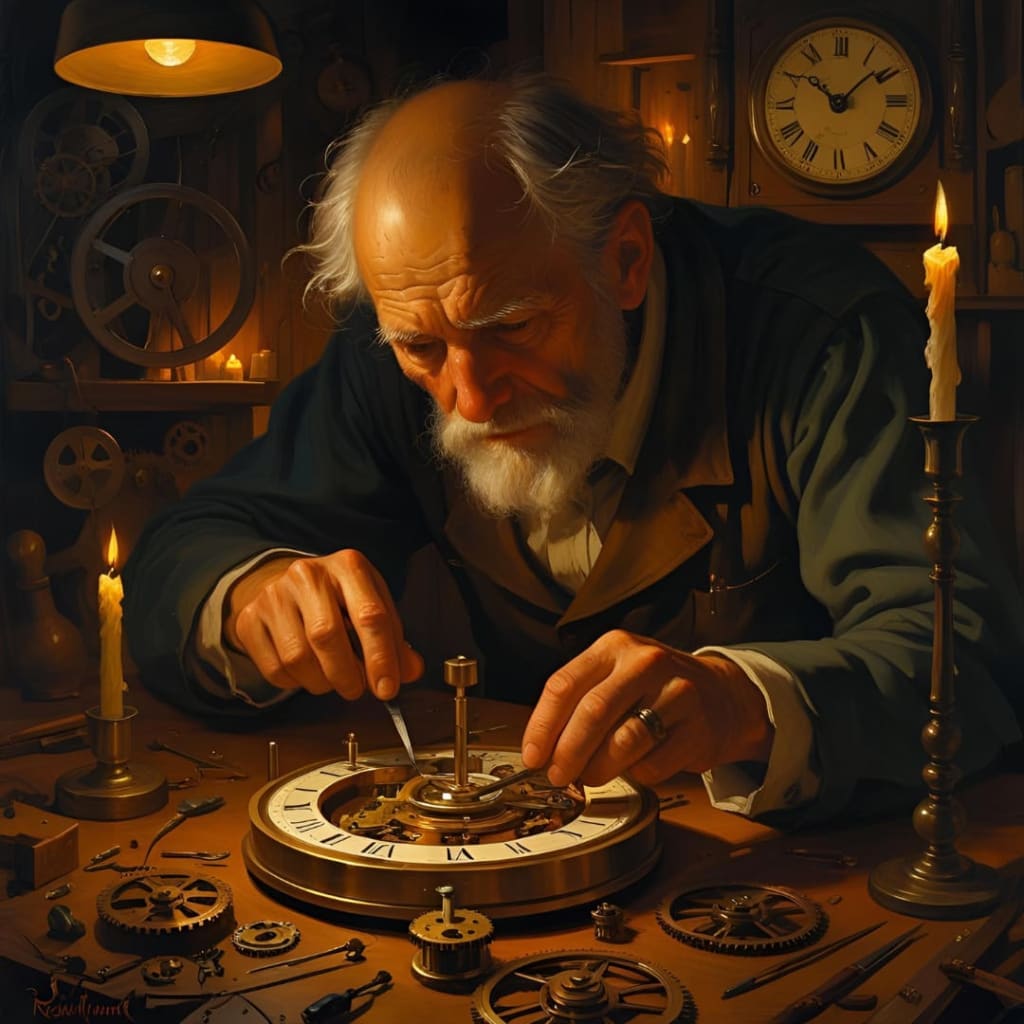
The village of Liermont was small, wrapped in hills and fog like an old secret. Time itself seemed to slow there, moving gently through cobbled streets and mossy rooftops, where stories outlived the people who told them. At the heart of it sat a crooked little shop with a weathered wooden sign that read:
"C. Bellamy – Horologist."
Most just called it the clockmaker’s shop.
No one truly knew how old Mr. Bellamy was. He moved slowly, like he was always thinking in seconds and minutes instead of words. Tall and thin as a lamppost, with silver hair that never seemed to grow or thin, he appeared timeless—like one of the clocks he cared for.
Inside the shop, clocks filled every inch. Dozens, maybe hundreds—big and small, cuckoo and carriage, chiming and silent. They covered the walls, hung from the ceiling, and stood in polished ranks along shelves and cabinets. Yet, what made the shop unsettling wasn’t the ticking. It was that every clock inside kept perfect time—yet none ever showed the same hour.
People joked that Mr. Bellamy had forgotten how time worked. Others, in more hushed tones, claimed he didn’t fix clocks—he bent time around them.
But no one truly cared, because the clocks he repaired never broke again.
It was on a gray Thursday—one of those days when the sky forgets it has a sun—that Elia wandered in. She was seventeen, curious, and drawn by the shop that her grandmother had always warned her about.
“He trades in more than gears,” her grandmother once whispered, eyes sharp with fear or reverence—Elia couldn’t tell. “That man remembers things time forgot.”
Elia pushed open the heavy wooden door. A bell jingled—not from above, but from somewhere deep within the maze of clocks. The scent inside was strange but not unpleasant: old wood, brass polish, and something faintly floral, like dried jasmine.
Behind the counter, Mr. Bellamy sat hunched, polishing a tiny brass pocket watch. His fingers were long and precise, like someone who knew the weight of every second.
Without looking up, he said, “You’re late.”
Elia hesitated. “Late?”
“For a girl who dreams of yesterday.”
Her breath caught. “How did you—?”
He finally looked up, and his eyes, dull silver like tarnished mirrors, seemed to look through her, not at her.
“You’ve lost someone,” he said quietly.
She swallowed hard. Her mother had died two months ago. No warning, no illness—just gone. A light switched off. She hadn’t spoken about it to anyone except her grandmother.
She said nothing, but Bellamy stood slowly, moving to a tall cabinet behind him. He opened a narrow drawer and ran his fingers across a velvet tray of tiny labels and compartments. With great care, he pulled out a clock no bigger than an apple—round, delicate, encased in glass and silver filigree.
He handed it to her. “This is yours.”
“I didn’t order anything,” Elia said, frowning—but she took it, almost without thinking.
“You didn’t have to,” he replied. “It remembers you.”
The clock ticked once in her palm. Then again. It was soft, like a heartbeat.
That night, unable to sleep, Elia placed the little clock on her bedside table. Its hands were stuck at 3:17. It didn’t match the time on her phone, or the wall clock, or anything else she owned.
And at exactly 3:17, the room changed.
The shadows grew long and golden. The air filled with warmth and the scent of jasmine—her mother’s perfume. Elia sat up, heart pounding.
A whisper drifted from the clock. Not words—just a presence. Familiar. Safe.
Then came the laugh.
Her mother’s laugh. Clear, rich, alive.
Elia gasped and looked around—and suddenly, impossibly, she was standing in her kitchen, sunlight spilling in. Her mother danced across the floor, holding a wooden spoon like a microphone, singing along to an old jazz record. The walls looked younger, brighter. So did Elia—maybe ten or eleven, sitting on the counter, laughing.
It lasted less than a minute.
When it ended, she was back in bed. The clock sat beside her, its hands still frozen at 3:17.
The next day, Elia stormed into the clock shop.
“What did you give me?” she demanded.
Bellamy didn’t look up. “A window.”
“A window to what?”
“To a moment that mattered. Time doesn’t forget, Elia. It just hides.”
“I saw her,” she whispered. “I heard her.”
He finally looked up, expression unreadable. “Then I’m glad the clock still works.”
She stared at him. “How many do you have?”
“Enough,” he said softly, “to remind the world that memories are more than shadows. But each clock only shows one moment. And once that memory fades, so does the time. It’s not forever.”
She looked down. “I’d like to keep mine.”
Bellamy gave a faint smile. “It already chose you.”
Years passed.
The people of Liermont rarely saw Elia after that, though lights still glowed in the crooked little shop long after sunset. The rumors came and went, whispered by old women and children with sharp ears.
They said Mr. Bellamy was gone—vanished like a shadow at sunrise.
And that Elia now ran the clockmaker’s shop.
Some claimed that if your heart ached for someone lost, you could leave a note by her door. No name, no details—just a feeling.
And maybe, just maybe, a small clock would be waiting for you.
Ticking softly with a memory time couldn’t quite let go.
The End.
About the Creator
Keep reading
More stories from Awais Qarni and writers in Fiction and other communities.


Comments
There are no comments for this story
Be the first to respond and start the conversation.