
The Clockmaker’s Daughters
In a town where every clock tells a different time, one girl learns which hour belongs to her fate.

When I was a child, my father told me never to listen to the clocks after midnight.
He said they whispered.
He was the town’s only clockmaker — a patient man with silver eyes and trembling hands that never seemed to miss a gear. Our house sat at the end of a cobbled lane where the wind always smelled like metal dust and oil. Inside, time lived in every corner: walls lined with pendulums, shelves of pocket watches ticking in uneven rhythm, and a great tower clock above our heads that never struck the same hour twice.
Father said each clock had a soul.
He also said some souls don’t rest easily.
Every evening before bed, I’d hear him talking softly to the clocks. It sounded like prayer — gentle, careful, almost apologetic. When I asked him what he said, he only smiled and told me, “I remind them they still have work to do.”
When he died, the clocks all stopped at once.
The town fell silent. For the first time, I heard what silence really sounded like — a hollow thing that stretched between heartbeats. I buried him alone behind the workshop, and when I came back inside, every clock began to tick again. But now they whispered my name.
The first night, it was faint — just a hum behind the pendulums. By the third, I could hear the words.
“Help us wind the hour,” they murmured.
“Turn the key before the thirteenth strike.”
I thought I was dreaming until I found the door.
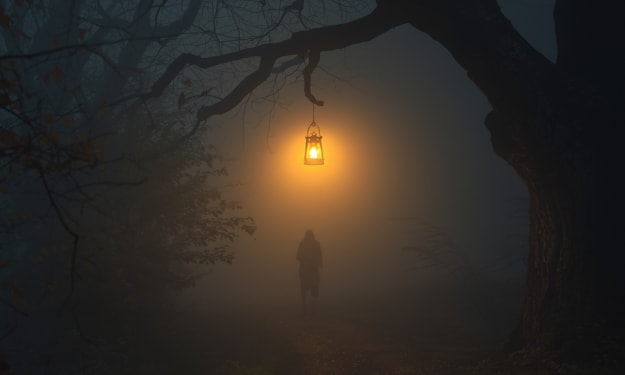
Behind Father’s workbench, hidden beneath a panel of gears, was a trapdoor leading to a stairwell that spiraled down into the earth. I carried a lantern — the same one he’d used during storms — and descended.
The air grew thick, smelling of iron and dust. The stairs ended in a vast room I never knew existed — filled with hundreds of clocks, suspended in the dark like floating constellations. Each one ticked at a different rhythm, each marking a moment that didn’t belong to now.
In the center stood a single chair.
And on that chair sat a clock shaped like a human heart.
It pulsed, beating time into the floor. Beside it lay Father’s silver winding key. When I touched it, the heart-clock shuddered — and I heard his voice.
“My daughters must keep the hours,” he said. “Or the world forgets to wake.”
The lantern flickered. The air bent. And suddenly, I saw her.
A girl — my reflection, yet not me. Her face was pale, her hair dark as midnight oil. A second daughter. The other half of a time divided. She smiled faintly, eyes glinting like clock hands.
“You took the key,” she said. “Now you must wind me.”
I stepped back, shaking my head. But the clocks began to strike — all of them — their chimes colliding into one terrible roar that filled the earth.
One. Two. Three…
When the thirteenth strike sounded, she vanished.
The clocks stopped.
It’s been years since that night. The town still runs, but the hours drift strangely — mornings come too soon, sunsets linger too long, and no one seems to notice. Only I do. Because at midnight, every clock in the house turns toward me. Their hands spin backward, whispering her name — the sister I wound into the dark.
They call her the second daughter.
The one who keeps the time that no one else can see.
And every night, I hear her voice again, echoing through the ticking silence:
"Your key is still turning, sister."
About the Creator
Keep reading
More stories from MUHAMMAD SAIF and writers in Fiction and other communities.
The Lantern at Hollow’s End
There’s a road outside the village that no one takes after dusk. It winds through the trees like a sleeping serpent — silent, cold, and shimmering faintly under the moon. The locals call it Hollow’s End, though no one remembers exactly why. Some say a house once stood there, some say a temple, and others whisper it was something far older.
By MUHAMMAD SAIF3 months ago in Fiction
Pyro's Spell, Friday, May 18th, 2007
“Here you are ladies, early as usual.” Anton informed his six gorgeous passengers. “Same time again tonight?” Anton had landed one hell of a gig this time. All he had to do was pick up six exotic dancers at the same place and time, then drive them 20 minutes down the road. Each girl gave him $20 to drop them off, and another $20 when he picked them back up.
By Anton Mathias Heft 6 days ago in Fiction


Comments
There are no comments for this story
Be the first to respond and start the conversation.