
The Clockmaker’s Daughter
In a forgotten clock shop, Clara discovered a legacy of love, loss, and the timeless beauty of human connection.

The Clockmaker’s Daughter
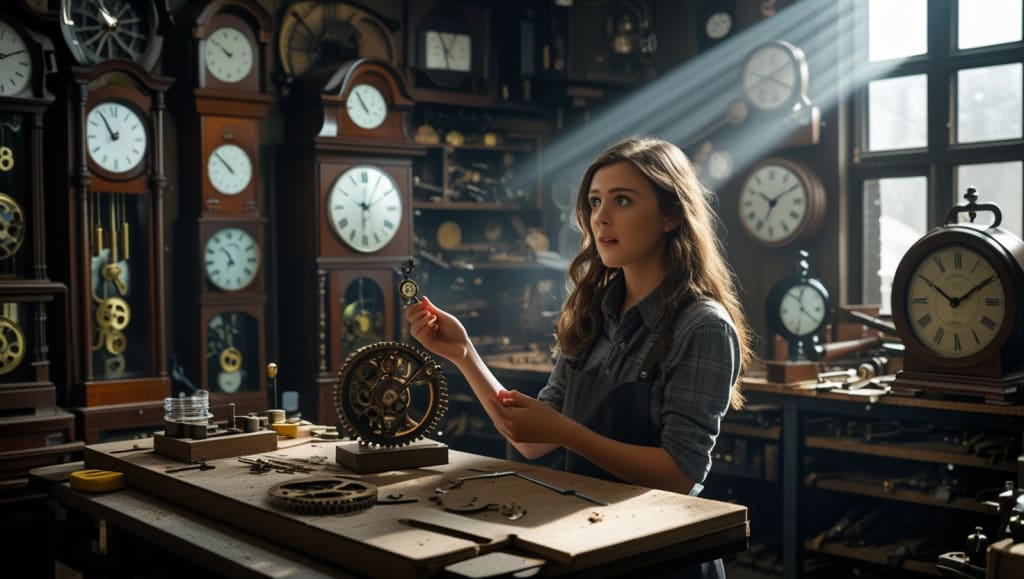
The bell above the door chimed softly as Clara stepped into the tiny clock shop tucked away on the corner of Maple Street. The air was thick with the scent of oil and aged wood, and the faint ticking of a hundred clocks filled the room like a heartbeat. The walls were lined with timepieces of every kind—grandfather clocks with polished mahogany frames, delicate pocket watches with intricate engravings, and cuckoo clocks that seemed to watch her with their tiny, painted eyes.
At the back of the shop, an old man with silver hair and round spectacles bent over a workbench, his hands steady as he adjusted the gears of a broken clock. He didn’t look up when Clara entered, but his voice, warm and gravelly, broke the silence.
“If you’re here to sell me another fake Rolex, save your breath.”
Clara smiled despite herself. “I’m not here to sell anything. I’m looking for someone.”
The man finally looked up, his eyes narrowing behind his glasses. “Who?”
“My father,” Clara said, holding out a photograph. “His name was Henry. He was a clockmaker.”
Clara had grown up knowing almost nothing about her father. Her mother had always been vague, saying only that he was a “kind man who loved clocks more than people.” But when Clara found an old photograph of him standing in front of a clock shop, she knew she had to find him. The photograph was faded, the edges curled with age, but she could still make out the sign above the door: Elias’s Clock Repair.
The old man, whose name was Elias, studied the photograph for a long time before handing it back. “Henry was my apprentice,” he said finally. “But he left years ago. No one’s heard from him since.”
Clara’s heart sank, but Elias wasn’t finished. “He left something behind,” he said, rummaging through a drawer. He pulled out a small, ornate key and handed it to her. “He said if anyone ever came looking for him, to give them this.”
The key was cold in Clara’s hand, its surface etched with tiny, swirling patterns. Elias led her to a grandfather clock in the corner of the shop, its face carved with intricate designs of vines and flowers. He pointed to a small, almost invisible keyhole near the base.

“Try it,” he said.
Clara inserted the key and turned it. There was a soft click, and a hidden compartment slid open. Inside was a letter, its edges yellowed with age, addressed to her.
“Dear Clara, if you’re reading this, it means I wasn’t there to tell you this myself. I’m sorry for that. But know this: you were never a mistake. You were the best thing that ever happened to me. And if you ever doubt your place in this world, remember this—time is precious, but it’s the moments we share with others that make it worth living.”
As Clara read the letter, Elias watched her with a strange expression. “There’s something else,” he said. He led her to a small room at the back of the shop, where a beautiful clock stood on a pedestal. It was unlike any clock Clara had ever seen—its face was covered in tiny, moving figures, each one telling a different story.
“Your father made this,” Elias said. “He called it the Clock of Lives. Each figure represents a person he met, a life he touched. And this,” he said, pointing to a small figure of a girl holding a clock, “is you.”
Clara leaned closer, her breath catching in her throat. The figure was exquisitely detailed, from the curve of its smile to the tiny clock it held in its hands. Around it, other figures moved in a delicate dance—a woman with a baby, a man playing a violin, a child flying a kite.
“He worked on this for years,” Elias said. “He said it was his way of remembering the people who mattered most to him.”
Clara spent the next few weeks working with Elias, learning the art of clockmaking and piecing together the story of her father’s life. She discovered that he had been a man who believed in the power of connection, who saw time not as something to be measured but as something to be cherished.
As she worked, she added her own figures to the Clock of Lives—a reminder that every moment, every connection, was a gift. There was a figure of Elias, bent over his workbench, and one of her mother, holding a bouquet of flowers. She even added a figure of herself, standing beside her father, their hands clasped around a tiny clock.
In the end, Clara decided to stay in the shop, not just to honor her father’s memory but to continue his legacy. And as she worked, she felt a sense of peace she had never known before. The ticking of the clocks was no longer just a sound—it was a reminder that time, no matter how fleeting, was filled with moments worth holding onto.
The End
About the Creator
Dinesh Maurya
I'm a passionate writer, creative storyteller, and motivational enthusiast who has carved out engaging narratives to inspire and educate. I can offer linguistic expertise combined with richness in culture in my work.
Keep reading
More stories from Dinesh Maurya and writers in Fiction and other communities.
The Letter in the Attic: A Secret That Changed Everything
The Letter in the Attic The attic smelled of dust and forgotten years. Clara wiped her hands on her jeans, leaving streaks of gray on the denim, and stared at the box in front of her. Its edges were frayed, the cardboard softened by time. Her father had always been a man of few words, but now, in the silence of his empty house, she wished she had asked more questions.
By Dinesh Maurya12 months ago in Fiction
THE NIGHT SHE FELL IN LOVE WITH THE MONSTER
She first noticed him on the night the moon looked wrong. Too bright. Too close. Like it was watching. He stood at the edge of the forest, half hidden by shadows, eyes reflecting silver light. Not threatening. Not welcoming. Just waiting. Something about him felt ancient, as if he had been standing there long before she arrived and would remain long after she left.
By S.A Charles6 days ago in Fiction
When the Shelter Closes
Across the street from my house, a man slept under a tree, his dog by his side. My first, naive thought: he must be traveling through. But he kept coming back, often sleeping there during the day. Then it hit me—that person might not have a home.
By Bride of Sound5 days ago in Humans




Comments
There are no comments for this story
Be the first to respond and start the conversation.