
The City That Forgot Its Name
ILena first noticed something strange the day she arrived.

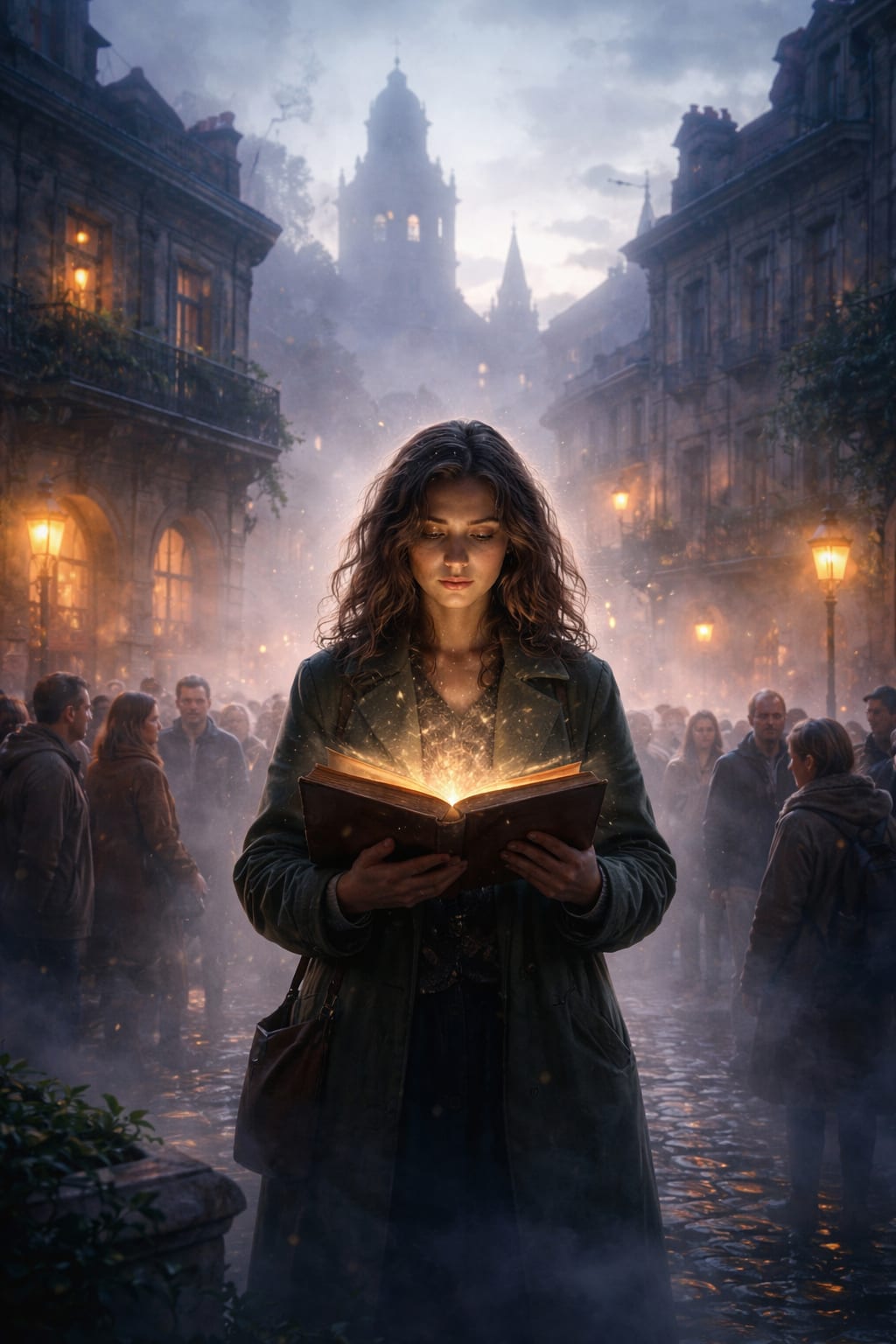
In the heart of Europe, tucked between rivers that curved like silver ribbons, stood a city with no name.
Maps labeled it with a blank space. Train conductors paused before announcing it. Travelers who arrived there forgot what they had come searching for. Locals called it simply “The City.”
Every morning, fog drifted through its narrow streets, wrapping around stone buildings and iron balconies. The fog was not ordinary. It carried whispers—soft, almost kind—but no one could understand what they said.
Lena first noticed something strange the day she arrived.
She had come from a distant coastal town after inheriting a small apartment from her grandmother, a woman she barely remembered. The letter attached to the keys contained only one sentence:
“The city will remind you of who you are.”
Lena assumed it was poetic nonsense.
Her apartment was on the fourth floor of a building that leaned slightly, as if tired of standing. Inside, the walls were painted pale blue, and dust coated the windowsills. On the kitchen table lay a notebook.
It was old. Leather-bound. Her grandmother’s handwriting filled every page.
But the words were not stories or recipes. They were lists.
Names.
Dozens of them.
Under each name was a single sentence:
Elise – forgot her brother.
Jonas – forgot his home.
Matteo – forgot his purpose.
At the very bottom, one name stood alone:
Lena – has not forgotten yet.
That night, Lena dreamed of bells ringing beneath water.
Over the following days, she noticed things others did not.
Shopkeepers hesitated before greeting customers. Children sometimes stopped mid-sentence and stared at nothing. Elderly couples walked hand in hand but could not remember how they met.
One afternoon, Lena visited the city library—a grand building of glass and stone. Inside, she found shelves filled with books that had no titles. Their pages were blank except for faint shadows, as though words had once lived there and vanished.
An old librarian watched her carefully.
“You can still see them, can’t you?” he asked.
“See what?”
“The spaces where things used to be.”
Lena nodded.
The librarian leaned closer. “Then the city has not taken you yet.”
“Taken me where?”
He tapped his temple. “Into forgetting.”
He explained that long ago, the city had made a bargain. In exchange for peace, safety, and prosperity, it would slowly take away what people valued most: their memories of meaning. Not their faces or skills—only the parts of life that made pain worth feeling.
Love. Loss. Purpose. History.
The city fed on them quietly.
“And no one noticed?” Lena asked.
“They noticed,” the librarian said. “They just forgot to care.”
Lena returned home and read her grandmother’s notebook more carefully. Between the lists, she found one longer entry:
The city does not steal memories. It trades them. If you give it your past, it gives you comfort. But comfort without meaning becomes a cage.
Her grandmother had written about resistance—small acts of remembering.
Music played out loud. Stories told repeatedly. Names carved into stone. Faces drawn from memory.
And then the final line:
Someone must remember for everyone else.
Lena understood then why she had been sent here.
That night, she walked into the fog-filled streets and began to speak.
She spoke names aloud.
Elise. Jonas. Matteo.
The fog trembled.
Windows glowed with soft light. People paused in doorways, confused but listening.
Lena told them stories she had read from the notebook—stories of brothers, journeys, dreams, and failures. Some cried without knowing why. Some laughed as if remembering a joke they had once loved.
The city resisted.
The fog thickened. The bells beneath the streets rang louder. Shadows stretched across walls like reaching hands.
But Lena continued.
She spoke of her grandmother, who had loved the sound of rain. Of a man who once crossed mountains for a promise. Of a woman who planted trees knowing she would never sit beneath them.
The next morning, something changed.
A man stopped Lena in the street.
“Do I know you?” he asked.
“No,” she said.
“But I feel like I should,” he whispered.
The fog was thinner that day.
The city did not collapse. It did not vanish. But it weakened.
People began writing again. They kept journals. They painted murals of forgotten faces. Children were taught family histories. The blank books in the library slowly filled with words.
The city could no longer eat what was constantly spoken.
Years passed.
Lena grew older. Her hair turned silver. Her voice softened.
One winter morning, she woke and could not remember her grandmother’s face.
She smiled sadly.
The city had taken its payment.
So she went to the square and sat beside a fountain carved with names. Children gathered around her, as they always did.
“Tell us a story,” they said.
She closed her eyes and spoke, not from memory, but from belief.
“There was once a city that forgot its name,” she began. “And one day, someone taught it how to remember.”
The fog lifted slightly, as if listening.
And though Lena no longer remembered why she had come, the city remembered what it had become.
A place where forgetting was no longer silent.
A place where stories were stronger than comfort.
And a city that, at last, deserved a name
About the Creator
Iazaz hussain
Start writing...
Keep reading
More stories from Iazaz hussain and writers in Fiction and other communities.
The Last Light of Valenbruck A
In the northern valleys of Europe, where pine forests met gray mountains and rivers ran like silver threads through stone, there stood a quiet town called Valenbruck. For most of the year, clouds covered its sky like a heavy blanket. Sunlight visited rarely, and when it did, people paused in the streets just to feel its warmth. The townsfolk believed this was normal. It had always been this way, or so the elders said. But Elin Marceau was not like the others. She was nineteen, with dark hair tied in careless knots and a habit of staring at the sky as if it owed her an explanation. Elin worked in the town’s old lighthouse—a strange job, considering Valenbruck sat beside a river rather than the sea. Yet the tower had existed longer than memory, built on a cliff above the water, its lamp facing the mountains instead of the horizon. Every evening, Elin climbed its spiral stairs and lit the great lamp, even though no ships passed and no travelers came. “Why do we still light it?” she once asked her grandfather, Henrik, who had been the keeper before her. “Because the light reminds the valley that it still belongs to the world,” he replied. “And because one day, it may guide something home.” Elin never knew what he meant. A Letter from the Past One winter morning, while cleaning the lighthouse storage room, Elin found a wooden box buried under old maps and rusted tools. Inside lay a bundle of yellowed letters tied with blue thread. The handwriting was careful, elegant, and unfamiliar. They were written by a woman named Sofia Valenbruck, over a hundred years ago. Sofia described a different town—one full of summer festivals, bright skies, and music drifting from open windows. She wrote of a time when Valenbruck was known as “the town of light,” a place travelers visited just to see the sun rise between the twin mountains. But then the letters changed. Sofia wrote of fear. Of a night when the mountains trembled. Of a storm that swallowed the sky and never truly left. “We dimmed the great lamp to hide ourselves,” one letter read. “And in doing so, we lost the sun.” Elin felt her chest tighten. “What great lamp?” she whispered. She ran down the tower and showed the letters to Henrik. His face grew pale as he read. “So it’s time,” he said quietly. “Time for what?” “To tell you what we buried.” The Secret of the Lighthouse Henrik revealed what the town had forgotten: Valenbruck’s lighthouse was never meant for ships. It was built to reflect sunlight using a massive crystal lens hidden inside the mountain behind it. Long ago, the lamp did not burn with fire but with captured daylight, spreading warmth across the valley even in winter. But when a violent storm came generations earlier, the people believed the light had angered the mountains. In fear, they shut the system down and sealed the tunnel leading to the crystal lens. Over time, the story became myth, and the purpose of the lighthouse faded into ritual. “We chose darkness because it felt safer,” Henrik said. “And then we taught our children that darkness was normal.” Elin stared at the tower window, where thick clouds hung low over the river. “What if the sun is still there?” she asked. “What if we just stopped letting it in?” The Climb That night, Elin did something no one had done in decades. She took a lantern and entered the forbidden tunnel behind the lighthouse. The passage smelled of damp stone and forgotten years. Her footsteps echoed like a heartbeat in the dark. At the tunnel’s end stood a massive circular door carved with faded symbols of stars and waves. With effort, she turned the rusted wheel. The door groaned open. Inside, a giant crystal lens rested in silence, covered in dust but unbroken. It looked like frozen sunlight trapped in glass. Elin cleaned it with trembling hands. When her lantern touched its surface, the crystal caught the flame and scattered it into dozens of tiny sparks along the walls. Her breath caught. She climbed to the old control platform and pulled the final lever. Above her, gears shifted. Stone plates slid away from a hidden opening in the mountain ceiling. For the first time in generations, sunlight poured inside. The Return of Morning The light shot through the crystal lens and up into the lighthouse tower. The great lamp burst into brilliance—not yellow, but warm white, like the memory of summer. Outside, people stepped from their homes in confusion. Children pointed at the sky. Old men removed their hats. Women shielded their eyes and laughed. The clouds above Valenbruck thinned, slowly, as if pushed aside by an invisible hand. A beam of light crossed the valley, touching rooftops, trees, and river alike. For the first time in living memory, the town saw a true sunrise. Elin stood in the tower doorway, tears on her cheeks. Henrik joined her, his voice shaking. “Sofia would have been proud.” A New Story for an Old Town Valenbruck changed after that day. Not suddenly, but gently. Flowers began growing near windows. Travelers returned, curious about the “town that found its sun.” Children painted pictures of blue skies instead of gray ones. Music returned to the streets. And the lighthouse was no longer just a ritual. It became a promise. Every evening, Elin still lit the lamp. Not because she feared the dark—but because she understood what light meant. It meant memory. It meant courage. It meant choosing hope even when fear felt easier. And sometimes, when the clouds gathered thick again, the people of Valenbruck did not complain. They simply waited. Because now they knew: The sun had never abandoned them. They had only forgotten how to open the door. Moral of the Story Fear can make people hide from the world. Tradition can make them forget why they once believed in light. But all it takes is one person willing to climb into the dark and turn the key
By Iazaz hussain14 days ago in Fiction




Comments
There are no comments for this story
Be the first to respond and start the conversation.