
THE CHECK ENGINE LIGHT IS MY SPIRIT ANIMAL
A Love Letter to the Machines That Bankrupt Our Wallets and Steal Our Hearts.

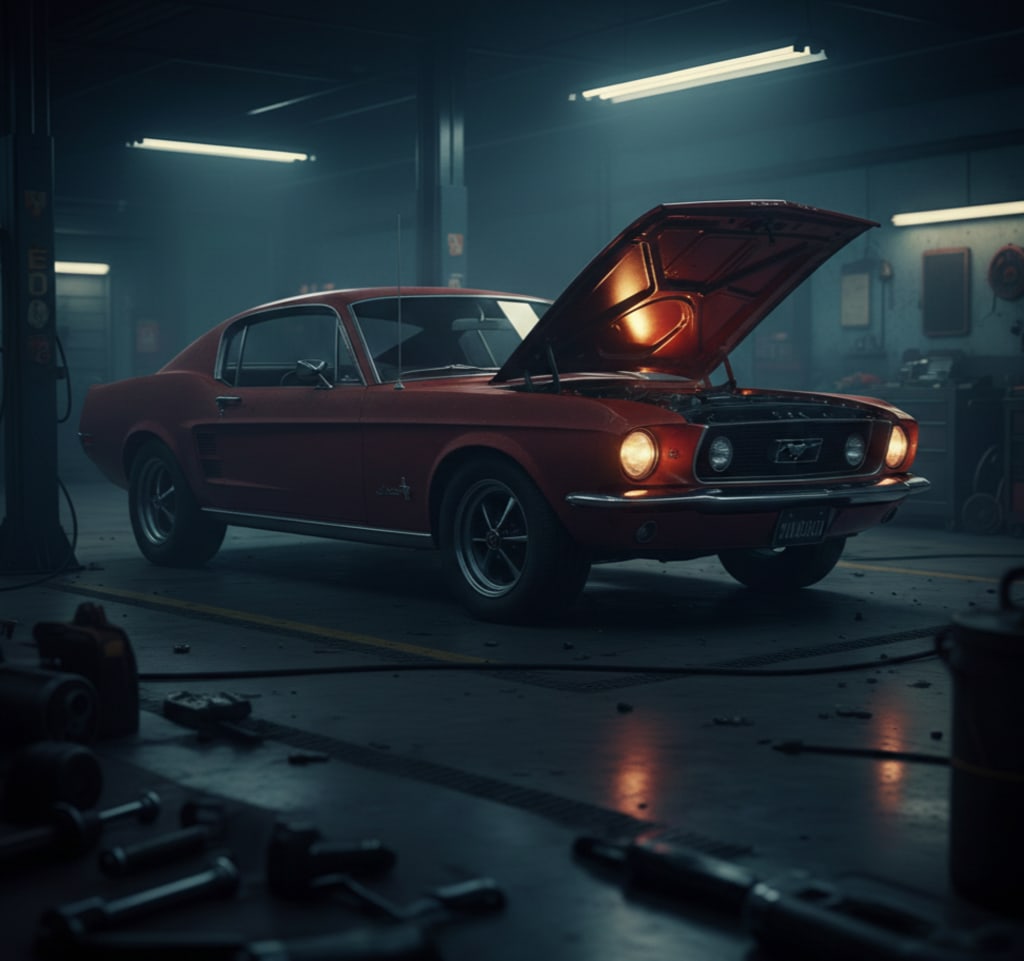
"The clock has struck three, the coffee is cold, and the shadows are beginning to speak. Welcome back to the desk of The Night Writer, where the stories are brewed in the dark."
Let’s be honest: cars are weird. They're these hulking metal beasts we invite into our lives, demanding fuel, affection, and an occasional, inexplicable sacrifice to the Great Mechanic in the Sky. We climb into them daily, entrusting our very existence to a symphony of controlled explosions and rapidly spinning rubber. It’s like a daily game of automotive Russian roulette, except the chamber is filled with traffic, potholes, and that persistent, existential dread of a flashing "Check Engine" light.
But where did these magnificent, frustrating contraptions come from? It wasn't always about lamenting gas prices or explaining to your toddler that no, we cannot take the Batmobile to the grocery store (though I've certainly tried).
The Dawn of the Horseless Horsepower (And Why It Probably Smelled Worse)
Imagine, if you will, the late 19th century. People are still riding around on actual horses, which, while majestic, leave behind a certain… aroma. Enter the pioneers of the automobile, looking at a horse and thinking, "You know what this needs? Less hay, more internal combustion!"
Karl Benz, bless his mechanically inclined heart, is often credited with the first true automobile in 1886. Picture it: a three-wheeled contraption that looked less like a car and more like a fancy, overgrown tricycle designed by a mad scientist with a penchant for top hats. It probably rattled like a skeleton doing the Charleston and spewed exhaust fumes that made modern smog look like a spring breeze. The first road trip? His wife, Bertha Benz, took it without telling him, effectively becoming the original "Honey, I'm taking the car for a spin (and maybe inventing road trips in the process)." She even stopped at an apothecary for ligroin to refuel – because gas stations weren't a thing yet. Imagine explaining that to your GPS: "Refuel at ye olde chemist, good sir."
The early cars were a delightful hodgepodge of steam, electricity, and gasoline. It was like a technological Wild West where everyone was trying to lasso the future. And for a while, electric cars were actually winning! Before the Model T democratized gasoline power, electric vehicles were quiet, clean (by comparison), and didn't require you to hand-crank the engine until your arm felt like it had wrestled a bear. Ah, if only they'd stuck with it. We might be living in a silent, emission-free utopia now, instead of arguing about charging stations.
The Ford Model T: When Everyone Got a Car (And Knew How to Fix It)
Then came Henry Ford, a man who looked at the artisanal, bespoke nature of early cars and said, "Nope. We're doing this like hot dogs: cheap, plentiful, and exactly the same." The Model T rolled off the assembly line in 1908, becoming the automotive equivalent of the ubiquitous 'Starter Pack.' It was affordable, reliable (for its time), and came in any color you wanted, "as long as it is black." Talk about minimalist design choices!
The Model T wasn't just a car; it was a cultural phenomenon. It gave rise to the American road trip, the joy of tinkering in the garage, and probably the first recorded instances of road rage (though it was probably more of a slow, exasperated sigh than an aggressive honk). People learned to fix these things themselves, which is a stark contrast to today where even changing a headlight feels like you need a degree in quantum physics and a special wrench blessed by ancient automotive gods. My grandpa once told me he could fix a flat tire on his Model T with a screwdriver, a prayer, and a strong cup of coffee. I can barely change the batteries in my TV remote without calling tech support.
The Age of Chrome and Confusion
Fast forward to the mid-20th century. Cars weren't just transportation; they were status symbols, declarations of freedom, and occasionally, mobile living rooms. Fins grew longer, chrome shone brighter, and dashboards began to resemble the control panel of a spaceship (if that spaceship was designed by someone who really loved buttons).
This was the era of the muscle car, the behemoths with engines that sounded like angry dragons gargling jet fuel. The gas mileage was abysmal, but who cared when you could go from 0 to "arrested" in under five seconds? This was also the era where cars started getting personality. The Volkswagen Beetle, the Cadillac Eldorado, the impossibly cool Aston Martin DB5 (complete with ejector seat for unwanted passengers, a feature I still think should be standard).
But with great power came great… well, complexity. Suddenly, the average driver wasn't just dealing with a carburetor; they were facing intricate wiring, power steering, and air conditioning that inevitably broke down right before your summer road trip to Death Valley. The car stopped being a simple machine and started becoming a sentient, temperamental entity with an inexplicable hatred for Mondays and your wallet.
The Modern Marvels and the Existential Dread of the Algorithm
Today’s cars are less about mechanical brute force and more about silicon wizardry. They brake for you, parallel park themselves (sometimes better than you can), and politely inform you when you've drifted out of your lane, often with a gentle ding that sounds suspiciously like a disappointed parent. We're living in the age of autonomous vehicles, electric dreams, and cars that can connect to your phone faster than you can find your actual keys.
But here’s the kicker: the more advanced they get, the less we understand them. My car once told me it needed "AdBlue." I briefly considered if it was a new brand of artisanal windshield wiper fluid before realizing it was a diesel exhaust fluid that sounded like something from a dystopian sci-fi novel. The "Check Engine" light, once a mere annoyance, now feels like a cryptic message from an alien civilization, demanding sacrifices I cannot comprehend.
We have cars that practically drive themselves, yet we still spend hours stuck in traffic, staring at the bumper of the car ahead, wondering if a horse-drawn carriage would actually be faster. We obsess over horsepower and torque, yet the biggest challenge many of us face is finding a parking spot that doesn't require the spatial reasoning of a NASA astronaut.
So, the next time you get into your car, take a moment. Appreciate the absurdity, the genius, and the sheer mechanical ballet of it all. Marvel at how far we've come from Karl Benz’s tri-wheeler, and maybe, just maybe, give a little nod to Bertha Benz, the original road warrior. And for the love of all that is holy, if your car asks for AdBlue, just Google it. Trust me.
"Daylight is coming to claim the quiet, but these words stay with you. If you enjoyed this journey into the midnight hours, leave a heart or a tip to keep the candles burning. Sleep well—if you can. — The Night Writer."
About the Creator
The Night Writer 🌙
Moonlight is my ink, and the silence of 3 AM is my canvas. As The Night Writer, I turn the world's whispers into stories while you sleep. Dive into the shadows with me on Vocal. 🌙✨
Keep reading
More stories from The Night Writer 🌙 and writers in Fiction and other communities.
Our Song
Evening has given way to night. Gently, I settle next to you on the comfortable, old love seat and reach for your hand. You snatch it away, again. It cuts me to the quick, but I hide the pain, understanding that the reaction is but part of your demented state. Since the accident, your presence here in our cozy home has been clouded by a haze I can't see. Nevertheless, I feel the frigidity of your expressions and it serves as an excruciating reminder of the immeasurable distance between us.
By Dana Crandell3 days ago in Fiction
Before the Guns Went Silent
The winter of 1943 was the coldest Anna could remember. Snow covered the broken streets of her village like a white lie, hiding the scars left by bombs and boots. Every morning, she woke to the same sound—the distant thunder of guns reminding her that the war was still breathing, still hungry.
By moeez yousafzai2 days ago in Fiction
The Angry Man in Your House
"If you grow up with an angry man in your house, there will always be an angry man in your house" This statement has caused plenty of controversy online, people say its a statement that blames victims while also undermining those who break traumatic cycles to form health relationships... but if I'm honest now that I'm in my 30s it makes more sense to me than ever, and I'd argue that its not just about fathers and uncles.
By S. A. Crawfordabout 10 hours ago in Humans




Comments
There are no comments for this story
Be the first to respond and start the conversation.