
The Ceasefire That Almost Failed Again
Afghanistan’s Border Night That Shocked the Region


The Ceasefire That Almost Failed Again
Ceasefires in Afghanistan have never been simple. They are written on paper but lived in mountains—mountains that do not care for agreements, politics, or promises. And on the night of the latest regional crisis, that old truth returned with frightening force.
For twelve hours, Afghanistan stood on the edge of becoming the center of a new, multi-front conflict—pulled between Pakistan’s defensive alerts, India’s military posture, and unidentified forces stirring trouble in the shadows. The ceasefire was still active, but on the ground, it trembled like a candle in the wind.
This is how it almost failed… again.
1. The Night Begins With an Echo
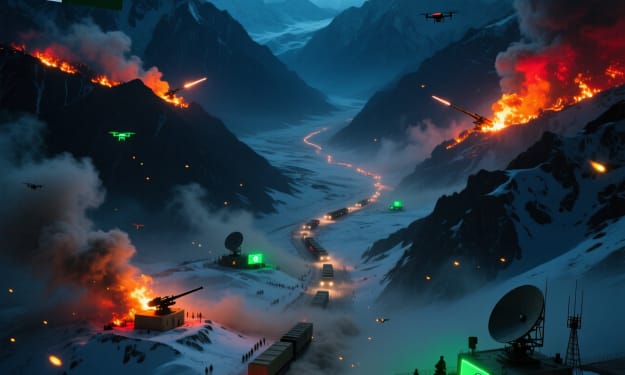
It started just after sunset in Kunar, a province known for its steep cliffs and unforgiving terrain. Afghan soldiers stationed near the ridge reported strange sounds—low, mechanical, vibrating through the cold air.
At first they thought it was winter wind hitting the rocks. But then the sound repeated… and grew louder.

A drone.
Then another.
Within minutes, six unidentified drones appeared on the radar, flying low, weaving between mountain shadows. They carried no identification signal, no broadcast ID, no communication frequency. Completely silent.
In a region already tense from the earlier border incident, this was enough to raise every alarm.
2. The Decision No Commander Wants to Make
Captain Farid Ahmad, commanding the border post, knew one mistake could trigger a disaster. His soldiers wanted permission to shoot down the drones immediately, fearing they were scouting targets for an attack.
But Farid paused.
In Afghanistan, he had seen too many nights that began with a misunderstanding and ended with tragedy. The ceasefire with Pakistan along certain areas was fragile, delicate as thin glass. One wrong bullet could shatter it entirely.
So Farid radioed higher command:
“Unidentified drones above Kunar. No hostilities detected yet. Requesting instructions.”
He waited. Seconds felt like minutes. The drones continued to move.
No reply came.
3. Across the Border, Tension Rises
On the Pakistani side, radar teams also detected the same drone formation. In past years, similar sightings had triggered accidental exchanges of fire. Now, in the middle of a regional crisis, fear ran higher than ever.
They activated aerial patrols. Jets prepared for takeoff.
Afghan forces saw that movement and interpreted it as escalation.
Two nervous armies, both watching the same sky, both thinking the worst.
4. The Mistake That Nearly Started the Battle
At 10:43 PM, one drone dipped lower—too low—passing close to an Afghan outpost. A young soldier, barely twenty, raised his rifle in reflex. His finger tightened on the trigger.
Farid shouted, “Don’t fire!”
But it was too late.
A warning shot cracked through the mountain air.
The sound echoed across ridges, bouncing like thunder. Pakistani sensors picked it up. Their border units braced. Their own soldiers moved into new positions.
Another misunderstanding. Another step closer to war.
5. The Desperate Race to Stop the Collapse
Kabul’s military headquarters rushed to understand the situation. They contacted Islamabad, urging communication before decisions became irreversible.
“Hold positions,” Afghan command said. “We are investigating. Do not respond.”
But on borders, messages travel slower than fear.
Farid knew he had to buy time. He ordered his men to activate flares—bright, high-reaching arcs of white light. A signal that Afghanistan was not attacking.
Across the border, Pakistani forces saw the flares and held back their artillery teams.
For the first time that night, tension eased—just slightly.
6. The Mystery Solved
Near midnight, intelligence analysts intercepted a strange signal from the drone cluster. Its frequency did not match any military pattern from Pakistan, India, or Afghanistan. These drones were modified, likely from a non-state group trying to trigger conflict between the three countries.
A trap.
And all three nations had almost walked into it.
When the confirmation reached border commands, a deep exhale seemed to move through the entire region. Afghan units were ordered to stand down. Pakistani patrols retreated slightly. A silent understanding passed across mountains that had nearly witnessed a disaster.
7. The Ceasefire Survives
By dawn, the drones vanished, slipping back into the sky like ghosts. The ceasefire—battered, stretched, almost broken—held together by the narrowest margin.
Farid stood at the ridge as the sun rose, tired but relieved. Behind him, his young soldiers packed up their equipment. Across the border, movement slowed to normal levels.
A war that almost happened had been avoided by seconds, decisions, and restraint.
8. What This Night Means
The near-collapse of the ceasefire taught Afghanistan and the region a harsh lesson:
Peace is not guaranteed by signatures—it is maintained by discipline, patience, and the wisdom to wait before firing.
And sometimes, by a commander shouting “Don’t shoot” at the perfect moment.
The mountains kept their silence.
The borders held their breath.
And peace—shaken but alive—survived one more night.
About the Creator
Wings of Time
I'm Wings of Time—a storyteller from Swat, Pakistan. I write immersive, researched tales of war, aviation, and history that bring the past roaring back to life
Keep reading
More stories from Wings of Time and writers in Fiction and other communities.
How the Conflict Nearly Escalated into Full War
How the Conflict Nearly Escalated into Full War For years, the region had lived under a cautious balance—an invisible thread of pressure between Pakistan, India, and Afghanistan. Diplomats called it “controlled tension,” generals called it “the edge,” and civilians prayed it would never snap. But last week, the impossible nearly happened. For seventeen hours, the region stood just one wrong move away from a full three-front war.
By Wings of Time 3 months ago in Fiction
Becca
"Everything is so... flat." Denille said stupidly as she looked around her new neighborhood. She looked around at the muted desert where even the smallest sign of life seemed to have given up. The plant life was shrubs that were half cooked by the heat and where there should have been a lawn, a mess of white rocks laid glistening in the sun. Even the sky looked stretched thin, like the sun had ironed it smooth. She’d moved from Riverside, where at least there were hills, but here in Barstow, everything felt baked and brittle.
By Sara Wilson4 days ago in Fiction
Whispers Beneath the Ash Tree
The first time Elara heard the whispers, she was twelve, crouched beneath the gnarled branches of the old ash tree that crowned the hill behind her grandmother’s house. The air smelled of wet earth and burned wood, a memory of last night’s fire still clinging to the soil. The voices were not loud—never loud—but soft murmurs that trembled through the leaves like wind through strings.
By Ihsanullah5 days ago in Fiction


Comments
There are no comments for this story
Be the first to respond and start the conversation.