
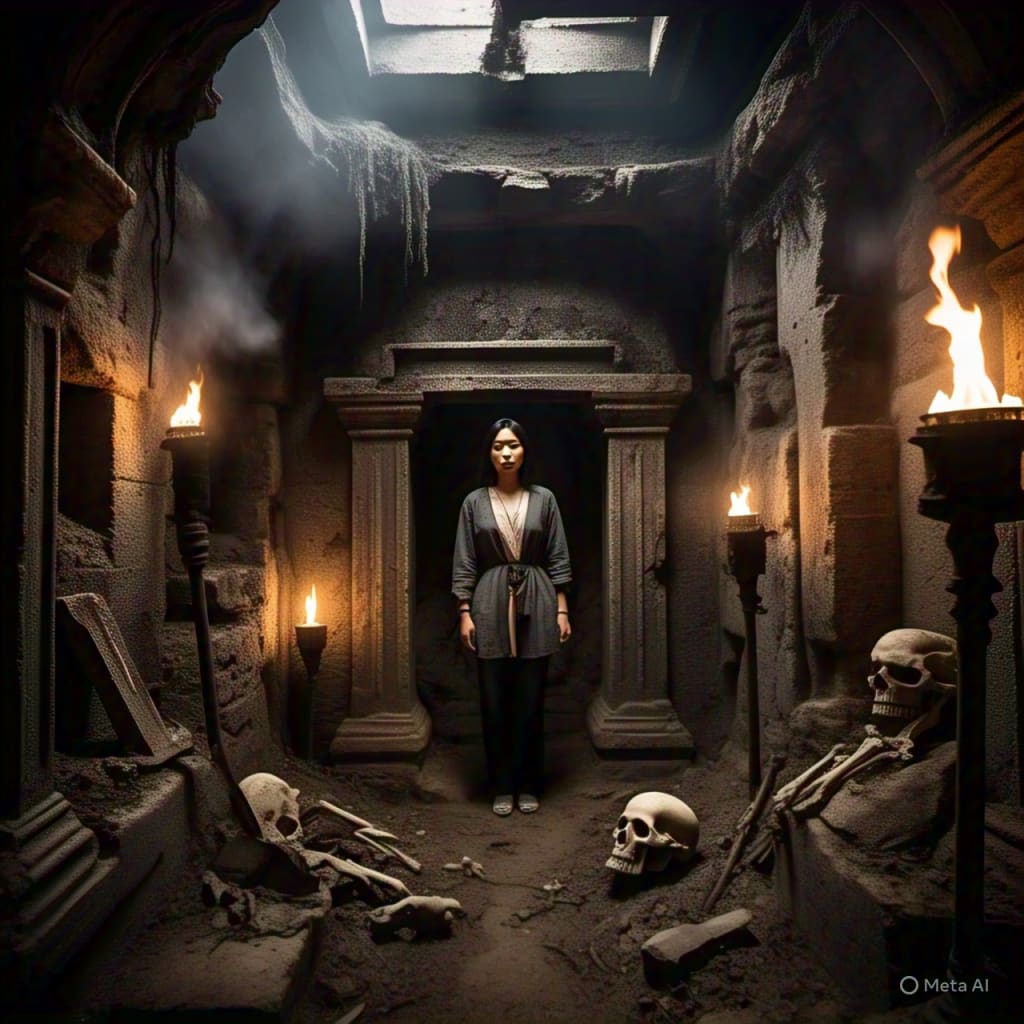
The thousand injuries of Fortunato I had borne as I best could, but when he ventured upon insult, I vowed revenge. You, who know the nature of my soul, will not suppose, however, that I gave utterance to a threat. At length I would be avenged; this was a point definitively settled. But the very definitiveness with which it was resolved, precluded the idea of risk. I must not only punish, but punish with impunity. A wrong is unredressed when retribution overtakes its redresser. It is equally unredressed when the avenger fails to make himself felt as such to him who has done the wrong.
It must be understood that neither by word nor deed had I given Fortunato cause to doubt my good will. I continued, as was my wont, to smile in his face, and he did not perceive that my smile now was at the thought of his immolation.
He had a weak point—this Fortunato—although in other regards he was a man to be respected and even feared. He prided himself on his connoisseurship in wine. Few Italians have the true vintner’s spirit. For the most part their enthusiasm is adopted to suit the time and opportunity—to practise imposture upon the British and Austrian millionaires. In painting and gemmary, Fortunato, like his countrymen, was a quack, but in the matter of old wines he was sincere. In this respect I did not differ from him materially:—I was skillful in the Italian vintages myself, and bought largely whenever I could.
It was about dusk, one evening during the supreme madness of the carnival season, that I encountered my friend. He accosted me with excessive warmth, for he had been drinking much. “My dear Fortunato, you are luckily met,” he said. “How remarkably well you are looking to-day! But I have received a pipe of what passes for Amontillado from a distance. I am on my way to Luchresi. If any one has a critical turn, it is he. Luchresi would not leave me until I had opened the whole pipe and put the genuineness of the wine to the proof. And yet, some fools say that Amontillado is a vintage inferior to sherry. I have my doubts, and I mean to settle the point, beyond dispute, before I am done with it.”
“As you are engaged, I am on my way to Luchresi,” I said. “If any one has a critical turn, it is he. Luchresi would not leave me until—”
“Your health is precious. You are rich, respected, admired, beloved; you are happy; as once I was. You are a man to be missed. For me it is no matter. You will not die this time. But if you do—”
“Enough,” he said, laughing. “Let us go. Come.”
“To your long life!” I said, raising my glass.
“To your long life!” he replied, smiling.
We entered the vaults beneath the city streets, the dripping walls and the dank air filled with the scent of mold and decay. Fortunato, wrapped in his cloak, walked ahead, his eyes gleaming with excitement.
As we walked deeper into the vaults, I led Fortunato to the deepest recesses, where the air was thick with the smell of nitre. He coughed, but continued on, his determination to taste the Amontillado driving him forward.
“Come,” I said, “let us go back; your health is precious. You are rich, respected, admired, beloved; you are happy. Do not risk it.”
“Enough!” he said; “the cough’s a mere nothing; it will not kill me. I shall not die of a cough.”
“True—true,” I replied; “and, indeed, I had no intention of alarming you unnecessarily—but you should use all proper caution. A draught of this Médoc will defend us from the damps.”
We passed through a range of low arches, descended, passed on, and descending again, arrived at a deep crypt, in which the foulness of the air caused our flambeaux rather to glow than flame.
At the most remote end of the crypt there appeared another less spacious. Its walls had been lined with human remains, piled to the vault overhead, in the fashion of the great catacombs of Paris. Three sides of this interior crypt were still ornamented in this manner. From the fourth the bones had been thrown down, and lay promiscuously upon the earth, forming at one spot, a mound of some size.
Within the wall thus exposed by the displacing of the bones, we perceived a still interior recess, about six feet in depth. In
About the Creator
Keep reading
More stories from Mohammad Roman and writers in Fiction and other communities.
The last leaf
The Last Leaf In a small studio apartment in Greenwich Village, two young artists, Sue and Johnsy, lived together. They were more than just roommates; they were close friends who shared a deep bond. Johnsy, whose real name was Johanna, was a talented painter with a bright future ahead of her. However, her life took a dramatic turn when she fell ill with pneumonia.
By Mohammad Roman9 months ago in Motivation
Ludacris and Nelly draw backlash over bookings at MAGA-coded music festival
Ludacris and Nelly headlining a mostly right-wing event is good for them. It’s also great for the genre of hip hop. The two rap veterans have showcased their talents on other stages. Why can’t they perform for mostly MAGA folks and grab that bag?
By Skyler Saunders6 days ago in Beat



Comments
There are no comments for this story
Be the first to respond and start the conversation.