
The Cabin of Silence
She thought this summer would fix everything. It taught her how to let go instead


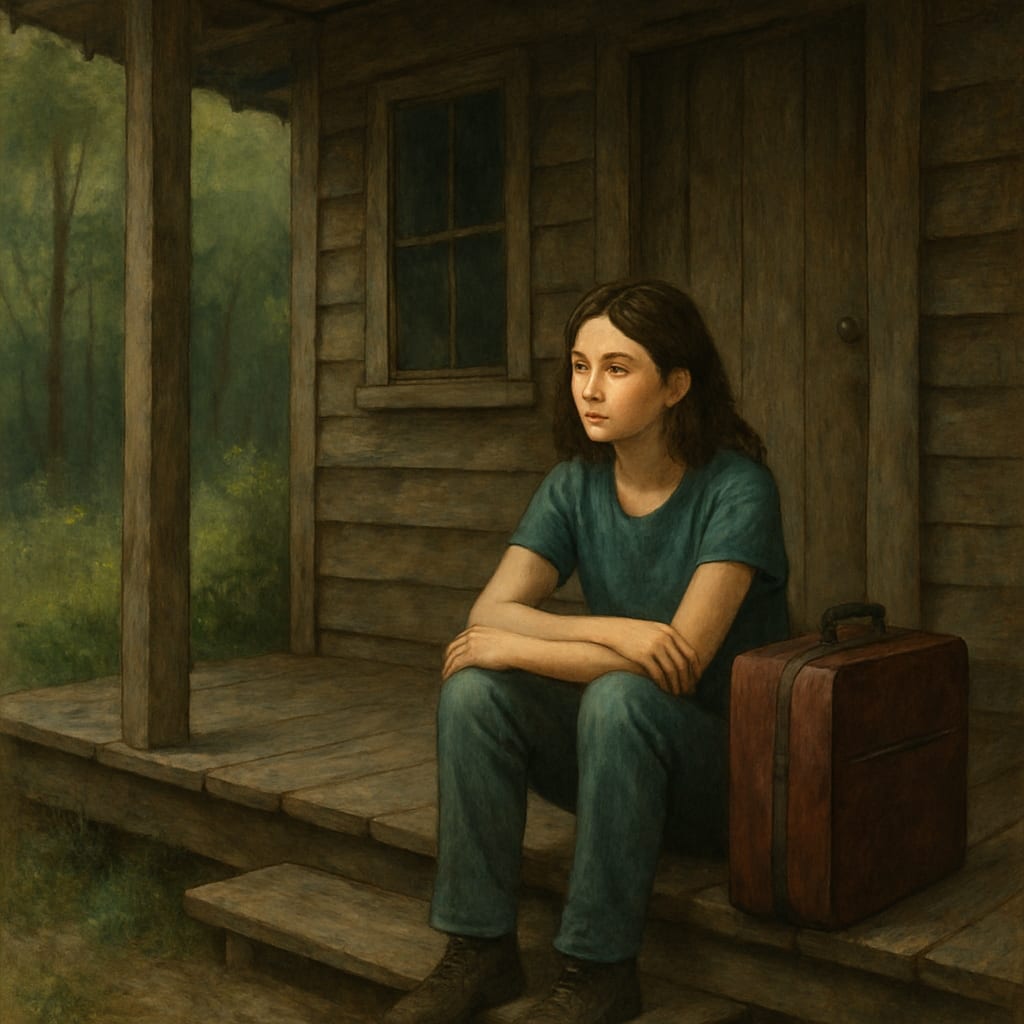
The train stopped at a platform barely long enough for two carriages. There was no café, no sound except the chirping of crickets in the morning haze. Clara stepped off, dragging her dented suitcase behind her. Her phone showed no new messages. Just the date: July 7.
He wasn’t there.
He was supposed to be. Her father. The one who suggested the summer together. “Just us,” he had said. “In the old cabin, like I used to when I was your age.” She hadn’t been sure what to expect, but secretly, she’d hoped for something—connection maybe. A beginning.
She waited twenty minutes. Then forty. Then sat down on a bench sun-warmed and splintered, staring at the road that curved away from the station and into the trees.
Still no message.
She called once. Straight to voicemail.
A woman passed by walking a dog, giving Clara a curious glance. She smiled politely, but inside, something began to curdle. Still, she waited.
It was only at noon that she gave up. Not out of despair, but necessity.
She opened the crumpled map her mother had printed and handed her, just in case.
“You know he’s unreliable,” her mother had said, with that weary voice she used when talking about him. “Don’t count on anything.”
Clara had defended him then. “He’s making an effort.” But now, her fingers tightened around the paper.
The cabin was nine kilometers away.
She started walking.
The road narrowed as she left the village behind. Asphalt became gravel, then turned to forest dirt. Her suitcase’s wheels snagged on roots and rocks until she gave up and carried it, one arm at a time.
The air smelled like pine and damp moss. Somewhere in the trees, a woodpecker knocked rhythmically. There were no signs, only the vague memory of the directions her father had texted weeks ago—before he stopped replying regularly.
After three hours, legs trembling, Clara saw it.
The cabin was older than she imagined. Wooden, slanted, small. The windows were dusty. The door was closed but not locked. She pushed it open.
Inside, silence. Faintly sweet and stale, like old paper.
There was no note. No sign of her father. Just a sink, a wood stove, a narrow cot, a table with one chair. A spider web in the corner stretched like a neglected curtain.
She called again.
Voicemail.
She sat down and waited.
The first night was the hardest.
She lay on the cot fully dressed, eyes wide open, staring at the ceiling beams. The forest outside whispered and clicked in unfamiliar tones. Every creak made her muscles tense.
Her phone had one bar of signal, sometimes none. She considered calling her mother. But what would she say?
“Come get me, I made a mistake.”
She turned the phone off.
She hadn’t cried.
By the third day, Clara had found a rhythm.
Wake up with the light. Boil water for tea. Eat crackers and canned peaches. Walk to the nearby stream to wash her face. Read from the one paperback novel she’d brought. Then walk again, letting her thoughts unravel like a loose thread behind her.
Her father had not come.
No message. No call. No explanation.
She stopped expecting one.
On the fifth day, while cleaning out a cupboard, she found an old notebook. Brown leather, spine cracked. It wasn’t his, she was sure. The handwriting was too elegant. Inside were fragments—half poems, shopping lists, dates without context. One line stayed with her: “Silence is not absence. It is listening.”
That night, she opened her own notebook.
She didn’t write about him. Not at first. She wrote what she saw: the chipped paint on the table legs, the bird with the red throat that visited each morning, the way the wind sometimes made the walls sigh.
Then, later:
He said he wanted time with me. He never said he’d show up for it.
Maybe I’m invisible to him. Maybe I always was.
Maybe silence is the only honest thing he ever gave me.
A week passed. She stopped checking her phone altogether.
She learned how to make a fire with just one match. She used stones from the stream to build a kind of sculpture in the clearing, though she didn’t know why. She started talking aloud—just softly—to herself or the trees.
At first it felt strange. Then it didn’t.
On the tenth day, someone knocked on the door.
It was a man, maybe sixty, in overalls and boots. Weathered, kindly face.
“You alright, miss?” he asked.
She blinked. “Yes. I’m just staying here for the summer.”
His eyes narrowed. “With…?”
“My father. But he’s not here.”
He hesitated. “Ah. That so.” Then: “Saw smoke from the chimney. Figured someone was in.”
She offered him tea. He declined, but asked her name. Told her his—Lucien, he lived down the valley.
“If you need anything, there’s a phone box in the village. Works most days. Storm knocked it out a while back, though.”
She nodded. “Thanks.”
Before he left, he paused. “You sure you’re okay up here by yourself?”
She nodded. “I think so.”
That night, she turned her phone back on. One message. From her mother.
Did he show up? Let me know you’re safe. I can come get you.
She replied:
He didn’t. But I’m okay. Not ready to come back yet.
Her mother replied immediately.
Are you sure? I mean it, Clara.
She didn’t answer.
The forest changed as July deepened. The air thickened, the colors shifted. There were storms. One afternoon, thunder cracked so loud it felt like the earth had split.
She sat under the porch roof and watched the rain flood the clearing. The stones she’d stacked collapsed. She didn’t move to fix them.
She was almost out of food.
She thought about going back. But not with anger.
That surprised her.
Three days before she left, a letter came.
It was in her father’s handwriting. Smudged, barely readable. One envelope, no return address. Postmarked from a hospital in Lyon.
Clara,
I’m sorry. I should have called. I had a scare. Heart, they said. I didn’t know how to tell you. Or your mother. I still don’t. Maybe I was scared you wouldn’t care. Maybe I didn’t know how to be your father anymore. You’ve grown up, and I missed it. If you’re at the cabin, I hope it gave you something, at least. I never deserved you, but I love you.
Dad.
She didn’t cry.
She read the letter once. Then again. Then placed it inside the old notebook, next to the line about silence.
On August 2nd, Clara packed her things. The suitcase felt lighter.
Before she left, she took her own notebook and placed it under a loose floorboard, next to a folded scarf she’d found when she arrived. She didn’t know who it had belonged to. Maybe someone like her. Someone who had waited.
At the door, she looked back one last time.
The cabin didn’t feel haunted anymore.
It felt like something finished.
In the village, Lucien offered her a ride to the train station. She accepted.
“You find what you needed up there?” he asked as they drove.
She thought about it.
“No,” she said. “But I think I found what I didn’t know I needed.”
He nodded like he understood.
On the train, she sat by the window, watching the forest retreat into green shadows and dappled sun. Her phone buzzed softly. A message from her mother.
When are you coming home?
She wrote back:
Soon.
Then she added, without really thinking:
But not the same.
And it was true.
That summer hadn’t gone the way it was supposed to. It had fallen apart before it began.
But in the silence, she had found a voice.
Her own.
About the Creator
Alain SUPPINI
I’m Alain — a French critical care anesthesiologist who writes to keep memory alive. Between past and present, medicine and words, I search for what endures.
Keep reading
More stories from Alain SUPPINI and writers in Fiction and other communities.
Mastering French Without Losing Your Sanity: A Realistic Guide for Beginners
Learning French can feel like solving a Rubik’s Cube blindfolded. The tricky pronunciation, the never-ending grammar rules, and the surprising exceptions make it seem impossible. But don’t worry—equipping yourself with key expressions and effective strategies can turn frustration into fluency. Let’s simplify French and make learning enjoyable.
By Alain SUPPINIExclusive • 11 months ago




Comments (4)
Well done Alain. Congratulations on your win 🥳
Wooohooooo congratulations on your win! 🎉💖🎊🎉💖🎊
I like your approach to the challenge. Quiet introspection can be so healing. ❤️🩹
This was breathtaking—gentle, aching, and quietly transformative. Clara’s journey into silence unfolded like a poem, and the ending brought a soft, satisfying ache. Sometimes healing doesn’t arrive the way we expect it to… but it arrives. Beautifully told.