
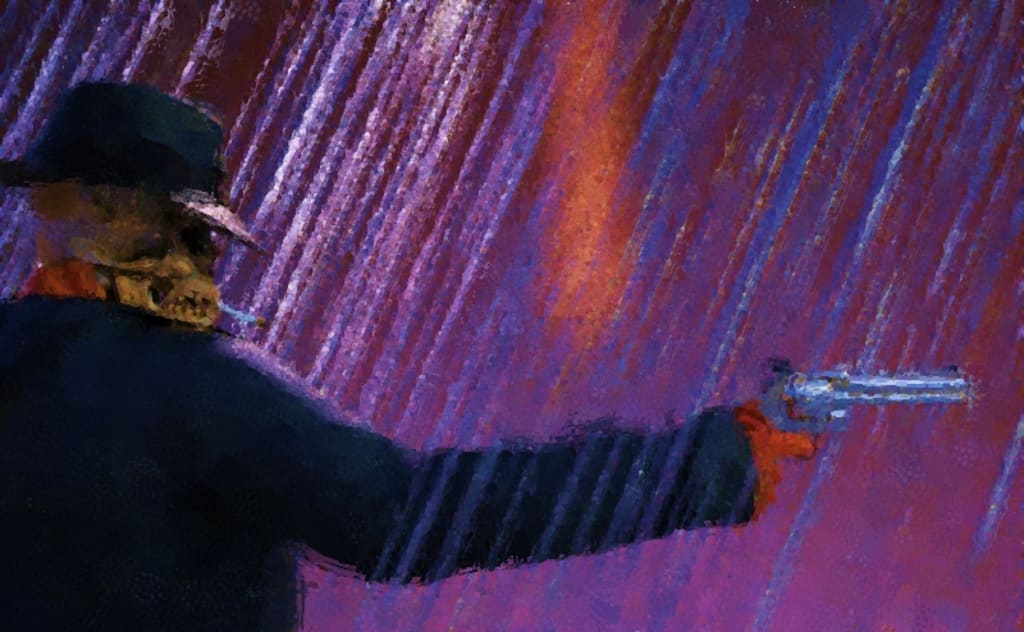
Orderly Charlie Dollar rubbed his temples. The r-KIV implant’s probing of his hippocampus was intense at the best of times, but this last disjunction had been a real cluster frak, and he was quickly developing a throbbing headache as his memories were sorted and catalogued for the Judge Advocate’s Exterms. He dabbed at a smear of blood on his collar with a wet wipe. He knew precisely whose blood it was, though he didn’t know her name. Her pleading eyes still filled his brain, even without the r-KIV replaying their encounter in slow motion in his mind. Ident scans on her came back negative. No fingerprint, dental record, retinal pattern or facial recog existed for the woman. In thirty years as an Orderly, Dollar had never before encountered any person who didn’t exist. His hands shook from the frustration, the gall. Did a life even matter if it was unrecognized by the system? Dollar was the system’s answer to that question.
“Charlie?” his partner asked.
“WHAT? What is it, Libby?” he fired back. She recoiled visibly, her brow furrowing under her dark bangs. Although she had risen to the rank of Orderly, she was still young and a little intimidated by Dollar’s muscular frame and scarred chin. He regretted his tone immediately. “Sorry, kid. Didn’t mean to snap,” he said, adjusting the collar on his bureau-issued raincoat. The words “Bureau of Rescissions” were emblazoned in large block letters across the back, and in smaller letters, “BCU” adorned each shoulder.
“I screwed up,” she said. “I get why you’re mad.”
Dollar stepped closer to her so that his body cam would get a clear shot. “I would like to place a hand on your shoulder as a gesture of emotional support. Do you consent to my touching you?”
Libby smiled and nodded.
“Verbally, please,” Dollar said, tapping his microphone. “For the record.”
“Yes, I consent,” Libby said.
Dollar placed a reassuring hand on her shoulder and forced a smile. “It wasn’t so bad. Boy was tall for his age. Lighting was bad. Not so hard to think he was over the age of consent, plus the way he came at you … I remember it being very threatening.”
“But will the Exterms see it the same way? I’ve heard that Orderlies who get sacked …”
“I think you’ll be OK. We should know in a few minutes,” Dollar said, trying to sound comforting. He started to remove his hand from Libby’s shoulder, but she stopped him momentarily by tilting her head, squeezing his big mitt between her cheek and shoulder with a smile. Brazen. He slid his hand into the pocket of his raincoat and leaned against the rain-speckled door of their unmarked aero-cruiser. He watched from beneath the wide brim of his hat as the MorgBots bagged and loaded bodies onto the open flatbed of a truck. No autopsies necessary. No inquiries. No families – at least none that would dare show their faces near a government agent, if they had an ounce of brains. These were Unmutuals. Nobodies. He saw again the woman’s angry, pleading eyes. That was fury he recognized, righteous fury, but what leg did an Unmutual have to stand on in discussions of morality? He forced the memory down, locked it in that dark mental vault where years of horrors lay. Not a woman, according to official vocab regs. Just a birthing person and its spawn.
A mother and her children, he heard a voice say.
Dollar looked around with a start. There was a crowd of people behind the police line, a bunch of low CRs huddled under their state-issued charcoal-colored cloaks, their masked faces protruding, each one as featureless as the next except for two eyeholes and a forehead-stamped QR code. If one of them had spoken, there was no telling. The crowd stood eerily motionless, passive, dumbly staring as if awaiting orders. Cattle. Road kill. It was a crap neighborhood, like maybe a million or more nationwide. Opportunity Zones they were called. Ghettoes, really, for the teeming masses, the great bulk of humanity whose Citizenship Ratings had fallen below 3.0, meaning they were not eligible for work, driving a car, smoking, eating meat or going outside after curfew. Dollar glared at the low-CRs standing mute, starved, staring, bereft of will and reason, too strung out on Sammies and Joeys rationed out like bread to register anything but the vaguest echoes of the world around them. Any sign of human emotion or desire had been sucked out of them by a government that sought to control every facet of existence. Yet those same people victimized by the system had allowed it to happen, even applauded it as they sat by and traded their rights one by one for free electronics, food, the promise of health care, rent money, endless entertainment. Bread and circuses. There were so many of them, dull, soulless. Too many. No wonder the Betters were so keen on population reduction.
Dollar and Libby had gotten the call late in the afternoon. A suspected disjunction was reported in O-Zone 12. Some good citizen looking to raise his CR a couple notches had reported a baby’s cries coming out of a condemned building. The dump turned out to be a former church, firebombed in some long-ago peaceful demonstration by Anfash, the Central Party’s anti-terror enforcement arm. What Dollar and Libby had found inside was several families – families – zero-CR breeders living together in illicit permanent relationships and popping out unlicensed spawn by organic means, heedless of the drain on resources and the threat to the planet. All low CRs were required by law to be sterilized. They were allowed to sex their brains out with anyone or anything that tickled their fancy, but the results had to be fruitless, and no permanent attachments were allowed. What Dollar saw at the church was multiple Class Five disjunctions, and that was before the religious violations were even considered. Or the shooting. The only thing more illegal than breeding and practicing a non-state religion was owning a firearm. The mandatory solution for all of this was therapeutic rescission – a euphemism for on-the-spot summary execution in the name of the communal good. Only children under the age of consent – 12 – would be spared, in hopes they were still young enough to train and turn into good citizens. Such children were known as Reclaims, and their lives were not easy, as any trace of Unmutual notions was beaten out of them, physically and mentally.
It was something Dollar knew about firsthand. He had once been a 12-year-old Reclaim, child of a madwoman who had given birth to three children at a time when the Reproductive Statutes had recently been implemented. Despite Dollar’s years of repurposing, if he tried, he could still close his eyes and see the government orderlies as they rescinded his mother. They had turned to his sister Faith next. A young woman, she was over the age limit, and the orderlies had taken their time, using her for their amusement before finishing her with multiple shots to the head. He remembered Faith’s skull exploding in slow motion, a hideous crimson flower spreading its petals. He was hauled off to a repurposing center, but his sister Hope had somehow managed to escape rescission. Now, his memories were faded by time and abuse he suffered … for his own good, they said. They had saved him in fact, brought him into the light of civilization by molding him into an obedient killer, a role model for others. They had purged his mind of rebellious ideas like individuality, rights and freedom, gifting him with a spotless conscience.
Mostly.
A lifetime later, Dollar had no idea what happened to Hope, he only remembered she was sweet and smelled like strawberries. He pulled out a heart-shaped locket he wore around his neck, the only proof that his family had once existed. Inside, the smiling faces of his mother and sisters surrounded him and beamed out of the picture. The corner of his mouth curled up in a half smile.
“What’s that?” Libby asked, eager for any distraction to take her mind off the Exterms’ impending decision.
“The only thing I have left from my family,” Dollar said, offering to show her. “I was a Reclaim. Don’t recall if I ever mentioned it.” Libby shook her head and studied the little image. The inscription said, “My heart, my loves.”
“That’s my mother, me, my sister Faith and my other sister Hope. She was the only one who escaped rescission. Never heard from her or about her again.”
Libby nodded thoughtfully. “Did you ever try to find her?”
Dollar shrugged. “Wouldn’t know where to start looking. Wouldn’t matter anyway.”
A long, uncomfortable silence followed. Libby’s thoughts were full of dread. She hadn’t planned to shoot the boy, but he had charged at her. If he’d only been a couple years older, it would have been justified, no question. Now, if the Exterms decided her transgression warranted, she could lose her position, her Citizen Rating, her home. She could be sent to repurposing. The thought made her shiver. Her eyes glanced over the low-CRs still watching at the edge of the crime scene. She could be forced to become one of them. Libby imagined living in squalor, doped up on government pills, no hope, no future, no purpose. Then she thought of the Unmutuals who had been living in the old church. They had even less than those around them. They were in most ways cut off from society, yet they continued to thrive and multiply. They seemed … were they happy? She tried to imagine having children in such a place. She looked at Dollar and asked, “Why do they do it? Breeders? They must know there’s almost no chance they won’t be caught. Their children, too. Why would anyone risk that?”
Dollar tucked the heart-shaped locket back into his shirt. “When we were rescinding the adults, one of them gave me the strangest look,” he said. “I asked her why she was looking at me. She said, ‘You know this is wrong. We’re free people.’”
“Free people? Wrong? What’s that mean?” Libby said.
Dollar shrugged, “I have no idea.” But he did.
Their earpiece communicators suddenly beeped with an incoming message. “I think that’s for you, kid.” The Exterms’ decision was concise and logical. Libby would get off with a warning, a temporarily lowered CR and a month’s probation. In the end, the boy’s life was unimportant. Libby pumped her fist in celebration.
“Well, that could have been a lot worse,” Dollar said, a broad smile crossing his grizzled face.
Libby nodded. “I was expecting the worst.”
He inclined his head. “Nothing left but to clean up. How about we close out here and go home now? I’m getting soaked.” The pair walked back toward the crime scene to look over the job the MorgBots were doing. One mechanical assistant was sorting through a tray containing wallets, personal possessions, belt buckles, jewelry, cybernetics, that sort of thing, part of the protocol to make sure resources were not wasted. The items would be recycled, refurbished and reused where needed. Other bots were closing the truck’s tailgate, having filled the bed with more than half a dozen bodies. As the truck pulled away, Libby called Dollar’s attention to one of the objects marked for recycling. Suddenly, he grabbed the little chain and saw a locket, twin of the one he had worn his whole life.
His fingers felt thick and clumsy as he fumbled with the clasp and finally popped open the tiny case. Inside was a photo and inscription that mirrored his own locket. That was his family, his dead family, smiling back at him. Dollar turned his head to see the truck, far down the road now, taking its cargo of corpses to be incinerated, erased from the face of the Earth.
“Hope,” he whispered.
About the Creator
Keep reading
More stories from writers in Fiction and other communities.
The Fletcher
There wasn't any work that day, so I was perfecting my foot dangling when the ugly kid knocked. He does that quite often, especially because he has such trouble telling the bloody doors in the inn apart. The candle's lit, mind you, where that ugly kid is concerned, but the light is dim.
By D. J. Reddall3 days ago in Fiction
One Hard Thing
Stop me if you’ve heard this one before: You have the number, you know your schedule- you’ve even picked out the perfect day and time to make this appointment. Shoot, you’ve even picked out alternative days and times just in case their schedules can’t accommodate you!
By Taylor Rigsby3 days ago in Motivation


Comments
There are no comments for this story
Be the first to respond and start the conversation.