
The Bridge of Words
My Grandfather Built a Bridge That Didn’t Cross Water—It Crossed Silence

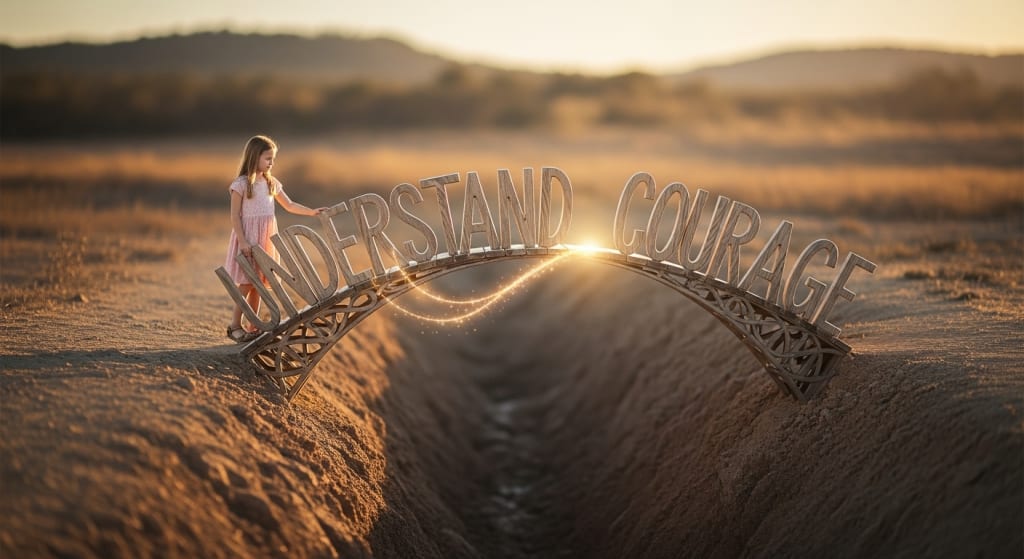
In the town of Twin Oaks, the only thing we had in common was the ravine. It split the town in two—not with water, but with a deep, silent chasm of old grievances. On the East side, the Millers. On the West, the Hargroves. A hundred-year-old argument over water rights had fossilized into a permanent cold war.
My grandfather, the town carpenter and eccentric, didn’t build houses or fences. He built with words. His workshop was full of sculptures made from beautifully carved oak and maple words: “Hope,” “Joy,” “Serenity.” People bought them as decorations, admiring the craft but missing the point.
His final, mad project was the bridge. He built it alone over five years, spanning the dry ravine at its narrowest point. It was his masterpiece. But it was useless. It was too delicate for carts, too exposed for a road. It was a bridge made of words, literally. The railings were sentences. The planks underfoot were strong verbs like “Build” and “Mend.” The supporting arches were carved from solid beams of “Courage” and “Trust.”
The town laughed. “Old man’s finally lost it,” they said. “A bridge to nowhere, made of nonsense.”
He died the week after he placed the final piece—a keystone word that simply read, “Listen.”
I inherited his workshop and his quiet obsession. I’d walk onto the bridge, tracing the carved letters, feeling the ghost of his hands in the grooves. I missed him terribly. The silence he left behind felt deeper than the ravine.
One evening, Mrs. Hargrove, my grandfather’s age and sharp as a tack, approached the bridge. She stood on the East side, staring across at the Miller’s orchard.
“Silly old fool,” she muttered, but her voice held affection, not malice. She placed her hand on the first word of the railing: “Remember.”
As her fingers touched the wood, a strange thing happened. The word glowed with a soft, golden light. A faint, spectral image appeared in the air above it: my grandfather as a young man, laughing, handing a ripe apple to a young woman—a young Mrs. Hargrove.
She gasped, snatching her hand back. The image vanished.
Heart pounding, I walked onto the bridge. “It’s okay,” I said softly. “Try another.”
Hesitantly, she reached out and touched the word “Promise.” Another glow, another memory: my grandfather and Mr. Miller, her sworn enemy, shaking hands over a fledgling apple tree sapling.
“They were friends,” she whispered, her eyes wide with shock. “Before the big fight. Before all the lawyers…”
The magic wasn’t in the bridge itself. It was in the speaking, the touching, the activating of the words. The bridge was a catalyst. It didn’t just describe connection; it physically manifested shared memories and buried feelings when the words were engaged.
News spread. Tentatively, people from both sides began to visit the bridge.
A Miller teenager, angry about a stolen bike, stomped onto the bridge and slapped the word “Angry.” It glowed red, and the feeling washed over him so purely it exhausted him. He then touched “Understand” and saw the Hargrove boy he fought with worrying over his sick mother. His anger dissolved into awkward empathy.
An older Miller man touched “Sorry.” The word glowed a soft blue. He didn’t say it to anyone specific, but a wave of calm settled over the bridge. On the other side, an old Hargrove woman felt her lifelong grudge loosen its grip, just a little.
The bridge became a town therapy session. You couldn’t cross it without engaging with a word, and every word had a cost and a reward. “Pride” was heavy to lift. “Forgive” was terrifying to touch, but those who did were bathed in a light, freeing warmth.
The final test came on the anniversary of the original argument. The two family matriarchs, Mrs. Hargrove and old Mr. Miller, faced each other from opposite sides of the ravine. The whole town watched, holding its breath.
Mr. Miller, stiff and proud, stepped onto the bridge first. He didn’t look at Mrs. Hargrove. He walked to the center, to the keystone, and placed his hand on the word “Listen.”
The bridge glowed from end to end. A symphony of whispers filled the air—all the arguments, all the pain, but also all the shared history, the births, the harvests, the collective memory of a town that had forgotten it was one.
Mrs. Hargrove stepped forward. She placed her hand over his on the word.
They stood there for a long time, silent tears on both their faces. They weren’t just listening to the bridge; they were finally listening to each other.
No dramatic agreement was signed that day. But the next morning, a Miller kid and a Hargrove kid were seen fishing together in the ravine, which everyone had decided was neutral territory.
I am the bridge keeper now. I maintain the words, oiling the letters and repairing the wear and tear of countless hands.
The bridge of words still doesn’t cross water. It crosses something far more difficult to span: silence, pride, and pain. It stands as a reminder that the words we choose to build with matter. You can build a wall with “Never” and “Mine.” Or you can choose to build a bridge, word by careful word, and walk bravely across to the other side.
About the Creator
Habibullah
Storyteller of worlds seen & unseen ✨ From real-life moments to pure imagination, I share tales that spark thought, wonder, and smiles daily
Keep reading
More stories from Habibullah and writers in Fiction and other communities.
The Candle Maker’s Secret
The shop smelled of beeswax, honey, and secrets. When my grandmother passed, she left me two things: her creaky, clapboard house and her beloved candle shop, “The Wick’s End.” The will had one peculiar instruction: “Elara, you must keep making the candles. The recipe is in the red book. Do not deviate.”
By Habibullah6 months ago in Fiction



Comments
There are no comments for this story
Be the first to respond and start the conversation.