
THE BREATH OF SIX-SEVEN
The Collision of Reality, Memes, and Conceptual Horror

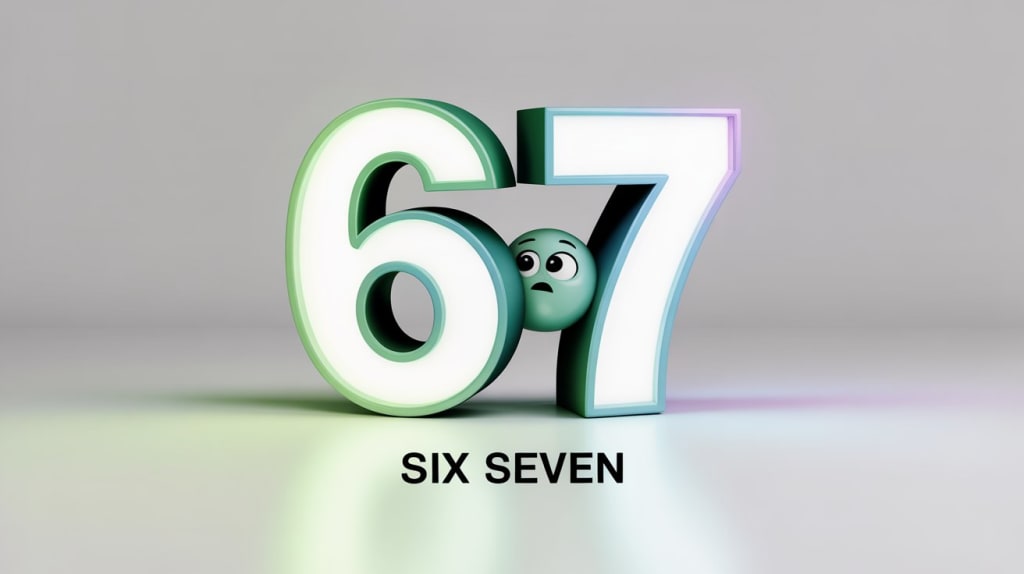
Introduction: What is "6-7" Anyway?
If you have opened any social media platform in the past few weeks, you have almost certainly encountered the sound—the insistent, slightly off-kilter chant of "Six-Seven." From children on the playground to teenagers creating complex video edits, everyone seems to be repeating it, shouting it, singing it, or incorporating it into their routines with a strange, compelling urgency. Ostensibly, it is nothing more than another fleeting digital trend, yet there is a resonant, unnerving quality to this simple sound that separates it from ordinary memes.
This analysis and narrative delves into that uncanny pull, exploring the ambiguous reality of its origin, and exposing the unsettling, artistic horror woven into its very fabric. It is a story not just about a sound, but about what happens when a meaningless digital fragment finds meaning within the human nervous system.
The Origin: Where Does Reality Begin?
The genesis of the "6-7" phenomenon is firmly rooted in a track produced by an obscure underground rapper. A brief, simple phrase within the song—the two spoken digits, "six-seven"—was so rhythmically stripped down, so inherently non-sequitur, and yet so magnetically sticky that it instantly leapt from music to cultural artifact.
Initially, it was just that: a simple meme. A snippet of audio, a shared joke, a moment of viral levity that swept through feeds. But then, something profoundly strange began to happen: people were no longer just listening to the sound; they were beginning to feel it. The sound migrated from the earbuds to the internal landscape of the listener.
Linguists and sociologists, scrambling to analyze the phenomenon, offered a chilling hypothesis. They suggested that certain primal phonetic clusters or non-semantic vocalizations possess the power to become a "social breath" for a large group. Such sounds don't convey meaning; they induce behavior. The phrase "6-7" was exactly such a piece—an empty vessel of meaning, yet utterly overflowing with effect. It wasn't about the numbers; it was about the cadence, the pitch, and the low-frequency bass that seemed to bypass the ear canal entirely.
The Story: The Breath of Six-Seven — A Symbiosis of Art and Fear
The cities began to change. As dusk settled, a faint, curious echo began to reverberate through the urban canyons. It wasn't loud, but it was omnipresent. The streetlights would subtly flicker, the air would hold a slight, expectant tremor, and occasionally, a distant whisper would drift in the night breeze, as if someone was softly enunciating directly into the listener’s inner ear: "Six... seven..."
Adults initially dismissed it as children playing a prank, or perhaps an elaborate marketing stunt. But the game shifted drastically when those who heard the refrain began to find their own breathing patterns involuntarily syncing with the rhythm of the chant. It was as though the sound wasn't just reaching the auditory cortex; it was slipping past the conscious mind and settling into an ancient, receptive chamber hidden deep within the chest cavity.
While most people knew the surface-level reality—it started with a song—the deeper, persistent questions gnawed at the collective subconscious: Why was this particular piece of audio so potent? Why did children enter a strange, detached state when repeating the phrase? And why did an increasing number of people claim to feel a minute, chilling ripple just beneath their skin immediately after hearing the words "six-seven"?
Soon, the physical manifestations began. A small, horrified fraction of the population reported waking up to find faint, subtle etchings on their skin—a wrist, a cheekbone, the soft skin beneath the collarbone. It would start as a barely perceptible line or curve, slowly resolving itself into an incomplete shape—a semicircle... then a definite curve... followed by a straight line, forming something unnervingly close to the digits "6" and "7".
This was no longer coincidence. The simple meme had transformed into a self-replicating myth, and the myth was now seeking corporeal expression.
Children, the most open receptors to this strange frequency, would gather in schoolyards. They would stand in a circle, raise their hands high, and chant the ritual phrase without conscious thought: "Siiiix-Seven!" At first, this was met with nervous laughter from teachers. But soon, the laughter died. Some of the children’s voices began to carry a strange, guttural reverberation, a rough, metallic echo, as if another, older sound were hidden just beneath their vocal cords.
On the city's periphery, the artificial lights began to strobe with more consistency. A curious, heavy frequency saturated the air—the exact low bass frequency buried within the viral social media videos.
Then came the climax. In one terrifying moment, thousands of phones across the city chimed simultaneously, signaling the peak hour of the trend, and the new viral sound was played, collectively.
That instant was like the entire atmosphere taking one enormous, resonant breath. A thick, pulsating thrum of sound enveloped the entire urban landscape.
The analysts and the victims now understood: "6-7" was no longer a mere word. It had become a self-aware talisman—a vocal, rhythmic entity that slipped past all defenses, inhabiting the body as a joke, a spasm of panic, or a faint, pervasive whisper that finally found its lasting home within the flesh.
Is "6-7" Truly Horror? Or Just Humor?
This is precisely where the phenomenon's uncanny genius lies. This single, simple trend is simultaneously:
Hilarious (as a piece of pop culture)
Horrifying (as a violation of the body)
Meaningless (as two arbitrary numbers)
Profound (as a mechanism of collective control)
It is the single audio cue that causes some people to laugh uncontrollably, others to clutch their chests in vague anxiety, and others still to simply repeat it endlessly—as if the word itself is now using them as a momentary megaphone.
Conclusion: The Word, The Sound, and The Presence
Most trends are merely observed, a transient pattern quickly forgotten.
Some are only heard, a brief noise in the background of life.
But "6-7"...
It stands as one of the few contemporary memes that isn't just consumed; it is felt.
It is music, it is meme, it is myth—and now, it is something that has entirely transcended the limitations of language.
Whenever you hear that faint whisper late at night, and those two simple digits send a slight, involuntary tremor down your spine...
Remember this truth:
Some sounds, once given enough energy, stop being information and start becoming reality, etching themselves permanently into the confines of the human body.
About the Creator
Wellova
I am [Wellova], a horror writer who finds fear in silence and shadows. My stories reveal unseen presences, whispers in the dark, and secrets buried deep—reminding readers that fear is never far, sometimes just behind a door left unopened.


Comments (1)
its became gen Z slang hehe