
The Boy With Half a Name
A flash story about memory, motherhood and what can't be held.


She noticed it first in his voice.
He came in from the backyard, cheeks still flushed, cuffs heavy with grass. Her name rose on his lips and faltered, the sound snagging in his throat like a word left too long in silence. He lingered there, eyes narrowed, head tilted, as though the missing part might drift back on its own.
“Say that again,” she said, crouching beside him and brushing dirt from his sleeves.
He laughed in a quiet, strange way. “I forgot your name.”
“You’re lucky you’re cute,” she told him, keeping her tone light. “Now go wash up before dinner.”
He was five. Names sometimes slipped.
That night, rinsing soap from her hands, she shaped her own name with her mouth to be sure she still knew it. The word came out whole, familiar. Yet it felt borrowed, like a coat worn by someone else.
The next day he hesitated at the preschool sign-in sheet. The crayon hovered.
“Go ahead,” she said gently.
He wrote three letters. E M. His brow furrowed.
“You know the rest,” she said.
He looked up. “I think I used to.”
She waited for a smile, for a joke. None came.
By the end of the week he no longer answered to “Emory.” He only turned when she called him “Em,” and even that sounded wrong, a name that belonged to another child. She practiced saying it on walks, in the car, before bed, but the word stayed brittle. Detached.
She uncovered the birth certificate beneath a drift of tax forms, the name Emory James Halpern printed in sky-blue ink. Pressing her thumb to the paper, she tried to fasten the word in place, but when she whispered it aloud the syllables bled away, fading thin as watered paint.
Her husband brushed it aside. “He is still our boy. You treat a shadow like a wound when it is only a season. Children shed names the way trees shed bark and keep growing taller.”
“He’s unraveling,” she whispered.
Soon, even “Em” faded. He didn’t turn when she called from the stairs. He didn’t flinch when she said it sharply.
She wrote his full name on index cards and taped them to the fridge, the bathroom mirror, the inside of his closet. She stitched it into the lining of his coat. She whispered it into her phone recorder and played it back at night, trying to fix the sound in her memory.
It still slipped away. A sandcastle at high tide.
Her sister came for dinner and called him “Em.” When asked his full name she blinked. “Isn’t that it?” Even the preschool teacher didn’t recall more than three letters. E M.
The rest no longer existed.
One night she woke to the sound of his voice over the baby monitor, a device they hadn’t touched in years. She hadn’t even known it was still plugged in.
“I don’t think I live here anymore,” he said softly.
She bolted upright. The monitor crackled, then went still.
He sat in the hallway in his pajamas, drawing shapes on the hardwood with his finger. Curves and slashes, like letters from a forgotten language.
She reached for him.
“They said it would be like this,” he murmured.
“Who did?” Her voice broke.
He shrugged. “The pale ones who gather the names.”
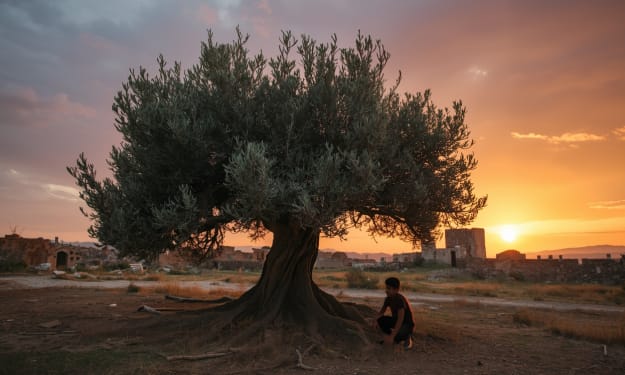
In the morning he kept to silence, neither asking for cereal nor reaching for his toys. He lingered at the window instead, the branches of the oak shifting in the wind while he watched with the patience of someone awaiting a signal only he could recognize.
She sat beside him and tried to call him again, syllable by syllable, but the word broke before it left her mouth. It was like speaking in a dream, slurred and unfinished.
“What do I call you now?” she asked.
He didn’t look at her. “They’re taking the rest today.”
“Who?”
“I don’t remember. But it’s time.”
He leaned close and whispered in her ear. The sound refused the shape of language, carrying instead the hush of ashes when the fire dies and the breath of wind through the ribs of an empty house. She reached to hold it, but it scattered before she could.
“I love you,” she said. It was the only phrase that remained.
He didn’t answer, though he took her hand, his fingers warm for a moment and carrying the weight of something that still felt familiar.
She fell asleep outside his room, curled against the doorframe with the baby monitor beside her. At some point she dreamed of calling someone she once knew, though she couldn’t remember who.
In the morning the bed lay empty, the coat still hanging by the door with his shoes arranged neatly beneath it.
She searched every room, every drawer, every crack in the plaster. Nothing remained.
Only the echo of something that had almost been a name.
About the Creator
Fatal Serendipity
Fatal Serendipity writes flash, micro, speculative and literary fiction, and poetry. Their work explores memory, impermanence, and the quiet fractures between grief, silence, connection and change. They linger in liminal spaces and moments.
Keep reading
More stories from Fatal Serendipity and writers in Fiction and other communities.
No Word Comes Near Enough
The English language has its limits. I learned this when I became a student of the Bible and looked up the Greek and Hebrew definitions behind the Scriptures I loved. Some languages have so much more depth and power than the one I use to convey my thoughts. But, even so, I don't think any word could ever come close to describing this void and pain I am journeying through. I don't know how to swim through its murky waters.
By Shirley Belk5 days ago in Poets


Comments (1)
Wow that is painful. Good imagry and work drawing the reader in.